


Academic Information
Students who are unfamiliar with the Israeli education system may find aspects different from what they are used to. It is essential to familiarize yourself with the policies and procedures governing academic coursework, exams and research at Reichman University (RU) as you will be responsible for complying with them. As academic life is the heart of the university, these policies and procedures are very strictly enforced and respected among the university community. Click here to go to the student regulations site.
Useful Academic Links:
- Academic Calendar 2026-2027
- Reichman University Student Exchange Factsheet 2027-2028
- Courses Approved for Exchange Students 2026-2027
- Student Regulations Site
- Student Handbook
- Student Course Search
- Student Exchange Final Exam Zoom Request Form
- Pre-Arrival Booklet - Fall & Full Year 2026-2027
- Course Registration Instructions Booklet
Academic Year:
The academic year at Reichman University is divided into two semesters, each with 14 weeks of teaching:
- Fall Semester (usually equivalent to Semester A abroad) begins immediately following the Jewish holiday of Sukkot (usually around mid-October) and runs through the middle to end of January.
- Spring Semester (usually equivalent to Semester B abroad) usually begins at the end of February or early March and lasts until the end of June/early July.
Each semester is followed by two exam periods (Moed 'A' and 'B') which run for approximately 3-5 weeks each. Full details are available by visiting our Academic Calendar.
Course Credits:
The following is a chart for credit conversion:
| Israeli credits | ECTS |
| 1 | 1.5 |
| 2 | 3 |
| 3 | 4.5 |
| 4 | 6 |
| 5 | 7.5 |
| 6 | 9 |
Course Selection:
Exchange students receive a dedicated list of courses approved for exchange students from a variety of disciplines a few weeks prior to their arrival to Israel including a registration instructions guide. Students get to choose courses from the fields of psychology, business, communications, economics, government, sustainability and more. Students are strongly advised to consult their home institution on intended courses of study. Exchange students are subject to course availability and/or capacity limitation constraints and in some cases pre-requisites.
Please note that only MA Government courses are available to Master level students and Bachelor (undergraduate) students cannot register for Master level courses.
Once you have reviewed the list of courses approved for exchange students, to receive further course information, you may visit the student handbook here for the general course search. Please keep in mind that not all courses listed in the handbook are offered to exchange students.
Once you put the course number in the general search bar, you will see further course information such as course description and syllabus. Course availability changes from year to year, subject to professors and resources available. Therefore courses may not always have a syllabi posted ahead of time. When viewing the course search page, it's important to pay attention to the teaching language (make sure you look for English), course days and times, semester, and group ID.
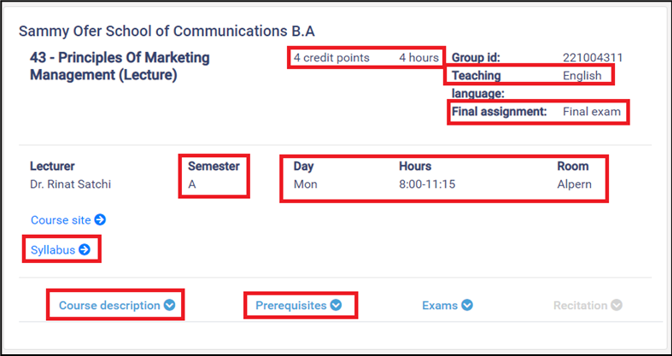
Each course is usually worth between 2-4 Israeli credits. A two-credit course meets 90 minutes per week over the course of the academic semester. The normal course load for Reichman University students is 6-9 courses for one semester, depending on the number of credits. Please be aware that some courses also have a recitation class besides the main lecture. A recitation is an additional exercise course in a smaller group that all students in this course have to register for and attend (besides also attending the lecture course).
All students are subject to course-capacity constraints and therefore final course selection and registration takes place on arrival at Reichman University during the Add/Drop period. The "Add/Drop period" usually begins a few days before the beginning of the semester and through the first week of the semester. This allows students to attend the first lecture of the course and then fine tune their study plan/course schedule by adding and/or dropping courses.
Course Restrictions
The following course restrictions apply to exchange students:
- Workshops, Public Diplomacy, Zell, Entrepreneurship and Argov Fellowship courses are not available.
- MA courses other than approved MA Government courses.
- Computer Science and Law – Approval to join Computer Science or Law School courses is subject to final approval by the School of Computer Science/Law School and is only an option for students coming from a university where we have an exclusive Computer Science or Law exchange agreement as these courses are very limited.
- Communications Workshops and Seminars are not open to students outside of the School of Communications.
- Courses with pre-requisites: Students need to pay attention to course pre-requisites and make sure they have fulfilled them at their home university in order to have the proper knowledge to succeed in the course at Reichman.
Assessment, Examination, and Grading:
Information on coursework is given at the beginning of each semester. The majority of assessment is usually based on a final exam, but can also include written assignments, tutorial participation, class attendance, practical work, group projects, and seminar presentations.
Final exams begin immediately after the conclusion of the semester and last for approximately 3-6 weeks. Exchange students are expected to study at Reichman University for the entire semester and to sit for the exams on campus. Exchange Students who have extenuating circumstances and must leave early before completing all their final exams need to make the Exchange Office aware to be provided an alternative option.
**The final exam will not be replaced by a written assignment on an individual basis under any circumstance.
English Requirements:
All incoming exchange students are required to possess English language proficiency equivalent to a B2 level. Reichman University does not request official language certificates, but trust that our partner universities check their nominated students’ language level in English to make sure they meet the minimum requirement.