

The Internet Blackout in Iran – The Big Picture
By Col. (res.) Udi Evental | November 29, 2019
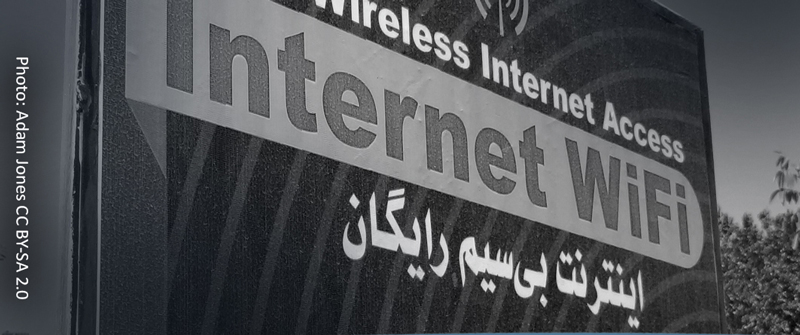 |
| Photos: Adam Jones CC BY-SA 2.0 |
On November 24, the U.S. administration placed sanctions on Mohammad Jahromi, Iran's Minister of Information and Communications Technology for widespread internet censorship and for imposing the internet blackout during the Gas Price protests. The administration held Jahromi accountable for "launching Iran's National Information Network (NIN), which has enhanced the Iranian government's ability to monitor, restrict, and completely block internet usage in Iran."
The American sanctions demonstrate the central role of the internet in the Gas Price protests. The protests erupted on November 15 and rapidly became violent. On the first day of the riots, the internet was disrupted in Mashad, but a flow of video clips depicting demonstrations across the country and the regime's violence in dispersing the crowds flowed out of Iran and filled social network feeds across the world. By the following day, November 16, the internet across Iran was nearly completely disconnected (95%) and the flow of video clips from Iran stopped immediately. Monitoring the real situation on the ground became impossible and most reports coming out from Iran were those released by state-controlled media. Only several days later, on November 20-21, the internet blackout was lifted gradually (except mobile connectivity) – as the regime regained control in the main arenas of the demonstrations and public order was restored.
The internet blackout in Iran is one of the most comprehensive nation-wide disconnection by a government. The regime effectively disconnected 80 million citizens from the outside world, but continued to operate an internal nation-wide network – the NIN – that was used by the regime's agencies. This undertaking proves an advanced technological capacity that required a multi-year effort. Following the "Green Wave" demonstrations in 2009 and as one of its key lessons, the regime was able to concentrate Iran's global internet connections to two main exchanges that allowed the regime to quickly disconnect them.
As such, the regime-enforced internet blackout is a milestone in the efforts of authoritarian regimes to censure and obstruct media and communication networks in real-time and achieve information dominance. This episode might yield broader implications on the Middle East and affect the global debate on the free flow of information.
Imposing an internet blackout is typical of oppressive regimes that seeks to quash protests. Blackout events occurred in many countries, including Egypt, Iraq, Mauritania, Kashmir, Russia, and Sudan. Internet disconnection makes it far more difficult for civilians to communicate with each other and to lead an effective and organized protest movement. It also allows the regimes to use considerable force and hide from the world the gross violations of human rights and brutal measures.
It seems there is a correlation between the length and scope of the blackout and the level of violence against civilians. In the last round of riots in Iraq, the regime, probably guided by Iran, disconnected social media networks for some fifty days, during which hundreds of civilians lost their lives.
In Iran, exploiting the cover of the blackout, the regime used brutal and violent measures. With some 100-to-300 fatalities and thousands of civilians arrested, the Gas Price protests have become the deadliest wave of protests since the Islamic Revolution. The regime declared that the protests have ended and issued deterring and vindictive messages of its intention to punish harshly those involved in the demonstrations, including calls from the conservative circles to execute demonstrators. Based on testimonies from previous waves of demonstrations, the regime probably tortured many of the incarcerated demonstrators also to instill fear among them and prevent additional protests.
The regime's dilemma – Considering the widespread protests, the regime would have probably preferred to extend the internet blackout. However, the regime was forced to restore the internet because of the severe economic damage caused by the blackout as Iran is an advanced country with internet penetration reaching 76%. The estimated cost of the damage caused by the demonstrations is up to several hundreds of million U.S. dollars per day, with the primary damage inflicted on small businesses, start-ups, online service providers and the IT sector. The economic damages caused by the demonstrations, along with the impact of the rising gasoline prices caused a surge in the price of basic products in Iran. Thus, days of deadly protests, during which many Iranians suffered a painful cost, ended with soaring cost of living. This is likely to increase the repressed resentment and frustration – till the next outburst.
A model for Middle East regimes – The wave of protests spanning across the region – from Africa to the Gulf – has placed the leaders of the region under pressure, concerned about their stability. Therefore, they are seeking to tighten their oversight and control in their countries. They will most likely examine the lessons of the rapid oppression of the protests in Iran and seek to develop similar capabilities that the Iranian regime used, specifically with regards to controlling the internet and disconnecting their people from the outside world.
The Middle East and the global struggle over norms of internet use – The Middle East is therefore expected to join the international authoritarian camp, led by China and Russia, that upholds the principle of "internet sovereignty" and opposes the liberal concept led by the West of a global open architecture that provides free use of the internet. Against this backdrop, Israel is expected to stand out in the region as an island of democracy – also in the field of freedom of information.
The normative struggle over the question "who will control the internet?" currently plays out at the UN. Russia succeeded in passing a resolution to advance an international treaty against cyber crimes that will legitimize states to deepen their oversight and control of the internet. In advancing this resolution, Russia was supported by "benign democracies", including China, North Korea, Myanmar, Nicaragua, Syria, and Venezuela. In Russia, Putin is following China's steps and he is working to expand bilateral cooperation with China on internet use. Putin has passed legislation in Russia that permits disconnecting the internet during emergencies (disguised as defending cyber-attacks) and requires internet suppliers to install components and applications that will allow close oversight by the government.
The dilemma of the U.S. and the West – During the events in Iran, the U.S. failed, or chose not, to activate measures that could have undermine the regime's disconnection of the internet – restoring civilian access to the global network. The U.S. will have to determine whether it should use such measures in future internal oppression events. This could risk offering the authoritarian camp a pretext to enhance monitoring measures to block "external intervention".
Authored by Col. (res.) Udi Evental
If you wish to receive the weekly brief regularly, please follow the link to register.
