

The Regional Turmoil Spoils Iran's Schemes
By Col. (res.) Udi Evental | November 10, 2019
 |
| Photos: Sayyed Shahab |
The wave of protests that are powerfully sweeping across Iraq and Lebanon reminded all the Middle East regimes that although the "Arab Spring" started nearly a decade ago, the regional turmoil has yet to exhaust its historical course. The regimes in the region still seem to be far from effectively addressing the fundamental economic, social, governance, and demographic challenges.
Mass protests triggering a crushing tsunami toppling governments and authoritarian leaders that have ruled their countries for years – Sudan's Bashir and Algeria's Bouteflika for example – put leaders across the region on high alert. Against this backdrop, the regimes are expected to focus their attention on the domestic arena, at the expense of regional and international issues. They will likely strive to strengthen their grip on their respective countries and to bolster the states' monitoring, oversight, and oppression mechanisms. This is particularly true in Egypt's case – which most recently suppressed a budding wave of protests.
The events in Iraq and Lebanon seized the regional agenda and appear to have diverted or at least temporarily stalled evolving strategic trends. This development is notable in Iran's case.
Over the past six months, Iran adopted an assertive and aggressive posture in the region and vis-à-vis international actors regarding its nuclear file. Iran's acts of aggression – from sabotaging and seizing oil tankers, through shooting-down a U.S. drone and attempting to attack Israel from Syria, onto a wide and sophisticated attack on Saudi Arabia's critical oil infrastructures – yielded an irresolute U.S. response that appears to have only bolstered Iran's self-confidence and boldness.
The U.S. withdrawal from North Syria and the entrance of Russia and Turkey to the void left behind, demonstrated that America is disengaging from the Middle East. The declining strategic importance of the region in terms of U.S. national interests – particularly its diminishing dependence on Middle East oil – reinforced Iran's motivation to drive out the U.S. from other regional arenas, especially Iraq. Leading the opposition to U.S. presence in Iraq, are the Shiite militias identified with Iran. These militias have gained broad legitimacy and political power (the second largest bloc in the Iraqi parliament), and are determined to preserve their position as a separate armed force (also equipped with Iranian weaponry) that is not subordinate to the Iraqi state.
It appeared that Iran was "riding the wave", increasing its power and influence with no one to stop it … till the outbreak of mass protests in Iraq and then in Lebanon.
In both countries, demonstrations began as a spontaneous protest triggered by growing anger and disgust of corrupt governments uncapable of addressing the dire economic situation, growing young adults' unemployment, and collapsing public infrastructure. Rapidly, the demonstrators turned to a more fundamental agenda – ending the political-sectarian order – which they identified as the underlying cause for their country's economic bankruptcy and paralysis.
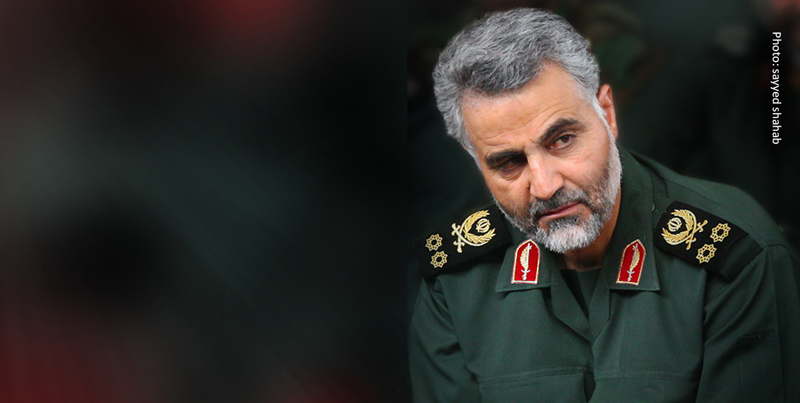
In Iraq, the demonstrations also revealed a clear anti-Iranian sentiment. The demonstrators blamed Iran, and specifically Iran's Quds Force Commander, Qasem Soleimani, who arrived in Baghdad urgently, for the violent crackdown against the protests that claimed the lives of more than 250 citizens and for blocking the resignation of Iraq's Prime Minister, Adil Abdul-Mahdi.
Demanding an end to Iranian influence in Iraq, demonstrators are burning and trampling pictures of Iran's supreme leader, Khamenei, and Soleimani. Protestors are assaulting Iranian symbols of power even in Shiite strongholds, such as the city of Karbala, in which the Iranian consulate was attacked on several occasions with protesters removing the Iranian flag and replacing it with the Iraqi flag.
Under these circumstances, Iranian interests in both Iraq and Lebanon are under potential threat. The demand to eliminate the sectarian orders could challenge Iran's position, influence and assets, specifically on the weapons of Hezbollah (in Lebanon) and the Shiite militias (in Iraq) – an issue already contested in both countries.
At a deeper level, Iran's attempts to clamp down on the demonstrations and undermine their legitimacy by asserting that the protests are guided and financed by external parties, led by the U.S. and Israel - are likely associated with the concern that the protests might diffuse and "infect" the Iranian public domain. This, based on the assumption that the embers of the 2018 wave of demonstrations in Iran are still simmering and could reignite because of the similarity between the demands of the Iraqi and Lebanese protesters to topple their corrupt and dysfunctional regime and the claims against the religious elitist and despicable regime in Teheran, which has brought the Iranian economy to the brink of abyss.
What are the implications from an Israeli perspective?
- While Iran and its proxies in Iraq are under attack, it will be difficult for Tehran to launch retributive attacks against Israel. This will draw back the focus to Syria, in which Israel has more effective tools to deal with the threat, or to distant Yemen, in which according to Prime Minister Netanyahu, Iran seeks to deploy precision-guided missiles that could strike Israel. Most likely, Iran has yet to deploy such capabilities in Yemen – at least till mid-September – otherwise it would have used them in the attack on Saudi oil facilities, establishing a stronger geographical link with the responsibility for the attack, claimed by the Houthis. However, in the Red Sea arena, Iran with its Houthi proxies has demonstrated its capability to attack vessels...
- Iran could focus on the nuclear issues at the expense of regional provocations. This fits well with its announcement on the fourth phase of decreasing its commitments to the JCPOA – injecting gas into the centrifuges in Fordo.
- The protestors' demands to change the political order in Lebanon has positive potential – increasing censuring of Hezbollah and its military capabilities that are not controlled by the Lebanese state. The events in Lebanon might create additional restraints on Hezbollah regarding confrontation with Israel, which in any case it is trying to avoid. However, pressed against the wall, Hezbollah might opt for brinkmanship increasing tension with Israel to divert public attention away from the domestic uproar.
- With Iran challenged, UAE and Saudi Arabia might slowdown their appeasing overtures towards Tehran following the eroding confidence in American strategic support.
Authored by Col. (res.) Udi Evental
If you wish to receive the weekly brief regularly, please follow the link to register.
