

Never Judge the Middle East by its Cover: Appearances are often Misleading
By Col. (res.) Udi Evental | February 10, 2020
 |
| Photos: White House |
In a constantly turbulent Middle East, reality and perceptions are not always synchronized. Events over the past few weeks repeatedly exposed the deep gap between reality and the attempts of key actors (and commentators) to package and market their narratives. A few notable examples:
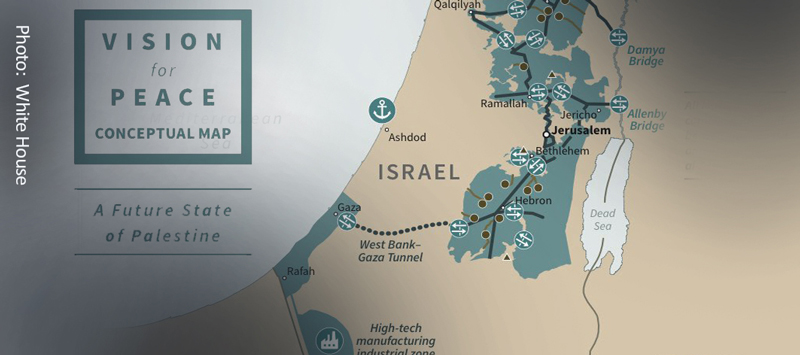
- The likelihood that the Trump peace vision will bring the parties closer to peace is nil, but its risks are high.
- The Russian response to Trump's vision and its public harsh scrutiny of Israeli military operations in Syria have undermined the image of close Russian-Israeli relations led by Putin and Netanyahu.
- In Iran, the mass mourning of Soleimani's killing rapidly dissipated to make way for the return of protests and the regime taking the opportunity to further repress freedom.
- In Lebanon, the new government – with "technocratic" ministers that actually represent the sectarian system and old interests – was coined the "Halloween government".
President Trump's peace plan is detached from reality. The plan distances the Palestinians from the negotiating table and is not expected to lead to a breakthrough. Rather, it might lead to unilateral annexation and a complicated situation that will threaten Israel's security and its Jewish and democratic character.
In Israel, the tendency is to dismiss the Palestinian Authority's threats to sever ties and end the security coordination, assuming it has much more to lose. This position, however, overlooks the continuing decline of the Authority as a political and economic entity. This trend is increasingly powerful as the viability of the two-state solution erodes. The two-state solution was the basic paradigm upon which the Authority was established – and without it – the Authority has no reason to exist, particularly as its legitimacy diminishes and it faces economic uncertainty, growing political pressures, and despair.
These trends will become increasingly powerful and peak with annexation. The combination of the decline of the Palestinian Authority and the application of Israeli law on large parts of the West Bank is expected to pull the plug on the two-state solution, embolden the idea of a "one-state", which is increasingly popular among the Palestinian public, and pose a grave and multidimensional threat to Israel.
Thus, we are entering a path that could eventually lead Israel – and its armed forces (IDF) – to reassume overall responsibility over the West Bank. Instead of having IDF deal with the strategic challenges posed by Iran and the northern front, it will once again have to allocate forces to police the West Bank and manage the day-to-day lives of millions of Palestinians. This reality, along with the Palestinian public's demand for equal civil rights could severely damage Israel's reputation as the sole democracy in the region and its international standing, and open the way to legal processes against it that are already under way.
Apparently, the moderate response of Arab countries to Trump's plan was misinterpreted by Israel – proof that the Palestinians have lost Arab support and that the Palestinian issue no longer impedes normalization.
Despite Arab countries' anathema towards the Palestinian cause and their desire for closer relations with Israel due to common interests regarding Iran and terror, one should not get confused. Arab leaders will not abandon the Palestinians, if only not to expose themselves to public unrest, especially in an age of deep instability in the Middle East. In that respect, the effect of the Arab League's clear and symbolic statement stands in reverse ratio to the power and influence of the League as an institution, which most commentators are happy to brand as irrelevant.
Unilateral measures on the basis of Trump's plan are expected to damage Israel's relations with Jordan. These relations are at the core of Israel's national security and are irreplaceable. Unilateral measures would undermine the peace treaty and reflect negatively on the Israeli-Jordanian security and strategic cooperation.
Trump's plan generated a "cold shoulder" in the international arena as well. Moscow, to where Netanyahu travelled to brief Putin, dismissed the plan and claimed that it clearly violates previous resolutions of the United Nations. Another Russian measure dealt a blow to the image of close Russian-Israeli relations under the leadership of Putin and Netanyahu. The Russian Ministry of Defense and its armed forces blamed Israel's Air Force of using civilian airliner as a cover to launch attacks on targets in Syria, jeopardizing its passengers.
The background to the Russian allegations, which were extensively covered by Russian official outlets (Sputnik, RT, and TASS), is not clear and unusually, they followed recent mutual visits of Putin to Jerusalem and Netanyahu to Moscow. Possibly, these allegations reflect Russian discontent with the level of Israel's cooperation and updates through the de-confliction mechanism.
In Iran – it turned out that the impressive mass identification with General Soleimani's killing was momentary and subject to a specific context (an assault on the national honor). Notwithstanding, it dissipated quickly, virtually overnight, to clear the way for the return of public protests against the regime following the downing of the Ukrainian plane and the public's disinclination to follow the regime's attempts to bolster the anti-American sentiment. Numerous video clips showing Iranians refusing to march over American and Israeli flags went viral.
With the brutal response of the regime to the fuel protests in mid-November still fresh in memory, the regime easily quelled the beginnings of the new wave of protests. Exploiting the mass support towards Soleimani, the regime took the opportunity to disqualify 90 incumbent members of parliament and hundreds of parliamentary candidates – all associated with the reformist camp – from running for the upcoming elections on February 21. With barely any competition and an expected low voter turnout, the conservatives are expected to gain absolute majority in the 290-member parliament.
In light of these events, many commentators repeated the old and often-disproved mantra that American policy allowed the regime to quash domestic unrest and the reformist agenda. Actually, the disqualification of candidates associated with Rouhani – whom many in the public no longer believe representing a reformist agenda – and the damage inflicted by the killing of Soleimani – actually create a fertile ground for renewing domestic protests.
And from one arena of domestic unrest to another – the formation of the new government in Lebanon raises the question whether it will bring an end to the demonstrations although it falls short of the public's demands. The new government was quickly branded as the "Halloween" government because its so-called "technocrat" ministers actually represent the old sectarian system and interests.
The new government is pro-Syrian and pro-Iranian and dominated by President Aoun and Hezbollah. It does not include representatives of the Sunni and Druze blocs, and the Christian "Lebanese Forces" movement. The chances that this government will solve the crisis of public infrastructure and services and rehabilitate the economy in need of an international bailout of 25 billion USD are very low. Most commentators assess that domestic instability will persist and could rekindle domestic protest. Developments in Lebanon will have an impact on other regional arenas, specifically Iraq that faces similar challenges of forming a new government.
Authored by Col. (res.) Udi Evental
If you wish to receive the weekly brief regularly, please follow the link to register.
