

Violent Escalation in Gaza – Ten Insights
By Col. (res.) Udi Evental | November 13, 2019
 |
| Photos: Israel Defense Forces |
Following the killing of Baha Abu al-Ata, the commander of the military arm of the Palestinian Islamic Jihad (PIJ) in North Gaza, the organization retaliated with extensive salvos of rocket fire targeting Israel, including Tel Aviv. What follows are ten insights emerging from the current round of hostilities.
- The Palestinian Islamic Jihad's Double Challenge – The PIJ is undergoing a process of bolstering and expanding its military capabilities for years, reflecting the growing military threat emanating from Gaza. Unlike Hamas that operates under constraints and limits as the de-facto governing authority in Gaza, the PIJ has broader latitude to establish itself as a terror organization. Particularly over the past year, PIJ has assumed an independent and aggressive posture posing a double challenge – both to Hamas and to Israel.
- Hamas' Dilemma – Hamas retains significant capabilities and sufficient power to restrain PIJ, even through the use of force. However, acting to forcefully coerce and restrain the PIJ is deeply antithetical to the identity and image of Hamas as a Jihadist movement (Hamas' name = "Islamic Resistance Movement"). Recent events show that such action might also generate internal objections among Hamas' operatives. Despite several violent collisions, Hamas, for years now, has "embraced" the PIJ in an attempt to control its activities through operational coordination and a joint "war room" shared by the various Palestinian organizations in Gaza.
In recent months, and for various reasons, Hamas has chosen not to restrain the PIJ, and specifically refrained from dealing with the rogue Abu al-Ata. Israel's targeted killing of Abu al-Ata has created a fundamental dilemma for Hamas as a hybrid organization, tearing it between its commitment to "resistance" on one hand, and its desire – as the governing authority – to maintain the status-quo and achievements it attained from Israel, on the other. Now, Hamas will have to determine whether to allow Israel to weaken the PIJ or to join the PIJ and actively take part in this round of violence.
Until now, Hamas has resorted to providing the expected "lip service" without actively engaging in hostilities. Hamas is well aware that if this round of violence will end without extracting a "painful price" from Israel, it might undermine Gaza's deterrent posture regarding targeted killings (and this might also apply to operatives of Hamas). The type and nature of targets Israel will attack during this round will have a direct impact on Hamas' decision-making on its own role. - Israel's Choice – In this round of violence, Israel targeted a senior commander of the PIJ and its subsequent attacks were all focused on PIJ targets. In so doing, Israel deviated from a long-standing principle in its approach to Gaza holding Hamas responsible, as the de-facto governing authority, for all terror operations and rockets launchings towards Israel. In future escalatory rounds, Israel will have to determine whether this round of violence was exceptional in that respect.
- The Effectiveness of Targeted Killings – Beyond preventing or delaying an imminent terror attack, the targeted killing of a senior military commander has an operational impact on the organization. The more talented and charismatic the commander is, the operational effects might last longer. A notable example in this respect is the killing of Imad Mughniyeh that Hezbollah accuses Israel for carrying it out.
However, in most cases, targeted killings do not lead to strategic shifts – not in the level of threat posed by terror groups, nor in their policies or courses of action. For instance, the targeted killing of Hamas leaders and founders, Sheikh Yassin and Abdel Aziz al-Rantisi, in 2004 did not lead to the collapse of Hamas, nor did it reduce the threat it posed to Israel. To the contrary, the threat posed by Hamas only increased dramatically after it seized control of the Gaza Strip. The PIJ is also expected to recover from the killing of Abu al-Ata and appoint a "worthy" successor. - Strengthening Israel's Deterrence – The targeted killing of Abu al-Ata along with Israel's alleged attempt to simultaneously kill a senior leader of PIJ based in Damascus, Akram al-Ajouri, demonstrates the depth of Israel's intelligence infiltration, its long operational reach, and its determination to strike those leading terror operations. This message is going to resonate beyond Gaza, in the region as a whole.
- PIJ's Gaza-Diaspora Relations – Assuming that the simultaneous operations of targeted killing – in Gaza and Damascus – are related, it suggests that Israel considers that PIJ's leadership based in Syria is responsible for terror attacks from Gaza, even if partially by authorizing them. Nonetheless, it seems that like in the case of Hamas, the lead has shifted from the "diaspora" to Gaza with the local Gaza-based leadership assuming growing influence over the organization's policy, including in ordering terror attacks.
- "Rogue" Actors and Instability in Gaza – The Gaza Strip consists of a large number of armed organizations and groups, each following diverse rationales, ideologies, identities, and interests. Within this complex web, one can detect several rogue actors at various levels – among the organizations and groups and within their ranks. Small Salafi groups oppose the rule of Hamas and its policy of restraint, while the PIJ competes openly with Hamas. The multitude of rivalries – between organizations and within their ranks – establish continuous instability that the internal socio-economic and demographic pressures further accentuate. In this chaotic setting, only a strong and powerful governing authority can manage to survive. Thus, there is no alternative to the rule of Hamas, except for Israel re-seizing control.
- Iran's Role – The PIJ is often portrayed as an Iranian puppet in the Gaza Strip. Indeed, the PIJ receives support from Iran – financing, knowledge and training. Compared to its relative size, PIJ receives more from Iran than does Hamas. Nevertheless, the events of the past year have repeatedly demonstrated that PIJ's decision-making is driven primarily by local considerations regarding its position and influence within the Gaza Strip (vis-à-vis Hamas, Egypt, and Israel; its share in the benefits of the arrangements with Israel, local initiatives of its operatives, etc.). The limited direct confrontations between Israel and Iran over the past two years – and particularly preventing the Iranian drone attack from Syria in August – during which the PIJ did not interfere – demonstrate that Iran does not have a "ON button" by which it can activate the PIJ to attack Israel.
- Egypt's Role – Of all the intermediaries and third-side brokers (including Qatar and the UN), Egypt repeatedly demonstrates that it is the dominant and most accessible actor to mediate understandings that can terminate escalatory rounds of violence.
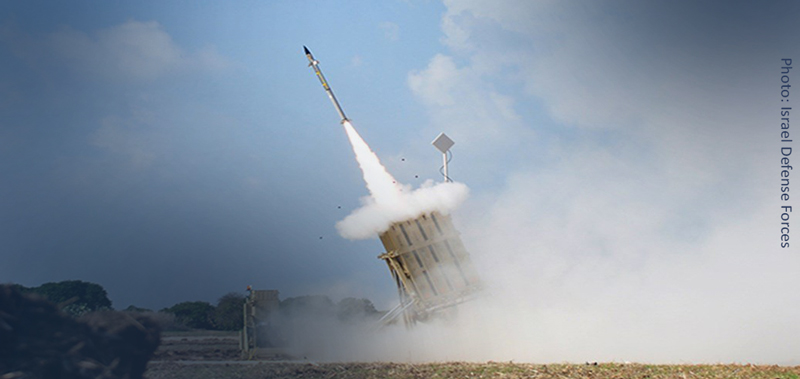
- Active Defense Produces Freedom of Action – The current round of violence, during which Israel's Iron Dome batteries intercepted dozens of rockets headed towards civilian targets, demonstrated yet again that its active defense capabilities allow Israel to carry out armed operations, such as targeted killings, by mitigating the risks of uncontrolled escalation leading to war.
Authored by Col. (res.) Udi Evental
If you wish to receive the weekly brief regularly, please follow the link to register.
