

U.S. attacks Shiite Militias in Iraq – What Next?
By Col. (res.) Udi Evental | December 31, 2019
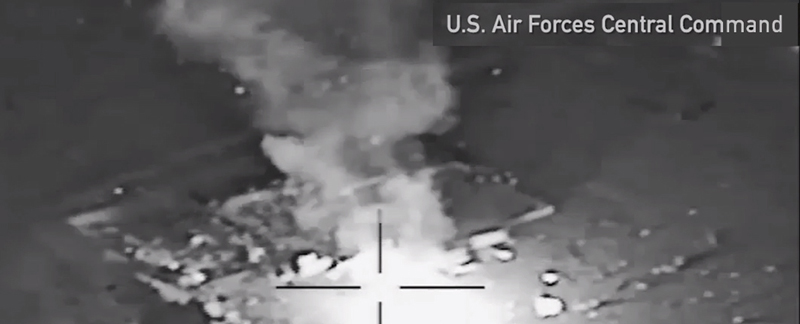 |
| Photos: U.S. Air Forces Central Command |
The U.S. attacked (December 29) five facilities of "Kata'ib Hezbollah" (Battalions of Hezbollah) along the Iraq-Syria border. Kata'ib Hezbollah is one of the largest Shiite militias operating in Iraq, supported and associated with Iran. The attack, centered on the border crossing near al-Qaim struck three targets on Iraqi territory and two in Syria, including weapon depots and command centers of the 45th Brigade of the Popular Mobilization Units (al-Ḥashd ash-Shaʿbī) – the umbrella organization of the Shiite militias that were absorbed into Iraq's military. According to various reports from Iraq, including those of the Shiite militias, at least 25 combatants were killed and some 55 wounded.
The American attack came at response to an attack of more than 30 rockets – several days earlier – on an Iraqi base near Kirkuk (Northern Iraq), which resulted in the death of an American contractor and injured several American soldiers. The attack on the base in Kirkuk is part of a steady rise over the past two months in rocket and mortars' attacks on targets with Americans present, including the secured "Green Zone" in Baghdad.
To a large extent, the American response was predictable as Washington made it recently clear – in public and at different levels from the President down – that harming Americans is a redline that the U.S. will not tolerate.
The unprecedented American attack triggered a shock wave in Iraq. Hundreds of supporters of the Shiite militias - following the militias' guidance – stormed the U.S. embassy in Baghdad and breached the compound. Earlier, the militias' leadership affiliated to Iran and led by Abu Mahdi al-Muhandis threatened a painful retaliation against American forces stationed in Iraq and beyond. The Iranian Islamic Revolutionary Guard Corps (IRGC) stated that responding to the American "crime" is a natural right.
In the political-diplomatic arena, the U.S. was caught in Iraqi crossfire. The Iraqi government and parliament, the Shiite militias, the cleric Muqtada al-Sadr, and the powerful Shiite religious authority, Ayatollah Sistani – all condemned the American attacks.
The Shiite militias and al-Sadr renewed their calls to remove American troops from Iraq. The Iraqi national security council stated that the attack constitutes a violation of Iraqi sovereignty and targeted Iraqi forces that fought ISIS. The council further stated that the Iraqi government will re-examine the cooperation with the U.S. on fighting ISIS and will not accept that Iraqi territory will become part of a fighting zone of a regional or international conflict (alluding to the U.S. and Iran).
Along the condemnations of the U.S., some Iraqi public statements revealed reservations of the militias' activities. Ayatollah Sistani pointed out that the attacks on the U.S. are "illegal actions" that the Iraqi government should prevent so that Iraq will not become a "playground". Muqtada al-Sadr, the leader of the largest faction in the Iraqi parliament, contended that the militias ought to be restrained so that the U.S. would have no justification to continue with attacks. Furthermore, Iraqi military sources were quoted in the media stating that "Iran wants to manage its war with the U.S. over our soil."
The ramifications of the American attack are still unfolding and three major questions appear to be important for the near future:
- Iran or the U.S.? The American attack has changed the focus in Iraq. From a widespread anti-Iranian public protest, scrutiny is now diverted to the American presence. Encouraged by Teheran, the Shiite militias are trying to strengthen this trend to turn the public protest against the U.S. and weaken its very pronounced anti-Iranian sentiment. Over time, this objective will not be easily attained after months of protests resulting in 400 fatalities, many of which by the Shiite militias.
- The U.S. freedom of action – will be affected by the struggle over the core message of the protests. Should the protests refocus on the Iranian presence in Iraq, it will increase American maneuverability and freedom of action to respond to anticipated retaliatory attacks from the Shiite militias. Thus, the Iraqi domestic discourse will dramatically affect the question whether the American attack will herald a change in the patterns of American engagement in Iraq and the region – the use of force in response to any attack or even threat on American forces – or whether the American attack will remain an isolated event.
- What message does the attack convey to Iran? The American attack aimed to restore its deterrence vis-à-vis Iran in Iraq and across the region considering the growing audacity of the regime in the Gulf since the Spring. Secretary Pompeo and the State Department's Iran coordinator, Hook, made it clear that the attack intended to "deter Iran" and to "convey a message that the Iranian regime will understand". The question is whether the U.S. attack on a proxy (Kata'ib Hezbollah) will bolster American deterrence vis-à-vis Iran or actually reinforce Iranian confidence that as long as it utilizes proxies, Iran itself will not be harmed.
The preliminary assessment is that in the immediate future, the American attack will curtail American freedom of action in Iraq and that at the strategic level it will not achieve its objective vis-à-vis Iran. Teheran is expected to continue operating via proxies – in Iraq (retaliatory attacks) and across the region (strategic attacks) to try and break the pressure of sanctions.
The U.S. will have to determine if and how powerfully to respond to future attacks in Iraq considering domestic trends in Iraq and if to respond to attacks that will not result in casualties, because restraint could be perceived as accommodating and accepting attacks on its assets.
At the broader level, the U.S. will have to determine and manage risks concerning the question on whether future attacks by Iranian proxies should trigger retaliatory attacks on Iranian targets so that the deterrent message will be received in Teheran.
Regarding Israel – it will have to continue and deal, mostly alone, with Iran's effort to entrench military capabilities along its borders and with the IRGC's Quds Forces attempts to retaliate against alleged Israeli attacks aiming to foil Iran's schemes.
Under the current circumstances, Israel must understand that the Iraqi arena is "boiling" and that it will have to act prudently in addressing threats emanating from the Iraq and Eastern Syria and closely coordinate its actions with the U.S.
Authored by Col. (res.) Udi Evental
If you wish to receive the weekly brief regularly, please follow the link to register.
