


The Front No One Is Stopping: The Deterioration of Democracy in Israel
Prof. Amnon Cavari, Head of the Institute for Liberty and Responsibility, Reichman University
This week saw the publication of the 2026 annual report of the Varieties of Democracy (V-Dem) index, one of the most comprehensive and important assessments of the state of democracy worldwide. The trend emerging from the latest publication is troubling, globally and, in particular, for Israel.
The V-Dem index is a large-scale international research project, based on the work of hundreds of scholars, that measures the quality of democracy. It is grounded in the understanding that democracy has multiple manifestations, but rests on a shared set of core values. Each democracy emphasizes certain aspects over others, and the quantitative measurement of these aspects (through expert surveys) enables comparative evaluation across countries, intending to assess whether democratic quality is eroding or strengthening over time and relative to other states.
The trend emerging from the new report indicates that democracy worldwide is in clear decline. While the late twentieth century and early twenty-first century saw an overall global rise in democratic indicators, the past decade has witnessed a halt, followed by a downturn. This is not a sudden collapse within a single year, but rather a cumulative, gradual, and ongoing process driven by decline in established democracies, newer democracies, and regimes with limited democratic features alike. This is precisely what makes the process so dangerous. Democratic erosion no longer occurs through a single revolution, but through the slow weakening of norms, institutions, and constraints on power.
In Israel, the picture is even more severe, with data pointing to a faster and deeper decline than that observed globally. As shown in the graph comparing Israel to OECD countries on the liberal democracy index, while the reference countries exhibit a clear decline from their peak, Israel shows a more sustained and accelerating regression. This means that Israel is not merely part of a broader global trend, but stands out as a prominent case of sharp democratic deterioration.
This picture is reinforced when examining the five core V-Dem indices (focusing on the years since 2000), all of which point in a similar direction. The first is the electoral democracy index, which captures the basic expression of democracy: free elections, political competition, universal suffrage, and freedoms of expression and association. In this measure, Israel shows a dramatic decline.
The second is the liberal democracy index, which adds to electoral democracy the limitation of executive power, judicial independence, protection of individual and minority rights, and checks and balances. The erosion here is unsurprising, as these are precisely the areas where the current government’s actions have been most pronounced. Actions that fail to stop, even amid the ongoing war.
The third is the participatory democracy index, which examines the depth of civic engagement and the extent to which citizens can meaningfully participate in public and political life. Following an awakening over the last five years due to the scale of mass demonstrations against the government and repeated elections, we see, once again, a gradual decline.
The fourth is the deliberative democracy index, which relates to the quality of public discourse and whether government decision-making is based on considerations of the common good rather than narrow interests or power calculations. Once again, under the current right-wing government, this index also points to erosion following the relative resilience at the turn of the decade.
Finally, the fifth is the egalitarian democracy index, which assesses the extent to which political power and influence are distributed equally across different groups in society. Israel again shows a fast downward trend.
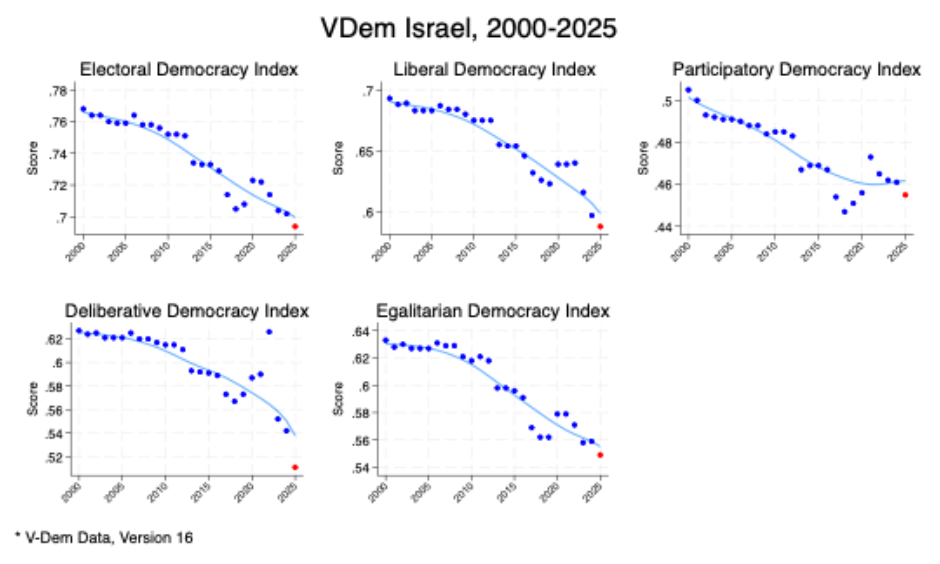
The fact that all five core indices indicate deterioration is particularly noteworthy and points to a broad process of democratic weakening manifesting simultaneously across institutions of governance, respect for rights, political participation, the quality of public discourse, and political equality. In other words, this is not merely a dispute over the judiciary, nor only political polarization, nor simply questions of governance—it is a comprehensive, multidimensional erosion of Israeli democracy.
The current war, naturally, has pushed public discussion about the state of Israeli democracy to the margins. Yet, in light of the coalition’s continued legislative efforts to advance regime change, its unrestrained attacks on judicial institutions and the electoral process, alongside the exclusion of social groups, unequal legislation, and, above all, attempts to silence critics, it appears that the war is being used to obscure the ongoing assault on democracy.
The V-Dem data serve as a reminder that safeguarding democracy remains essential even during wartime. And when the war ends, the struggle over the democratic character of Israel will remain with us and will require significant effort to repair. The new data do not indicate a temporary fluctuation, but rather a continuing trend—one that has intensified during the years of war. At present, the outlook on this front is also deeply concerning.