


Netanyahu promotes the "Deep State" conspiracy. Do Israelis believe it?
Prof. Asif Efrat and Dr. Omer Yair
In recent years, many countries around the world have undergone a process of democratic backsliding, in which the government becomes more powerful, removes checks and balances, and undermines fundamental rules and institutions. Among other things, the government seeks to become empowered at the expense of unelected government bodies: the bureaucracy and public administration, the judiciary, and the military and intelligence forces. These bodies lose their independence, their powers are curtailed, or they are simply ignored by politicians. One of the arguments intended to justify the attacks on these government and judicial agencies is that they constitute a "deep state"—this is a conspiratorial claim about a kind of apparatus operating in the shadows, where unelected professionals make decisions behind the scenes, in a way that advances their personal and/or political goals, while thwarting elected leaders. The elected leaders represent the people, but the Deep State is the one who steers policy against the will of the people. Weakening the Deep State, according to this logic, will return power to its rightful place: the elected political echelon.
This conspiracy has no basis in reality; no facts or evidence are presented to support it, and it is spread as part of propaganda speeches and media campaigns designed to strengthen politicians at the expense of the proper and democratic operation of state institutions. It has great impact precisely because it is unfounded: it is simple to understand and relies on emotions and moods that receive a satisfactory response thanks to it.
In the process of democratic backsliding that Israel is undergoing, Prime Minister Netanyahu himself has been spreading the "Deep State" conspiracy since March 2025. This is part of his fight against the gatekeepers, including Attorney General Gali Baharav-Miara and former head of the Shin Bet Ronen Bar. In Netanyahu's definition, "The Deep State is the permanent bureaucracy that is hardly ever replaced, … and it thinks it knows better what the voters want. [The Deep State] always leans to the left." Netanyahu further explained that "in America and Israel, when a strong right-wing leader wins the election, the Deep State in the service of the left uses the justice system in a distorted manner to thwart the will of the people."
If the theory of the "Deep State" has gained traction among the public, then the danger to Israeli democracy has increased. Support for the theory could weaken public trust in the legal system, the bureaucracy, and the security forces. It would allow the government to thwart the actions of these bodies and even take control of them. The question, then, is whether Israelis actually believe there are hidden Deep State forces that must be fought, as Netanyahu wants.
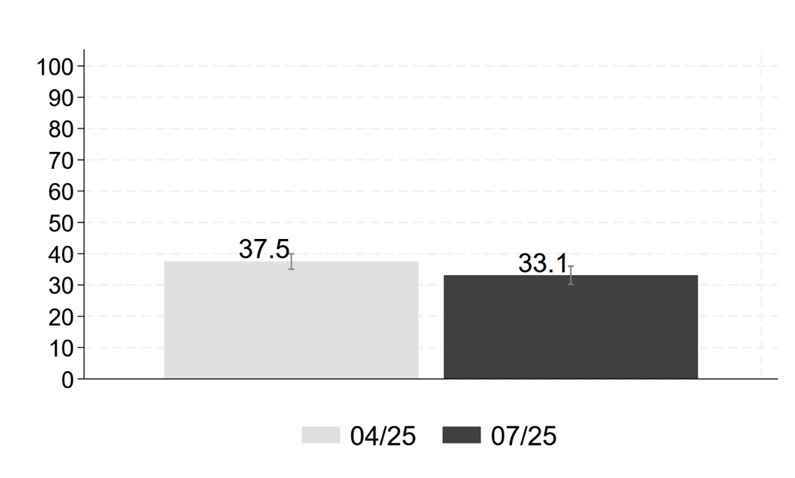
In two surveys we conducted at the Institute for Liberty and Responsibility at Reichman University in April 2025 (1490 respondents) and July 2025 (997 respondents) among representative samples of the Israeli public, we asked respondents to what extent they agree that, within Israeli government institutions, a “Deep State” exists, working to advance its goals covertly and without oversight. In both surveys, a fairly high proportion – about a third of the Israeli public – agreed or strongly agreed with the claim (see Figure 1 below): 37.5 percent in April 2025, followed by a slight decline to 33 percent in early July 2025, about a week after the end of Israel's war against Iran (Operation “Rising Lion”). It is possible that what was seen as successful cooperation between the government and the security forces in this operation somewhat reduced public belief in the existence of a deep state. Either way, a third of the public believing the claim makes this conspiracy theory relatively common compared to other conspiracy theories in Israel, including the one about "betrayal from within," which 24 percent and 22 percent of the public believed in the same polls we conducted in April and July 2025, respectively.
However, it should be noted that the percentage of Israelis who believe in the existence of a Deep State is lower than the percentage of Americans who believe that there is a Deep State in their country. In particular, in surveys conducted in 2020 and 2021, between 43 and 45 percent of the American public believed this. It seems that the discourse in Israel about the Deep State is based to a significant extent on the public discourse in the United States on the subject, but as of today, fewer Israelis believe in it than Americans.
Figure 1. Share of Israelis who believe in the existence of a Deep State in Israel in the entire sample
 |
In addition, in both surveys, there were considerable differences between coalition and opposition voters in the share of belief in the existence of a Deep State, with coalition voters more likely to believe in it. This is not surprising, both because of claims that have been heard among the political-ideological Right against the judicial system for decades, and in light of the claims made by Prime Minister Netanyahu. Thus, in April 2025, approximately 51 percent of coalition voters, compared to 27 percent of opposition voters, believed in the conspiracy theory about a Deep State in Israeli government systems. However, after the war in Iran, the gap narrowed somewhat, with 44 percent of coalition voters and 26 percent of opposition voters indicating that they believed in this conspiracy theory. It should be noted that these gaps are lower than the gaps between coalition and opposition voters seen in other conspiracy theories regarding the war in Gaza or regarding the "setting up" of Prime Minister Netanyahu by the judicial system, but they are still substantial.
Figure 2. Share of those who believe in the existence of a Deep State in Israel – coalition and opposition voters
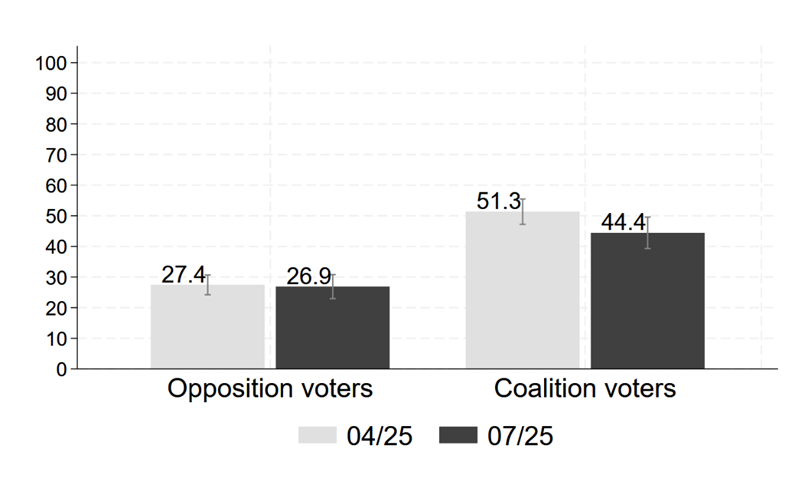 |
We believe that our findings constitute a warning sign. The attempt to discredit and weaken unelected government officials may be met with sympathy among significant segments of the public who accept the idea of a Deep State: about half of coalition voters, and even about a quarter of opposition voters. For them, the judiciary, the military, and the bureaucracy are working to distort the will of the people, and there is, supposedly, a justification for curtailing their powers and independence. Thus, the Deep State theory may be used by the government and its supporters to undermine democracy. But it is important to remember: despite claims about a Deep State, cooperation between the elected echelon and the security forces and senior officials has always been the basis for Israel's success. It is more likely that cooperation, rather than fights and struggles, will help advance the country in the future.
Prof. Asif Efrat is a senior research fellow at the Institute for Liberty and Responsibility at Reichman University.
Dr. Omer Yair is the research director and a research fellow at the Institute for Liberty and Responsibility at Reichman University.