


Quite a few Israelis believe in "betrayal from within" on 7/10 – some are certain of it
Omer Yair, The Institute for Liberty and Responsibility
Even today, more than two and a half years after the horrific Hamas attack on October 7, there is public controversy concerning the causes of the attack. Several surveys from the past two years have shown that quite a few Israelis believe that senior officials in the security establishment knew in advance about the Hamas attack but hid it from Prime Minister Benjamin Netanyahu in order to harm him politically. This is the conspiracy theory about "betrayal from within" on October 7. Thus, a survey by the Institute for Liberty and Responsibility at Reichman University found that at the end of 2025, more than a quarter of the Israeli public agreed with this claim, including about half of the coalition voters. And some argue that belief in this conspiracy theory has implications for how the various failures from that day should be investigated and corrected.
However, most surveys that examined belief in this conspiracy theory asked the public about agreement with the claim about a betrayal from within, but did not examine the respondents' degree of confidence that such betrayal did occur: whether they are convinced that the betrayal did occur, whether they think it may have occurred but are not completely convinced of it, or whether they are convinced that there was no betrayal from within.
Accordingly, in a new survey we conducted at the Institute for Liberty and Responsibility in April 2026, we asked two similar but different questions: Half of the respondents were asked the common question about agreement with the claim that senior security officials knew about the October 7 attack but hid it from Netanyahu in order to harm him. Respondents to this question were asked to indicate the extent to which they agree or disagree with the claim, including response options of "agree" and "strongly agree." In contrast, the other half of the respondents were asked whether they thought the same claim was true, with this question including response options of "thinks yes" and "certain yes." These are answers that allow for a clearer expression of the degree of confidence or uncertainty that the betrayal from within indeed occurred.
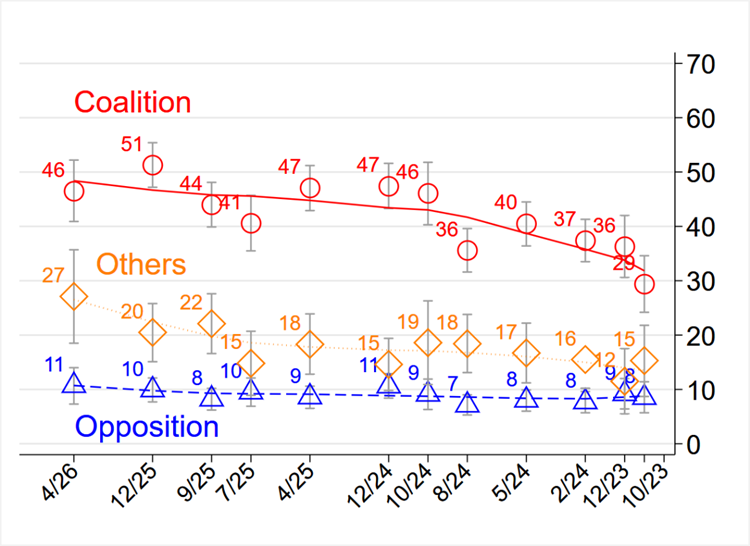
Regarding the first question (agreement with the claim about a betrayal from within ), we found that in April 2026, almost 30% of the public agreed with the claim. This figure reflects an increase in the extent of agreement with the claim of about 10 percentage points compared to November 2023. There are also large differences, which have narrowed slightly since the previous survey in December 2025, in the degree of agreement between coalition and opposition voters. It can also be noted that among “other” respondents – those who did not vote in the last elections for the coalition or opposition parties – we saw a significant increase in agreement with the conspiratorial claims in the last nine months, from 15% to 27% (see Figures 1 and 2 below).
Figure 1. Share of agreement that there was a betrayal from within on October 7, full sample
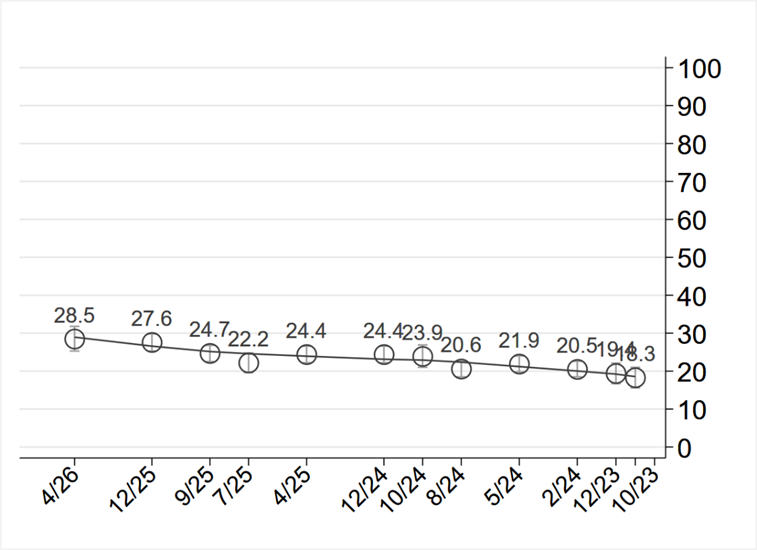 |
Figure 2. Share of agreement that there was a betrayal from within on October 7, among coalition voters, opposition voters, and other respondents
 |
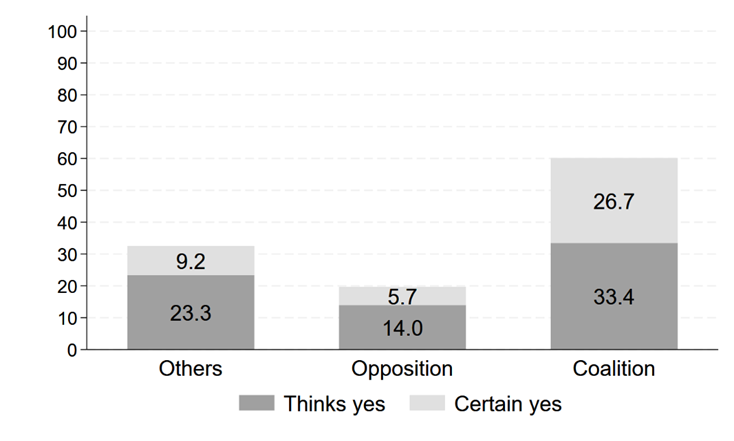
Analyzing the answer to the second question, regarding the extent to which respondents believe that there was internal betrayal on October 7, we see a slightly different picture. In total, no less than 38% of the sample answered at least "Thinks yes," with 14% of respondents answering that they are certain of a betrayal from within, while 24% answering that they think this happened, but they are not sure; this is in contrast to the 29% in total who agreed with the claim that a betrayal from within occurred. The largest difference is among coalition voters: 27% of them answered that they are certain that there was a betrayal from within, and 33% answered that they think it occurred, but they are not sure. Among opposition voters, the rates are much lower (6% and 14%, respectively), with "other" respondents in between (see Figure 3 below).
Figure 3. Degree of confidence that betrayal from within occurred among coalition voters, opposition voters, and other respondents
 |
It seems that there is one prominent negative aspect to these findings, alongside one major positive aspect. First, the negative aspect: If until now we believed that between 25% and 30% of the Israeli public, including about half of the coalition voters, believed in a betrayal from within on October 7, our current survey findings show that a larger proportion, almost 40% of the public and 60% of the coalition voters, are certain that there was a betrayal from within or are not sure about it but think that such betrayal did occur.
At the same time, there is a positive aspect to these findings. This is because a relatively small minority of the general public (14%) is certain that a betrayal from within has occurred, and many more believe that it may have occurred but are not sure of it. Previous studies have shown that those who indicated a more limited degree of confidence that a statement is true or that conspiracy theories have occurred were also more likely to change this position later than those who indicated absolute confidence. And other studies, including a study from Israel, have shown that exposing citizens to reliable information that challenges the truthfulness of conspiratorial claims has led to a reduction, sometimes even a significant reduction, in their belief that those conspiracy claims are true.
Thus, given that to date no positive, reliable evidence has been presented regarding any cooperation by any security officials with Hamas before the October 7 attacks, it is conceivable that it would be easier to change the minds of those who only think, but are not certain, that there was a betrayal from within, by exposing them to reliable information on the subject, especially if it is convincing information from a source perceived to be knowledgeable.
In summary, the survey findings lead to a worrying conclusion: a significant minority of the Israeli public – between 29% and 38%, depending on the different response options – is willing to believe a baseless conspiracy theory that accuses senior officials in the security establishment of betrayal. However, one can hope that a professional and reliable investigation of the events preceding the October 7 attacks by a professional and independent body will help to uncover the causes of the greatest disaster in the history of the State of Israel, and thus also help to debunk various conspiratorial claims regarding the causes of the October 7 attacks.
Dr. Omer Yair is the research director and a research fellow at the Institute for Liberty and Responsibility at the Lauder School of Government, Diplomacy and Strategy at Reichman University.