


The program empowers students with cutting-edge management expertise and hands-on innovation tools to create and scale breakthrough solutions in energy, water, and climate technologies. It develops leaders who can turn climate and AI-driven challenges into real business opportunities, and confidently lead innovation in a rapidly transforming global economy.
Accessibility menu

MBA in Climate-Tech Management
management, innovation, and climate technologies.
MBA in Climate-Tech Management

 Message from the Head of the Program
The MBA in Climate-Tech Management is designed to cultivate a new generation of business leaders, investors, entrepreneurs, and managers specializing in energy, Climate Tech, Sustainability, and Resilience. Graduates of the program will gain an understanding of the trends and needs arising from climate change and the race to AI and learn the common language and skills needed to drive practical solutions to these challenges. The students will learn how to manage, scale and commercialize technologies that address the world’s most pressing challenges.
The program is built on three pillars: Technology and Innovation, Strategy and Entrepreneurship, Finance and Regulation. These pillars will serve as the foundation for practical courses in the fields of energy, water, food systems, agri tech, supply chain, AI infrastructure, etc. Students will acquire the knowledge and tools to drive innovation, profitable growth, and the implementation of AI- and Deep Tech-based climate technologies to meet evolving market needs.
Join us to learn, navigate, and manage the business opportunities in this revolutionary field.
Program Overview
- The program is designed for career professionals with leadership potential from diverse backgrounds, including finance, science, engineering, law, strategy, entrepreneurship, etc. (technological knowledge is not required).
- Program graduates will build a strong professional network across industry and academia and will be well positioned for leading roles in startups, infrastructure and industrial companies, venture capital funds, strategic consulting, public regulation, and international organizations- with the ability to operate fluently at the intersection of climate, technology, and business.
- Program duration: Approximately 18 months (9 mini-semesters).
- Program format: Tailored for working professionals, with classes held on Thursday afternoons/evenings and Friday mornings.
- The faculty is comprised of top lecturers in the field, academics from Israel and abroad, entrepreneurs, and industry experts.
- Students will benefit from guest lectures, industry tours, hands-on projects, and events and conferences.
What Makes This Program Unique
- In their first year, students will complete core business administration courses — including investments, strategy, marketing, finance, and accounting — alongside introductory courses in energy, water, and food security. Building on this foundation, they will then embark on a range of in-depth courses in climate-tech management, such as breakthrough technologies, infrastructure investments and financing, risk assessment and management, regulation and climate change in the business world, startup-to-global scaling strategies, entrepreneurship, innovation labs focused on water and energy, AI and climate, production management, recycling methods, and more.
- Students will receive guidance from experienced industry mentors.
- Option to participate in a study trip to the US (New York and Silicon Valley), including a visit to academic innovation centers and the campuses of tech giants.
- Collaboration with international corporations, venture capital funds, industrial and government companies, and startups, which will play an active role in the learning experience.
- A variety of special activities and events, including:
- An AI & Climate-Tech hackathon in collaboration with Microsoft
- Informal meetups with senior industry leaders once per mini-semester
- Opportunities for student exchanges and visits to leading universities abroad
Skills and Tools Acquired by Program Graduates:

Diverse Career Opportunities
Management roles in the business and public sectors

Expertise in Climate Technology
Advanced technologies in energy, water, foodtech and agritech, engineering and science

General Management Methodologies
Data-based decision-making, team management, and internal organizational dynamics

Leading Initiatives
Spearheading impactful projects in corporations

Exposure to Global Challenges
In-depth knowledge of the technical, economic, strategic, and regulatory dimensions of managing companies
Courses taught in the program, alongside the core MBA curriculum:
-
-
This course covers fundamental statistical methods, including sampling distributions, the law of large numbers, and the central limit theorem as applied to sample means and proportions, with a focus on the normal approximation of the binomial distribution. Students will explore estimation techniques, including confidence intervals for proportions and mean differences — both for large and small samples, and for cases where the standard deviation is known (normal distribution) or unknown (t-distribution), as well as paired sample analysis. The course also covers hypothesis testing, including the general rationale for hypothesis tests, one-tailed and two-tailed tests, Type I and Type II errors, statistical significance levels, and test power. Specific applications include hypothesis testing in normal models, simple linear regression, and one-way ANOVA.
-
This course explores the central question of how companies can achieve and sustain competitive advantage over time. It focuses on strategic management in dynamic, competitive, and uncertain business environments from a top management perspective. Topics include business unit strategy, including characterizing relevant environments, analyzing trends and industries, and assessing their strategic implications. It explores the business value chain, examining a firm’s capabilities and resources, their development and dynamics, and their role in creating a competitive advantage. Additionally, the course touches upon core business unit strategies and approaches to growth.
-
The course addresses a a fundamental question critical to business and organizational success: What does effective management entail? It examines the core elements that drive organizational operations and fall under managerial responsibility, including vision, organizational structure, corporate culture, and human capital management — the pillars of effective management. The course examines these components through both theoretical frameworks and practical applications.
-
This course explores challenges in new products and development process management, with an emphasis on enhancing the ability to generate creative ideas. Contrary to the widespread belief that creativity is difficult to study or cultivate, the course is based on the perspective — supported by recent research — that creative thinking follows cognitive processes similar to those of professional problem-solving at its highest level. The key difference lies in how problems are defined. A well-framed problem directs attention toward areas rich in potential solutions, increasing the likelihood of creative breakthroughs. Creative thinking is an accessible and trainable skill that one can practice to be ready for the moment when an original idea is needed and to seize opportunities when they arise.
-
Digital marketing plays a key role in the growth of both small companies and large corporations, influencing nearly every function within an organization. This course provides a comprehensive review of various digital marketing channels, covering widely used technologies and methodologies. It incorporates insights from research in the field and practical experience with a number of industry-standard tools, providing examples from the Israeli and international markets. Students will analyze actual reports from a range of companies.
-
In today’s business world, managers are constantly surrounded by vast amounts of data, which can often feel overwhelming. To extract greater business value from the company’s information sources, managers need to understand the capabilities of data science and how to effectively integrate them into their business strategy. This course aims to bridge the gap that many managers face in navigating and utilizing data. It explores how data-driven technologies can enrich products and services and provide solutions to business challenges.
-
The goal of this course is to to equip students with the knowledge and skills needed to understand and interpret accounting and financial statements from the perspective of the report reader. In the first part of the course, students will focus on the presentation of financial statements (balance sheet, income statement, statement of changes in equity, and cash flow statement) and be introduced to fundamental accounting principles and terminology. In addition, they will learn to analyze and understand revenue recognition policies and inventory costing methods. The second part of the course will delve into accounting for fixed assets, investments, liabilities, equity, and additional financial elements. By the end of the course, students will have developed essential analytical tools to interpret and evaluate financial reports. This is a double course spanning two mini-semesters.
-
This course aims to provide students with with a strong analytical understanding of a wide range of financial concepts. The knowledge acquired will serve as a practical tool for solving various financial challenges, from everyday decisions such as loan and mortgage planning or evaluating the cost-effectiveness of installment purchases to fundamental business problems like comparing investment projects, pricing securities (bonds), and developing cash flow forecasts. The course will cover key financial concepts, including interest rates, cash flows, inflation, internal rate of return (IRR), net present value (NPV), and more.
-
This course provides a managerial perspective on the field of marketing. It introduces the “language of marketing” through a comprehensive review of fundamental concepts and key principles in the discipline. These foundational ideas serve as a basis for further exploration and analysis in more advanced marketing courses. The course emphasizes the application of these concepts within a managerial decision-making framework, with a particular focus on the development of a strategic marketing plan.
-
Business Model Innovation (BMI) plays a central role in creating value for society, with many organizations — including established companies, social enterprises, startups, and even non-profits — attributing much of their growth and success to the principles and guidelines of effective business models.
This course is taught with an applied approach to understanding, designing, and implementing business models. It covers the analysis of corporate business models and the development of BMI strategies for innovative companies. By the end of the course, students will be able to analyze and articulate the relationship between business models and value creation, describe, compare, and critique different business models, and develop BMI strategies for a variety of organizations.
-
This course offers students a practical exercise simulating a severe and rapidly unfolding corporate crisis in a highly media-exposed and digitally connected market. The course includes a theoretical component, in which major real-world corporate crises will be analyzed alongside strategies employed by management and key decision-makers to navigate them. The practical component includes a two-day workshop where students meet with industry mentors who present them with data from a significant crisis they have handled as senior managers in their organizations. The students will be divided into teams simulating a corporate management group. Each team will assume senior leadership roles, develop a strategic response to the presented crisis, and present their plan — first to mentors and later in a simulated press conference with representatives from the written and digital media. Attendance at the workshop is mandatory.
-








What’s happening in the MBA Climate-Tech Management program
-

Team workshop at MOLET
As part of our program’s “Beer & Climate” series, we held a team workshop at MOLET, where students built furniture from reclaimed wood. All items were donated to The Fifth Element at Sheba Medical Center, supporting rehabilitation efforts for those affected by October 7. It was a meaningful and bonding experience- finished, of course, with beers and pizza.
-

Two new core courses
We were excited to open the semester with two core courses in energy and water. Water Management Strategy, Innovation and Technologies led by Yossi Yaakobi from Mekorot, and Introduction to Energy: Markets and Technologies by Nurit Gal, CEO of e-NERGY. Together, they give students a strong managerial foundation to understand the major challenges and business opportunities in the energy and water sectors.
-

On Resilience and Energy Storage
Dr. Michal Valkin | 06.07.25 | Calcalist
-

Presenting the Program to "Hovlim" Course Graduates
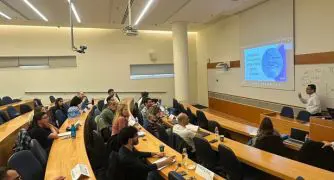
This month we were pleased to present our program to graduates of the "Hovlim" (Naval Officers) course at Reichman University. The head of the program, Dr. Michal Valkin, presented the field of climate technologies and the enormous business potential within it, with a special emphasis on water and energy technologies.
-

Talk is One Thing, Action is Another: Is Trump's Climate Policy Feasible?
In collaboration with Dr. Michal Valkin | 06.04.25 | Ynet


