


 Apply
Apply Faculty
 Brochure
 Dean, Sammy Ofer School of Communication





Venezuela
Accessibility menu
BA in Communication
Click Here For Virtual Tour Of Our Facilities!

"We connect information, technology, and people through communication."
BA in Communication
Program Highlights
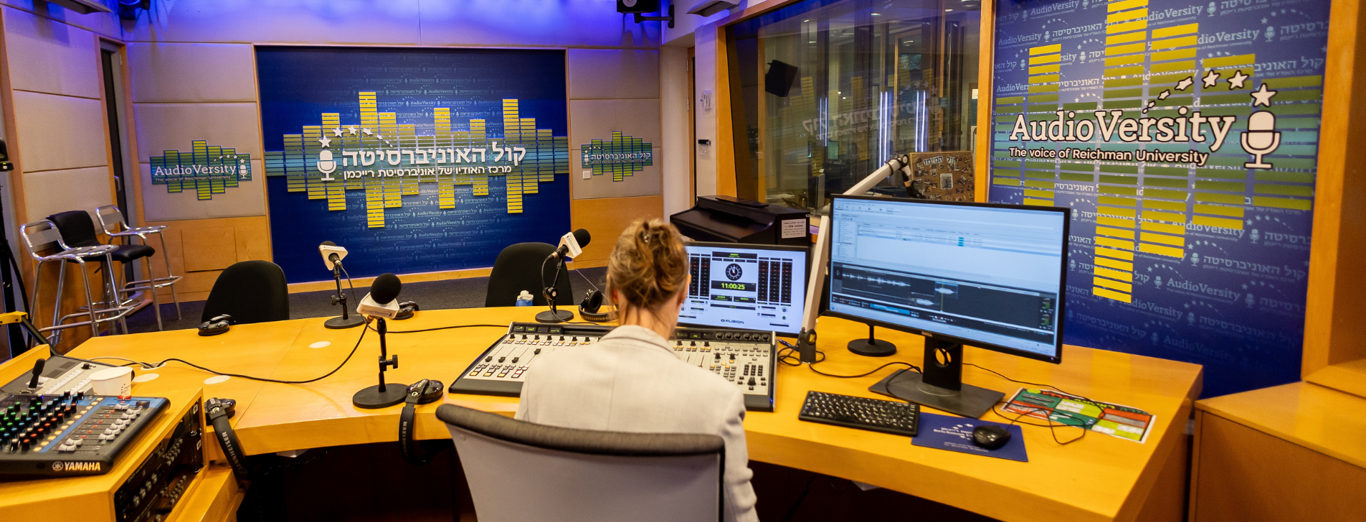
- Our students are taught and have access during their studies to the most advanced equipment and technology in the field including: TV and radio production studios, post-production studios, a Newsroom, and Digital Fabrication tools (3D printer) VR labs and Media Innovation Lab.
- In the second year, you can choose one of two tracks: The focused track, which allows you to concentrate on one specialization, or the combined track, which allows you to combine a primary specialization with a secondary one. The available specializations are: Marketing Communication, Human-Computer Interaction, or Content for Impact.
- A variety of internships are available for students starting from their second year of studies.
- Students have the opportunity to participate in the production of the school’s radio station, operating on FM 106.2 frequency.
-
Students also have the option to add a business administration cluster to their degree.
- The Sammy Ofer School of Communication also offers a student exchange program to its 7th semester students.
Honors Program
The Sammy Ofer School of Communication proudly presents its Honors Program, meticulously crafted to provide exceptional students with unparalleled opportunities to witness firsthand the application of program theory and practical content within leading companies, studios, and corporations in the industry.
Through immersive field visits, participants will gain invaluable insights, forge connections with industry luminaries, and engage with esteemed Reichman University Communication alumni.
Acceptance to this esteemed program is open to second-year students with a minimum Grade Point Average (GPA) of 90 in their first year.
For more information click here.
Specializations and Clusters
-
Human-Computer Interaction (HCI)
 Head of Specialization: Dr. Noa Morag
 We prepare you for product roles in the high-tech industry. You will develop product-oriented thinking which is based on understanding the user, the market and the emerging technologies. This will be achieved by developing critical thinking, creativity, strategic planning and management skills
Further Information -
Marketing Communication
Head of Specialization: Ms. Sivan Ben-Horin This specialization prepares graduates to work in advertising agencies, media consulting, client-side marketing departments, and high-tech companies. You’ll develop strategic and creative thinking that covers all aspects of marketing communication – working with clients and target audiences.
Further Information -
Content for Impact
Head of Specialization: Dr. Hadassi Bachar Yael This specialization prepares graduates for integration into the fields of traditional and digital journalism and media. You will acquire the knowledge and professional tools while gaining practical experience in creating meaningful content that drives and influences public, social, and political agendas.
Further Information -
Business Administration
Head of Cluster: Yaron Timor The Arison School of Business at Reichman University offers a cluster in Business Administration for communication students.
Further Information
High End Studios & Editing Rooms
Selected Courses from the Program:
-
-
The course is designed to introduce students to the basic concepts, models, and central theories in communication research. The course utilizes models to discuss current events in print and broadcast media and provides critical tools to examine each theory and model. Course Goals: Students are expected to manifest knowledge and understanding of basic theories in media effects research and of the main scientific paradigms within which they belong. Students are expected to be able to apply the theories and the main concepts within each of them to the analysis of current media content. Moreover, students are expected to be able to critically evaluate the theories with regard to their application to the current media field.
-
The course aims to provide students with the academic writing skills they need to fulfill academic requirements, particularly writing a seminar paper, by practicing the processing and presenting of information. In addition, students learn to read and write different types of academic texts. In the course, students learn the norms of academic writing and develop their ability to read scientific texts and methodically organize theoretical information through mapping, summarizing, synthesizing information from different sources, and presenting information critically. The classes include the presentation of theoretical material and practical exercises to master this material. The course requirements include submitting assignments on academic writing throughout the course, attending and actively participating in classes and submitting a final paper.
-
The course aims to provide students with the ability to understand the principles of scientific thinking while conducting a critical examination of the basic principles of scientific research. Furthermore, the course strives to provide students with the tools for critical reading of research and surveys and to familiarize them with the research techniques that characterize the work of communications researchers. Students discuss dilemmas related to all stages of research, understanding the essence of the scientific approach to acquiring knowledge, defining research questions and designing research frameworks that are suitable for investigating the problem.
-
In this course we will deal with the history of communications from the invention of language to the internet. We have a dual focus. First, we will examine the complex relationships between the society and the method of communications it employs, e.g., the way television or writing effects society and how society effected what is seen on television or written in books. Second, we will emphasize what we can learn from history: in what way is, for instance, the effect of printing on 15th-16th society, or that of the telegraph and the mass-produced newspaper on 19th century society, different -- or similar -- to the effect of the internet on 21st century society? What can we learn from history (and what can we not)?
-
The course is designed to provide students with a basic understanding in the field of political communication. We will examine how political actors compete over the media as part of a more general competition for political control and influence. The goal of the course is to provide students with the ability to think critically about such questions such as: Who are the political actors who are most likely to succeed in political communication? What are the journalistic norms and routines for the construction of political news? What are the influences of the different types of media on the political process?
-
Social psychology explores the interaction between the individual and his or her social environment. As such, it examines themes and issues of interpersonal, as well as mass communication, in order to understand people’s attitudes and behaviors within social contexts and in light of social influences. We will introduce and discuss research on human communication as a social process, communication and construction of the “self”, information processing, verbal and nonverbal communication in social encounters, self-disclosure and relationship development, persuasion and social influence, attitudes and social behavior, decision making processes, social cohesion, and leadership. The relevance of social psychology to the research of communication and media will be highlighted and discussed throughout the semester. Course Goals:
1. To understand the foundations of Social Psychology research and its relationship to communication.
2. To explore the role of Social Psychology in our daily and routine lives.
3. To understand how we think, perceive information and maintain relationships.
4. To explore the Psychological processes behind professional media content, such as commercials, articles, political campaigns and more.
-
In this class we will focus on content creation and production, starting out from the traditional models we all know, broadcast TV, moving on towards creating tailored media content, devised for digital platforms we all use on a daily basis. Together we will focus on the creative production process for both broadcast and digital platforms, learning the skills we need to devise, standing and delivering content, getting our message across, targeting and engaging your audience, also addressing new digital platforms such as Zoom. We will learn and experience real live productions in our TV Studio and Control Room, making use of all the studio facilities and the production requirements for a studio shoot – writing out a script, producing a line up, planning a shooting script and a floor plan. We will also have first hand experience with lighting, sound, filming and directing. Transitioning onto the online sphere we will pitch new ideas, bending the existing genres and familiar TV studios we all know onto digital platforms content creation and transmission: finding and creating alternative shooting options, using our mobile devices and computers, getting our content out there on the digital platforms and creating engagement. Our complex productions will be produced both within and outside of the TV studio, based on real, pre-researched, material; interviews; talk shows; news segments etc. Course Goals: New media technologies are daily changing our viewing habits, opening our eyes to new experiences and possibilities. We are active participants in this evolving world of media and visual content, learning to adjust our news and entertainment consumption to the newly emerging media platforms. The workshop focuses on production and direction of various TV genres, studying the recent integration of broadcast productions and digital platforms. The students will learn how to create original media content, from finding adequate ideas, concept development and research of visual and script materials, to preparing a breakdown, studio planning, creating an original script, going on Facebook live and recording the show in the studio. Each production will require planning, accompanied by personal consultation, preparation and presentation of a detailed production portfolio.
-
In a world where everything is visual, from advertising, interactive, television to social and digital media, our students and graduates need to have a basic knowledge of storytelling. The "Storytelling for Digital" workshop focuses on providing practical tools required for the field of media and digital production, developing creative and critical thinking. How to tell a compelling story that manages to influence and reach hundreds of thousands and millions of users, viewers, or audiences? Those who master the skill of storytelling will later know how to sell an idea for an advertisement, pitch an idea for a TV series, or create a video for a product presented to investors. Course Goals: Students will learn the basics of visual language and story production processes accompanied by industry-leading directors, producers, and content editors. They are starting from the idea, through familiarity with the script, production stages, roles of professionals in the set, basic concepts in photography and cinematic expression, digital editing to the finished video.
-
The advent of the Internet has revolutionized the world of journalism in every way. Reporting, publishing and consuming news are now forever changed. This workshop looks at the dramatic effects of the Internet on the journalism profession and the world at large. We discuss, among others, the evolution of phenomenon like Citizen Journalism; fake news, the radical change imposed on the business model of mainstream journalism; the unprecedented new access to sources and information through platforms like Twitter, Google Earth, YouTube and Facebook (both for journalist and news consumer); the challenges in verifying the information from social media; the new digital players news; the power of mobile devices in capturing powerful content; and the change in the style of writing for the Web. Alongside the discovering, the digital world students will learn about Broadcast. The students will learn to navigate between the different types of media from digital media to television to adapt the appropriate content to the platform on which it will be distributed and get to know the different methods of making content viral and clickable. Goals Goals In the workshop, we will deal with the evolution of a phenomenon like civil journalism; The radical change imposed on the business model of the mainstream press; New and unprecedented access to sources and information through Google Earth, YouTube, and Facebook platforms like Twitter. We will address the challenges of verifying information from social media; Digital news, the power of mobile devices to capture compelling news content; And the change in the writing style of the Internet. In the We will get to know the structure of the TV and the digital newsroom through editorial considerations, and various constraints. During the workshop: we will research, film, produce, edit, and prepare a 2 min—news item by professional standards. We will provide students with an essential toolbox that is necessary for every content creator/journalist / professional publisher/speaker, Marketer, and anyone who wishes to promote an idea.
-
In this class we will focus on content creation and production, starting out from the traditional models we all know, broadcast TV, moving on towards creating tailored media content, devised for digital platforms we all use on a daily basis. Together we will focus on the creative production process for both broadcast and digital platforms, learning the skills we need to devise, standing and delivering content, getting our message across, targeting and engaging your audience, also addressing new digital platforms such as Zoom. We will learn and experience real live productions in our TV Studio and Control Room, making use of all the studio facilities and the production requirements for a studio shoot – writing out a script, producing a line up, planning a shooting script and a floor plan. We will also have first hand experience with lighting, sound, filming and directing. Transitioning onto the online sphere we will pitch new ideas, bending the existing genres and familiar TV studios we all know onto digital platforms content creation and transmission: finding and creating alternative shooting options, using our mobile devices and computers, getting our content out there on the digital platforms and creating engagement. Our complex productions will be produced both within and outside of the TV studio, based on real, pre-researched, material; interviews; talk shows; news segments etc. Course Goals: New media technologies are daily changing our viewing habits, opening our eyes to new experiences and possibilities. We are active participants in this evolving world of media and visual content, learning to adjust our news and entertainment consumption to the newly emerging media platforms. The workshop focuses on production and direction of various TV genres, studying the recent integration of broadcast productions and digital platforms. The students will learn how to create original media content, from finding adequate ideas, concept development and research of visual and script materials, to preparing a breakdown, studio planning, creating an original script, going on Facebook live and recording the show in the studio. Each production will require planning, accompanied by personal consultation, preparation and presentation of a detailed production portfolio.
-
Radio is a basis for creating content on a variety of platforms and is a gateway to various roles in the digital space and media field. The workshop will provide familiarity with radio and audio on FM and digital in a variety of podcast formats. In addition, as part of the course, students will acquire tools and skills from the research and information gathering stages, through production, narration, program and audio editing. Course Goals: The workshop enables and produces experiential learning in a variety of broadcast roles: music editing, production, presentation and format development. In addition, students will learn to find the personal and unique voice they will formulate into an applicable idea through audio, and will practice storytelling on the various audio platforms.
-
Core Courses
-
We’ve all heard it said, “It’s not what you know; it’s who you know.” Social Network Analysis, is the study of who you know, who they know, and why it matters. This course takes a non-mathematical approach to the study of network theories and methods. It presents an introduction to various concepts, methods, and applications of social network analysis drawn from the social and behavioral sciences. Particular attention is given to the role of communications media (face-to-face, telephone, and new media), in facilitating interpersonal connectivity. The course focuses on how network structure is related to everyday life issues, such as health, access to social support, job attainment, and the spread of information.
-
The transformation of journalistic ethics in the modern age, beginning with operation desert storm and through the digital revolution that has swept through the coverage of contemporary news with an emphasis on conflict zones. In addition to the study of the history and evolution of news ethics, students will be presented with actual scenarios where journalistic ethics were tested in the last several decades. They will be given the opportunity to examine and practice decisions made in newsrooms and in the field as well as research the long term affects those decisions had on the profession and its practice.
-
Dr. Assaf Lev
The course presents the essence and nature of qualitative research, the empirical and interpretive logic that guides it, and its development in the social sciences. The course instructs how to collect data using various research methods, how to engage in field research, and how to conduct actual research among participants. The course also provides practical instruction in which we will perform analysis on different types of texts: written, spoken, and visual. Course Goals: The course aims to examine, apply and critique the main qualitative research methods. We will discuss critical qualitative research strategies such as diverse methods of collecting qualitative data, including interviews, observations, documentation, and more. We will deal with the analysis methods in different models of qualitative research and discuss the connection between qualitative research and quantitative research.
-
This course will focus on one of the main issues in cultural research - the cultural design of human identity. We will examine how visual media as a socio-cultural phenomenon plays a significant role in the reshaping of identity and its interactions within a materialistic environment. The course will cover a range of relevant issues that contribute to identity-reshaping, including, but not limited to, body image, consumerism, gender, and ageism. All of the above issues will be examined through written and visual texts as well as class discussions. Course Goals: The course will help students develop critical thinking regarding the connection between identity and culture. To understand how cultural construction is created and how it is related to different areas of our lives. Students will be given tools that will allow them to be more curious, ask question and to learn to be aware and alert to the media and cultural texts around them.
-
Humanistic thought, which puts Man at its center, is the cultural and intellectual foundation of the Western world. This course discusses several key issues from the rich history of humanistic thought, attempting to provide communications students with the intellectual background needed to understand the cultural world we live in, and be able to act rationally within it. The course has three main parts: epistemology (the theory of knowledge, asking how is it possible to know the truth about the world), ethics (asking what ought – and ought not – we to do), and political theory (asking what is the source of legitimation of state and government).
-
In response to the Covid-19 pandemic, governments have implemented laws and policies to enforce measures such as isolation, social-distancing, lockdowns, and contact-tracing. The justification is that insufficient action will put millions of people at risk of serious illness or death. Yet, many critical scholars and doctors have argued that in order to implement these extreme restrictions, scare and intimidation tactics are being used, and have questioned the ethics and morality of such tactics. Some critics have pointed to deliberate biases and distortions of vital information, and misleading policy makers and the public. These critiques sharpens important question – who shapes our knowledge of diseases and medical treatments? In recent decades, PR professionals have become the driving force behind much of the news, including health news. Pharma PR practitioners play a central role in creating public opinion and shaping our health agendas. The course will focus on the intersection between three powerful industries – the pharma industry, public relations and the media, and will address the roles played by PR practitioners in shaping media coverage, as well as health policies and clinical practices. During the course, we will try to lift the screen behind the pharma PR work, in order to understand how these influential industries operates, identify and analyze common PR strategies and tactics in this field. Among the issues we will explore: What is the best way to communicate a new drug to the public; how to build a successful drug information campaign without encouraging drug abuse; what are the best strategies to deal with a health crisis; and what role do public relations play in the age of new media and increasing use of covert advertising. In addition, we will discuss ethical issues related to PR strategies, as well as new challenges in this field, such as the increasing penetration of covert advertising and new media technologies.
Course Objectives:
• Have knowledge on basic concepts and definitions in this field
• Get to know central theories and models in Public Relations
• Discuss history and evolution of public relations ethics and professionalism
• Understand the complex and sophisticated corporate influence process exerted by the pharma and PR industries, and the role it plays in modern society
• Be able to critically evaluate various pharma PR strategies and tactics in terms of efficiency, ethics and law, and apply ethical principles to effective public relations practice
• Discuss the integration between PR activities, overt and covert advertising and lobbying in drug campaigns
• Examine strategies for crisis management in pharmaceutical companies
• Discuss how new challenges, such as the increasing penetration of covert advertising and new media technologies, are affecting PR professionals' work.
The course will focus on the intersection between three powerful industries – the pharma, public relations, and the media, and will address the roles played by PR practitioners in shaping media coverage, as well as health policies and clinical practices. During the course, we will try to lift the screen behind the pharma PR work, in order to understand how this influential industry operates, identify and analyze common PR strategies and tactics in this field. Among the issues we will explore: What is the best way to communicate a new drug to the public; how to build a successful drug information campaign without encouraging drug abuse; what are the best strategies to deal with a health crisis; and what role do public relations play in the age of new media and increasing use of covert advertising. In addition, we will discuss ethical issues related to PR strategies, as well as new challenges in this field, such as the increasing penetration of covert advertising and new media technologies.
-
Ms. Sagit Dinnar
Over the past two decades, the media landscape has changed its face beyond recognition. This is due to global processes, technological developments and social and cultural changes that have taken place in the world. Course Goals: During the course we will understand the structure of the media institution in Israel and around the world in general and draw the map of mass communication in Israel at the beginning of the 21st century, while examining the different patterns of interactions between the media institution and society.
-
Psycholinguistics covers the cognitive processes that make it possible to generate a grammatical and meaningful sentence out of vocabulary and grammatical structures, as well as the processes that make it possible to understand utterances, words, and texts. Stemming from theories on the relationship between language and thought, the course will focus on the role of language in shaping perceptions, inducing emotions and changing attitudes in the contexts of conflict, power relations and stages throughout the life span.
Content for Impact
-
Sigalit Maor
The issue of influence and especially influence operations has become a top priority for countries and organizations in recent years, as it poses a true challenge in the current digital reality. A series of attacks and threats on political institutions, corporations, and financial institutions around the world has further emphasized the important of the issue. During the Influence and perceptions class , we will focus on acquiring the needed knowledge in the field of influence and perceptions while presenting different tools to cope with this new reality. The class is designed to expand the students ' knowledge regarding the cyber world, strategic communications , psychological warfare, and influence operations. We will review current opportunities and trends in the field, alongside and in-depth understanding of the risks and threats, while obtaining tools that will help deal with influence operations and disinformation. We will examine the coping methods of various organizations, the typology of attackers, common types of attacks, case analysis, and best practices. Some of the topics we will discuss include: cyber warfare and influence operations, governments and civil society defense decision-making processes dor risks associated with influence operations. The students will also be provided with practical "Open Source Intelligence" and "Social Media Intelligence" collection and analytic tools.
-
Yarden Vtikay
Mandatory Workshop
We live in an era in which we are exposed to bombardment of information in various fields, social, political, military, and public. The information the audience is exposed to carries within in the interests and agendas of specific individuals, organizations or political parties. it is, therefore, more important than ever to also know how to advance ideas or organizations that work for the greater social good.
In the Strategic Communication: from Creation to Impact Workshop, students will learn how to lead and create a credible and relevant content strategy, with emphasis on creating and producing visual messages that currently makeup over 80 percent of online traffic. The work process will be based on building goals and objectives, identifying and understanding the target audiences, platforms, and the right way to build a digital campaign to create impact organically. We all love consuming videos online. It excite us, makes us laugh, and affects us. Likes, shares, and comments on Social Networks create a sense of satisfaction, visibility, and sometimes excitement. But only a clear goal and built-in plan that will create value for users/customers/consumers in a systematic way- will bring about the desired change and lead to the desired results in the field. Raising awareness, recruiting support, recruiting employees, raising funds, information about a new service/product for a particular community, and more. AS part of the workshop, students will use the tools learned to produce a digital campaign for nonprofit organizations.
-
Ms. Hila Perl
Mandatory Workshop
In today's world, the ability to create a political or social impact is no longer based solely on policies or ideals, but on the stories, you tell to make them known. Storytelling isn't just an overused buzzworld. it's a key skill for today's influencers, thought leaders, and activists. Those with unique positions within their various organizations are often required to engage with various audiences and present an idea, a technology, and important messages. There's nothing more engaging, more memorable and therefore, more strategic, than a story. If a picture is worth a thousand words, a video's worth is immeasurable. Done well, it's the ultimate format to engage both people and search engines. As we all go through digital transformation, producing and distributing videos is easier than ever. It's going "viral" that 's the challenge.
This workshop provides theoretical knowledge and practical tools which empower participants to deliver the messages effectively and capture the hearts and minds of various target audiences. The workshop includes a presentation/discussion dedicated to helping identify, develop, and adapt key messages into a format suitable for any target audience and cross-cultural consumption, and to marry them into effective stories. Throughout the workshop, we will develop skills and practice effective communication strategies.
-
Mr. Sharon Karp, Mr. Dovev Shoshan
Elective Workshop
Video content has become central in people's lives, with many owning multiple screens (mobile phones, tablets, computers, etc). AS such, the ability to build, acquire, and utilize an understanding of the video production process is significant. Cinematography and video editing are languages used to convey messages and ideas that aim to reach various audiences, stimulate, and influence them.
This workshop is designed to provide students with the required professional skills of visual content creation in various genres. Throughout the workshop, students will learn the various production roles both in front of and behind the camera as well as advance their editing skills whilst using Adobe Premier Software (the professional software used in the industry today)
Marketing Communication
-
Dr. Sharon Avital
Have you ever felt manipulated by a smooth-talking politician, a slick TV commercial, or a Girl Scout selling cookies? We will explore the strategies of persuasion and influence people use to manipulate our attitudes and behaviors, and discuss social scientific theories that explain when and why these strategies work. We will learn about the structure of arguments and the ways in which fallacies are used to manipulate opinion. We will also investigate how strategies of persuasion that have traditionally been used in interpersonal and mass communication (TV, radio, newspapers, etc.) are now employed in computers and digital media technologies.
-
Ms. Sharon Gesthalter, Ms. Eli Harris
The 'Marketing Strategy' workshop is an active class meant to impart the students with the basic knowledge and working tools needed to become strategic marketers who can apply strategic thinking and a strategic approach in their roles. This workshop includes frontal lectures, case study analysis, personal assignments and a final paper/presentation. Course Goals: In this workshop students will acquire the ability and knowhow needed to create, lead and execute a strategic marketing plan.
-
Mr. Moshe Karasik, Ms. Emmanuelle Tene
An introductory workshop to the vast universe of digital marketing and advertising. Throughout the workshop we'll hold an overview of the various platforms and core terms that are the basis for online marketing. The workshop includes an integrative approach for the various platforms. Course Goals: The course will provide tools for understanding the digital options for marketers. It will provide insights into the range of digital marketing management tools and platforms. Students will be able to use Google Analytics to measure digital activity, understand the essence of the digital media mix, understand the basic principles of Google search and know how to recommend basic actions for search engine optimization. In addition, they will receive tools for establishing an online campaign for brands.
-
Mr. Shay Even
Elective Workshop
The workshop offers a hands-on approach to understanding the world of public relations in the age of new media. Students gain practical tools used by public relations professionals. Students learn the responsibilities of a PR executive, how to develop and implement winning PR strategies and the significance of PR to any business or organization. Throughout the semester students will choose a topic to focus on and build full and creative PR campaign. Course Goals: This workshop is meant to present the student the most innovative and groundbreaking PR tools and strategies, and prepare them to work in the real world with practical tools and knowledge.
-
Mr. Yuval Hollander, Ms. Emmanuelle Tene
A hands-on workshop designed to give students tools that are commonly used in marketing and advertising agencies. The workshop will teach students the tools of the trade in order to handle clients independently. The workshop will provide an understanding of the various ways to analyze and asses the marketing work. The workshop combines case-studies, videos and practical use of social media. The workshop will focus on the Facebook eco-system.
-
Prof. Tal Azran
The question which content is more likely to gain virality on online social networks has become a major issue in various fields, including marketing studies and even political studies. Studies aim to examine, for example, whether logic-based content gain more engagement than emption-based content etc. to understand political manipulation. The seminar course will review the leading theories of virality and aim to encourage student to test some of these theories using applied research. As some of the classes will be conducted via the Zoom platform, we will host several guest lecturers Course Goals: The course aims to give students tools to conduct empirical analyses, specifically using applied research methods. The analyses are examining the students' own projects as well as other real-life cases to examine virality of various content on the main social media platforms.
-
Dr. Shiri Reznik
The seminar will focus on the different ways in which influencers design their public image and rhetoric style. We will examine the concept of "charisma", learn about useful rhetorical devices, and discuss influencers' ability to construct social and political perceptions. We will analyze the public image of branded politicians, like Obama and Trudeau, and discuss the phenomenon of celebrity politics. Can Beyoncé offer new feminist rhetoric? Can Taylor Swift influence the voting patterns of her fans? How can celebrities raise awareness to social dilemmas and maybe even change the world? Finally, we will study influencers' use of social media, understand how they construct parasocial interactions with their followers, and wonder if we can differentiate between the mediated persona and the real person behind it.
-
Dr. Ari Ktorza
Despite its euphoric image which suffused in the western world with a sense of rejuvenating freedom and soaring optimism, the Sixties remained an ideological battleground upon there is no agreement at all in the current public discourses. The purpose of this course would be to study some historical, psychological and cultural aspects of the 1960's, through the special field of the Sixties popular music. The Seminar course will examine the rise of the youth culture and the Counter-Culture, the sexual revolution, and the drugs revolution. This course would concentrate on the impact of post-Freudians approaches, a long side the influence of Carl Gustav Jung, and Abraham Maslow and Humanistic psychology on the Sixties culture. The course will be an introduction to the matrix of history, psychology, popular music and cultural studies.
Human - Computer Interaction
-
Dr. Hadas Erel
This course provides an overview of selected topics and theories in cognitive psychology that are relevant for HCI researchers and designers. The course is composed of twelve lectures and corresponding reading materials on selected topics and theories in cognitive psychology, focusing on the basic cognitive processes as perception attention memory and high cognitive processes as intelligence and creativity. Students will be asked to complete assignments intended to allow them to apply the knowledge they gain in class on HCI related projects, both academic and industrial. The syllabus is designed to suit for the changes needed due to the corona crisis, both expected and future changes during the semester, as it is expected to involve remote teaching only using the zoom platform, and some courses combining zoom teaching and small group teaching in a hybrid form. All content units have been adapted for instruction in Zoom, by editing the materials for a combined lesson, which has a combination of shorter lectures (15-20 minutes) and after each lecture unit there is an interactive unit of class discussion, interactive questionnaire, and use of additional interactive platforms such as Miro. This is intended to deepen the material learned and produce better involvement in the zoom platform. After the interactive unit, there will again be a lecture unit, according to the order of the topics in the syllabus. In addition, according to the pace of progress and the level of attention, in the last third of each lesson there will be another interactive element that will include division into rooms for small group discussions when the lecturer moves from group to group (when relevant of course and not in each lesson). The activity will include discussion, interactive questionnaire, or use of platforms for collaborative thinking. The Adjustment of the courses content units was performed according to the experience gained at the Reichman University in the second and summer semesters of 2020: breaking the lecture into shorter content units, using visual materials, using videos, integrating discussions. Students are asked to be prepared for learning with a laptop that has a camera, microphone and a good internet connection. Opening the camera and the possibility of remote communication is critical to the success of learning in this course. Course Goals: The students will gain knowledge on cognitive principles that are relevant for HCI and should be understood and used by HCI developers and designers. By considering this knowledge, students will be able to adjust their future work to human cognitive demands and to adapt their design to human cognitive processing. It will also provide the students with tools for evaluating existing HCI products
-
Mr. Alon Kasif
Digital products are now an integral part of our lives. Successful products meet a need, evoke emotion & provide simple user experience. The workshop incorporates design theory and practical hands-on experience. Course Goals: In this course you will learn the craftsmanship of designing great products, from ideas up to a working interactive prototypes at the end of the course.
-
-
Content for Impact
-
Jasmine Kainy
Elective Workshop
The audio-visual media world encompasses countless genres, streams, theories and practices. In a world saturated with rules and conflicting points of view as well as challenging technology, it is essential for each creator to learn the tools and develop the skills of directing the content and the story. In the Creativity in Directing and Production workshop, we will familiarize ourselves with principles and methods in the field of directing actors and directing scenes from well-known television series and films. We will also create projects that will provide students with the necessary toolbox as well as the ability to captivate audiences with a good story (whether it is 15 seconds or 90 minutes long).
The goals of the workshop are: 1. To provide the participants with the practical and theoretical tools for directing, with emphasis on developing a narrative concept, an original point of view and building a unique artistic style. 2. To turn students into skilled professionals with critical perception, original thinking and observational abilities. -
Ariel Margalith
Elective Workshop
The workshop Journalism, visual content and on camera skills, grants students journalistic skills, through a hand-on investigation of the strengths and limitations of various types of vide content on social media. Students will gain the necessary skills in order to create on-camera journalistic digital content that makes impact on societies and individuals.
The workshop is designed for the third year students that have demonstrated an interest in on-camera work and wish to develop their content creation skills further. These include research and development of a social media series, journalistic interviewing skills, on-camera writing and body language skills.
Students will be designing a 5 - episode short on-camera journalistic series, our of which one episode will be produced by them. Students will be working in teams, and as individuals to conceive and develop their journalistic on -camera content. They will be given space and tools to find their unique on-camera personality and develop it.
Marketing Communication
-
Dr. Rinat Satchi
Understanding consumer behavior and the environmental and personal factors that affect it is critical to building a successful marketing strategy, especially in the digital era, which is crowded in information and choices. In this course we will learn about the new consumer and the factors influencing his behavior. We will examine the consumer journey along the buying decision process through the implementation of theories and models in behavioral science (psychology, sociology and anthropology) and marketing on various examples and case studies. The course material is taught as a sequence of the buying phases. From the perspective of the individual consumer we will learn about need recognition, information search, attitude formation and evaluation of alternatives, purchase decision and post purchase behavior. At the same time, we will examine the marketers' perspective on issues such as consumer motivation, involvement, perception, information elaboration, learning and persuasion. In addition, we will study a number of general issues such as online consumer behavior and the impact of the sharing economy and crowdsourcing on consumers and companies.
-
Dr. Zack Haya
An introductory workshop to the vast universe of digital marketing and advertising. Throughout the workshop we'll hold an overview of the various platforms and core terms that are the basis for online marketing. The workshop includes an integrative approach for the various platforms. Course Goals: The course will provide tools for understanding the digital options for marketers. It will provide insights into the range of digital marketing management tools and platforms. Students will be able to use Google Analytics to measure digital activity, understand the essence of the digital media mix, understand the basic principles of Google search and know how to recommend basic actions for search engine optimization. In addition, they will receive tools for a basic evaluation of UI design.
-
Mr. Nimrod Dweck
The marketing and advertising world has gone and is going through dramatic changes due to advancements in media and technology. A successful campaign can no longer rely on the classic platforms of TV commercial, print, radio outdoor, etc. The rise of digital world, mobile phone & apps and overall technological capabilities have opened up a plethora of options and opportunities to reach resilient consumers and convey a message. In this workshop we will explore how to use these new tools to create new creative platforms as well as survey and analyze award winning concepts from around the world. Course Goals: 1. Develop innovative and critical thinking 2. Gain an in-depth understanding on how to dapt marketing and advertising messages to new and developing platforms.
-
Mr. Eran Sion
eCommerce is as much a sociological phenomenon as it is a business and technological phenomenon. Since it began in 1995, eCommerce has created enormous change in business firms, markets and consumer behavior and is projected to continue growing at double-digit rates over the next five years, remaining the fastest growing form of commerce. eCommerce is a complex phenomenon that involves considerations of markets, firms, consumer behavior, and technology, among others. This course focuses on principles of e-commerce from a business perspective, providing an overview of business models, and marketing strategies. We will discuss the basic concepts of eCommerce, explain theoretical and practical issues of conducting business over the internet and present methods for evaluating consumer needs. Course Goals: Upon successful completion of this course, students will be able to: 1. Understand the role and importance of eCommerce for business firms 2. Define the unique business model of eCommerce 3. Give examples of e-tailing products and services
-
Dr. Karin Zohar Cohen
Year - Long Seminar
This seminar will discuss digital marketing and propaganda in the social networks, with reference to relevant theories. We will examine how propaganda in social media acts, in order to understand it thoroughly and develop critical thinking towards its overt and covert messages. We will analyze case studies of social networks propaganda, while relating to cultural, social, political and technological aspects. In addition, in the seminar we will use a variety of methods, both quantitative and qualitative, in order to analyze social media propaganda, focusing on texts that appear on Facebook, Twitter etc'.
-
Mr. Shay Even
Year - Long Project
This final year long project deals with the ways and means to promote active political and social change through the political system, media and the public. In this project, we will explore together the worlds of political and parliamentarian lobby, the role of NGO’s in a democratic society, and public campaigns on current issues. For the central project, students will build, step by step, a public campaign for a public cause. The campaign will include all aspects of political and public marketing - strategy, political lobby, media campaigns, online campaigns, guerilla marketing and more. Course Goals: Prepare students to understand the full picture of political and public.
-
Ms. Sivan Ben-Horin
Year - Long Project
Students will create an integrated cross-platform advertising campaign including everything from concept development to execution phase of the various advertising media that will make up the campaign. The main project will address cause marketing involving research, ideation and creation of a corporate social responsibility campaign for a real client to do some advertising for good. During the course, we will review and utilize both traditional communication tools as well as explore recent technological innovations to determine the best creative solution to achieve the desired outcome. Course Goals: 1. Learning to create a cross platform marketing campaign utilizing online and offline platforms 2. Understanding how to create a CSR campaign and its importance in today's marketing world. 3. Develop critical and analytical thinking 4. Working with real clients to gain a simulation of real world processes
Human - Computer Interaction
-
Dr. Noa Morag
Technology shapes every aspect of the human experience and is the primary driver of social and ecological change. This course will allow students to be immersed in crucial topics of ethics and technology such as facial recognition algorithms, Search Engines, GPS technology, Online marketing, Robotics, AI, Biotech and more. Course Goals: The goal of this course is to allow prospective designers of the technology (that means you!) to be able to: 1) Be familiar with a range of ethical issues raised by modern technology 2) Understand the importance of questioning and debating over the social and cultural implications of technology 3) Use ethical reasoning to make informed and principled choices 4) Recognize and be familiar with the language and content of ethical discourse 5) Understand modern debates surrounding ethics and technology
-
Dr. Guy Eldar
Graphic design is everywhere – signs, logos, packaging, books, newspapers and magazines, on our walls and buildings, our screens – from the TV, to computers and smartphones. Each field of communication interacts with or is based upon graphic design. As future leaders in the communication profession, an understanding of design is crucial in getting the best results out of every project and undertaking. Course Goals: Design Rules! aims to break down the elements of design and to convey their meaning and use, to the non-designer student. Through theoretical introduction and some creative – self-reflective assignments, the students will get a glimpse at the work of the graphic designer and understand the meaning and usage of graphic design, in print and screen media. Studies during the Corona crisis: The course is designed to suit the changes needed due to the corona crisis and the restrictions that currently exist and may change by the government during the semester. Some courses will be taught by distance learning only on the Zoom platform, and some courses will combine zoom instruction and teaching in small groups in a hybrid form. Thus, there may be changes in the structure of the lessons, in the material studied and in the intermediate and final assignments. Notice of this will be given during the semester. Students are asked to get organized for online learning with a laptop with a camera, microphone, and a good internet connection. Opening the camera is critical to the success of learning in this course.
-
Mr. Shalom Amira
Over the past 80 years, computing has changed almost every way of life, and it is not stopping anytime soon. Transportation, manufacturing, communications, entertainment, medicine, and many other aspects of society are all being disrupted by the increasing availability and power of technology. This course will equip students with an understanding of the foundations of modern-day computing and computational thinking: from the origins of standalone, limited-purpose calculation machines to the interconnected, ubiquitous, and increasingly intelligent technology that is all around us. We will discuss the building blocks of computers and programming; how computing and the physical world interact; the role of “big data”; the Internet, the web, and the cloud; and artificial intelligence.
-
Ms. Merav Levkowitz
“Next” or “Skip”? “Cancel” or “Clear”? How does your app or website speak to its users? Is it funny or serious? Does it give them all the information they need, or does it leave them scratching their heads? Does it engage them, or are they dropping off without completing forms or processes? Welcome to the world of UX writing (also known as microcopy). Without those tiny blurbs of text on a website or in an app, we would be lost in cyberspace. UX writing guides us through forms and tells us what we did wrong; it preempts our questions and lets us know what to do next. In this course, we’ll dive deep into the fundamentals of English-language microcopy, starting with voice and tone, followed by processes and user thinking, and finally how to practice UX writing effectively.
Course Goals: By the end of the semester, students will be able to:
● Define their product’s voice and tone (i.e., how the product “speaks”)
● Get into the head of users and consider their experience
● Facilitate the UX writing process from ideation to delivery
● Ask the right questions for effective content strategy
● Craft impactful, user-friendly UX writing Assignments and Requirements:
● Attendance and active participation in class sessions ● Completion of weekly assignments to practice concepts introduced
● Completion of final project that synthesizes the principles and foundations of UX writing
-
Mr. Jehonathan Bar
There is a growing understanding in the industry that a good UX design might make the difference between a successful product and an unsuccessful one, which leads to an increase in the amount of agencies who offer product related services alongside graphic design and programing services. In this course the students will emulate such an agency and will work with real clients in order to create solutions for the client’s needs and problems. This will allow the students to experience the work of product managers and UX designers hands on. Throughout the year the students will be divided into smaller teams and allocate several customers with whom they will work. The students will need to learn the customer’s needs, the market they work in and their product, in order to provide the best solution for them, whether it is a major feature or an entire product. Throughout the process, each team will be accompanied by a mentor who works in the industry who will provide them with guidance and support.
-
Ms. Dikla Dotan, Ms. Mor Daniel
This course will focus on the fundamentals of the design world in reference to interfaces and user experience in the industry, from research to concept to detailed design. We will learn from the industry best practices, see how it's implemented in various products and services, and practice how to create a design that will align with world-wide standards. Course goals: The goal of this course is to provide students with practical skills and knowledge about the user interface design world. During the course students will learn the design process in product companies and the terminology a designer should know. The course will help students with practical tips and the know-how towards the real world job responsibilities.
-
Dr. Noa Morag
In this seminar we will examine digital interfaces and its impact on the user. As the high-tech industry matures, it understands the responsibility it has in the development and implementation of new products and features since these have a far-reaching impact on the individual and society. Technology designers are required to be aware of the behavioral, and social context in which the technology they produce operates, What are the values that the digital interface encourages or inhibits socially? What makes us use a particular feature? Does the feature produce anxiety and a feeling of loneliness? Does the interface encourage exploration and self-learning? how the technological features promote these values, how the interface shapes the user, his level of knowledge, his decision making, how the interface defines the user or May exclude it from use, and more. As future designers of technologies, this seminar will give you tools to examine technological interfaces based on academic knowledge and methodology in the fields of "Science Technology Studies" (Science technology studies), "Inclusive Design", "Value-sensitive Design" and "Responsible Design". Seminar Goals: 1. To be able to apply critical thinking on the use and production of digital technology 2. To sharpen your academic research abilities, from how to construct a valid research question to how to write a literature review, findings and conclusion. Students (Individually or in couples) will apply the theories learned in this seminar to a specific digital technological artifact of their choice. Projects of investigation can be a specific feature in an application (for example “stories” on Instagram) or a digital behavior (adding emojis on Facebook), a digital service (for example a dating app, Waze), a digital “IoT” (for example fitbit watch), robotics (for example Alexa, google home). In our first semester you will be introduced to theories and critical thinking in the field of social studies of technology. You will also choose your research domain and draft a research question and start researching for supporting academic literature (Literature review). In your second semester you will conduct a qualitative field research and collect empirical data. In the 2nd semester classes will be mostly based on personal meetings to support your project.
Why Study at Reichman University?
For the entire list of courses please refer to the Student Handbook
* In most undergraduate programs, students are required to take general elective courses as part of their curriculum, and can also choose elective courses from other undergraduate programs at Reichman university.
** At the end of the first year, each student must choose one of two tracks:
The Focused Track: allows you to concentrate on one specialization (32 credit points).
The Combined Track: allows you to combine one primary specialization (24 credit points) with one secondary specialization (8 credit points). The secondary specialization includes 2 courses, a workshop, and a pre-seminar.
The specialization is not listed on the diploma itself, but on an accompanying supplement.
*** Reichman University reserves the right to cancel, alter, or expand the academic programs and courses offered.
Graduates In The Industry

TikTok

McCANN

N12

Monday

Playtika

בן חורין אלכסנדרוביץ'

i24News

שטראוס

רדיו תל אביב

wework

מאקו
amdocs

WIX.com

fiverr
Proud Of Our Alumni
-

Perla Hanono
Reichman University possesses a unique charm and allure that is difficult to fully grasp until you experience it firsthand.
-
-

Eden Uriel
US
The skills and connections I gained at RU helped me land a marketing internship at Disney, where I now support campaigns for major franchises in the Israeli market.
-
-

Laura Attias
France
Studying Communication at RRIS was more than academic - it was a human adventure. It taught me to stay curious, listen, and seize every opportunity.
-
-

Amnon Neuman
USA
By joining RRIS you aren’t just joining a program, you are joining a family
-
-

Isaac Mordok
Panama
I absolutely LOVED studying Communications at IDC, I learned countless skills and insights at my time in IDC, all of these are extremely paying off now that I started my professional path.
-
-

Zack Weiss
Canada
The skills and real life experience I gained from professor Jon Bars class really prepared me for my future carrier path. The insights and internships provided real world experiences which helped me develop as a professional
-
