




The Importance of Building Social Capital in the Process of Establishing a Venture, with a Focus on Social Enterprises
Full Citation:
Carni, M., Gur, T., & Maaravi, Y. (2024). Entrepreneurs’ Social Capital in Overcoming Business Challenges: Case Studies of Seven Greentech, Climate Tech and Agritech Startups. Sustainability, 16(19), 8371.
Dr. Yossi Maaravi shared with us his latest research on the role of social capital in environmental entrepreneurship, published in the journal Sustainability.
Dr. Maaravi co-authored this research with Tamar Gur and Michaela Carni. It is worth mentioning that Michaela Carni conducted most of the interviews and drafted the initial version within just two months, an impressive achievement given that such work typically takes at least a year. Tamar Gur, who recently completed her PhD and manages our lab, guided Michaela with remarkable professionalism and delicacy. It is rare to see a project progress so efficiently, especially as Michaela is still an undergraduate student.
The inspiration for the research stemmed from the realization that environmental entrepreneurship faces unique challenges, primarily due to its duality: on the one hand, it must be profitable, and on the other hand, it must address urgent environmental problems. When examining startups in fields such as Greentech, Climate Tech, and Agritech, we realized that social capital plays a key role in helping entrepreneurs overcome business obstacles. We sought to understand how social capital, along with the trust and partnerships it fosters, contributes to advancing these ventures, leading us to conduct this study.
AI's Role in Developing the Research Questionnaire
Before delving into the research findings, it should be noted that AI was instrumental in developing the research questionnaire.
We began by identifying four leading articles in the field of social capital and fed each article separately into the AI system. The AI helped us generate questions based on each article, which we synthesized into a unified questionnaire. This process saved us considerable time and was a key factor in meeting the article submission deadline.
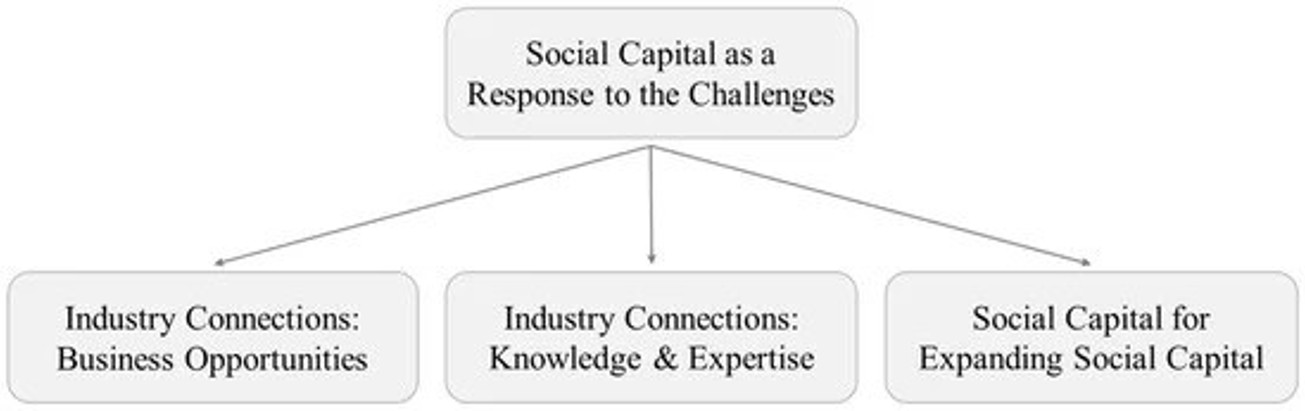
Diagram from the Article
The article emphasizes the importance of social capital in addressing the challenges faced by environmental entrepreneurs. The primary ways social capital supports startups span several dimensions:
- Access to Essential Knowledge and Expertise: Through social and professional networks, entrepreneurs can gain advice on market trends or technical insights from experienced professionals.
- Promoting Business Opportunities: Social capital facilitates strategic partnerships and customer acquisition through trusted networks.
- Securing Funding: Trust in the entrepreneur and their networks often holds more weight than traditional success metrics.
The significance of social capital is particularly pronounced in industries like Greentech and Agritech. These sectors benefit disproportionately from social capital due to their high levels of risk and often extended development cycles before achieving profitability.
Environmental ventures face greater technical challenges, market resistance, and complex regulatory hurdles compared to other industries. Social capital enables these entrepreneurs to access the collaborations, support, and trust needed to overcome such obstacles. It’s not just about what you know but who you know—networks that help navigate the complexities of these industries can make a critical difference.

From the Article
We believe this research provides valuable insights for both academia and the industry. The study encourages entrepreneurs and investors to prioritize building strong social capital and networks early in the venture’s development. Doing so can significantly improve the success rate of startups, especially in the environmental sector, where failure rates tend to be higher due to the inherent challenges.
Entrepreneurs can use these insights to develop collaborative strategies to sustain and advance their ventures over time.