


An academic program that combines practical and theoretical work on advanced topics in human-computer interaction. The programs include practical workshops with professionals from the industry such as: characterization of user experience (UX/UI) | Marketing and product management | Writing and graphic design for user experience. Courses and seminars include Ethics of User Experience | Cognitive Psychological Aspects of User Experience | User Experience in a VR Environment | Design of Physical and Digital DesignTechnologies and more.
Accessibility menu

Human Computer Interaction Specialization
Human Computer Interaction Specialization

 Dr. Noa Morag
Specialization Highlights
- Hands-on experience utilizing product design, human-centered design, and user experience (UX/UI) methodologies.
- The fully equipped product fabrication lab at the milab (Media Innovation Lab) for the advantage of our students includes software and hardware such as 3D printers, laser cutters, and more.
- Students design and prototype digital and digital - physical interfaces which are included in their portfolio
- Industry collaboration is integrated into the curriculum, with additional activities like UX Hackathons for interactive students.
Work in the industry in key positions
- Design of user experience (UX) design
- UX research
- UX writing
- Digital products management
- Product marketing in technology companies
- Product Marketing Analyst
- Customer success manager
- Management of digital projects in mobile or web start-up companies.
- UX Ethics
- Customer Success
Graduates in Product Roles in the High - Tech Industry










3rd Year HCI Projects


-

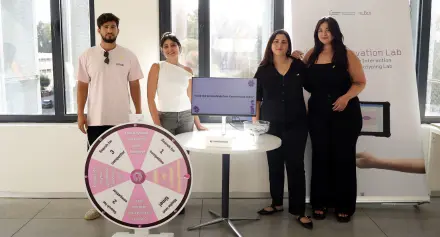
Final Project: milab UX Bootcamp
At the start of the year, high-tech companies present students with a challenge. To address this challenge, students must research, design, and develop a digital interface based on field research and the UX expertise gained in their specialization. At the end of the year, students present their solution.
-

Final Project: milab Product Marketing in Hightech companies
Students collaborate with high-tech companies to create a marketing campaign for their digital product. This project demands both analytical and creative thinking and requires students to demonstrate and present their work to the participating companies.
-

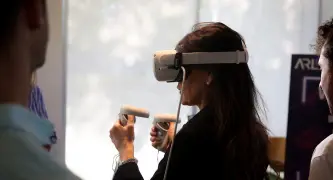
Research with the ARL
This research program introduces students to the study of immersive media interactions, including VR and AR interfaces. Students engage in research, ideation, definition, design, and production of innovative user experiences (UX) tailored to specific target audiences and markets.
-

Milab Research
This program specializes in cutting edge research in the field of human-computer interaction (HCI). We seek exceptional students who demonstrate independent learning capabilities, personal responsibility, effective task management, and a passion for research to join our lab faculty for a two-year period during their studies.
What Will You Study?
-
Our workshops in the specialization are taught by experienced industry lecturers. The goal is to provide you with practical tools and methods in the processes of define, design, development and management of technological products in technological companies in the market.
-
Digital products are now an integral part of our lives. Successful products meet a need, evoke emotion & provide simple user experience. The workshop incorporates design theory and practical hands-on experience. In this course you will learn the craftsmanship of designing great digital products, from ideas to working interactive digital applications.
-
This course will explore the key roles and responsibilities of a product marketer within a product team in the high-tech industry. The product marketer holds both internal and external responsibilities, requiring a deep understanding of the product, the user, target audiences, and the market. Their success is determined by their ability to effectively launch the product in a competitive tech environment.
-
The design of a product can make the difference between a delightful customer experience and successful product, or frustration and failure. Great products and designs rarely happen by accident. Following the interactive product design course, in this advanced class you will learn how to successfully design the user experience (UX) focusing on theories and methodologies practiced in the industry.
-
The products we interact with daily—such as social networks, mobile apps, games, and organizational systems—require product managers to understand user needs, design solutions that address those needs, and align them with business objectives. PMs are also responsible for the product's growth and adaptation over time, including measuring usage, testing different approaches, and prioritizing changes. Additionally, they must plan the product's market entry and financial justification. In this workshop, you will explore the role of a product manager through practical analysis of existing products. Building on your prior knowledge of needs assessment, target audiences, and product characterization, you will deepen your understanding of product management, business models, and marketing.
-
n the data-driven era, digital products (SaaS, IaaS, PaaS, etc.) have become key revenue drivers across industries. After launching a new product, the main challenge is maintaining market share and fueling growth. This course will focus on strategies for innovation and expanding product portfolios post-launch. We’ll cover the process of Product Acceleration, from developing a business strategy to achieving sustained growth for digital products.
-
“Next” or “Skip”? “Cancel” or “Clear”? How does your app or website communicate with users? Is it engaging or confusing? UX writing, or microcopy, plays a crucial role in guiding users through forms and processes. It addresses their questions, clarifies actions, and improves their experience. In this course, we will explore the essentials of UX writing, including voice and tone, user-centered processes, and effective writing practices.
-
This course covers the fundamentals of interface and user experience design, from research and concept development to detailed design. We will study industry best practices, analyze their application in various products and services, and practice creating designs that meet global standards. The aim is to equip students with practical skills and knowledge in user interface design. Students will learn about the design process in product companies, essential terminology, and gain practical tips for real-world job responsibilities.
-
This workshop builds on the second-year content, exploring advanced concepts and computer tools. It focuses on optimizing user decision-making, emotional motivations, and operational barriers that impact their search for information, actions, and purchasing behavior. The workshop will help you specialize in this field, enhance critical thinking and execution skills, and create professional projects by combining theory with practical application. It includes assignments, along with guidance and feedback during lessons.
-
-
The courses are taught by the School of Communication faculty and lecturers from industry. The purpose of the courses is to provide you with a broad thinking base, knowledge and critical thinking.
-
Dr. Hadas Erel
This course explores cognitive psychology theories relevant to HCI researchers and designers, covering topics like perception, attention, memory, intelligence, and creativity. Through twelve lectures and assignments, students will apply their knowledge to HCI projects. Students will learn cognitive principles crucial for HCI, enabling them to tailor their designs to human cognitive processes and evaluate existing HCI products effectively.
-
This course explores Human-Computer Interaction (HCI) which involves User Experience Design, and User Experience Research. Students will learn about the history of the field, key figures, and design principles for creating user experiences. Students will also learn how to apply theory to practice in conducting usability testing to evaluate ease of use for interactive products. Advanced topics include tangible interfaces, social robotics, and IoT, with reviews of innovative research. We’ll also examine the humanistic side of HCI, assessing technology’s societal impact. By the end, students will understand the UX design and research process in both industry and academia, and how HCI labs worldwide create groundbreaking interactions with technology.
-
In this course, we will explore various methodologies for game design, discussing the processes that lead to the creation of engaging and effective gaming experiences. The course will cover diverse characterization techniques, including user research, game experience design, game design principles, and understanding target audiences. -
Mr. Shalom Amira
Computing has transformed virtually every aspect of life, from transportation and manufacturing to communications and medicine. This course will provide a foundation in modern computing and computational thinking, covering the evolution from early calculation machines to today's advanced, interconnected technologies. Topics include computer basics, programming, the interaction between computing and the physical world, big data, the Internet, the web, cloud computing, and artificial intelligence.
-
Dr. Noa Morag
Technology shapes every aspect of the human experience and is the primary driver of social and ecological change. This course will allow students to be immersed in crucial topics of ethics and technology such as facial recognition algorithms, Search Engines, GPS technology, Online marketing, Robotics, AI, Biotech and more. Course Goals: The goal of this course is to allow prospective designers of the technology to be familiarized with a range of ethical issues raised by modern technology, to understand the importance of questioning and debating over the social and cultural implications of technology, to use ethical reasoning to make informed and principled choices, to recognize and be familiar with the language and content of ethical discourse and to understand modern debates surrounding ethics and technology
-
-
All the seminars are very practical and the knowledge you will receive will serve you in the world of work. The purpose of the seminars is to develop your methodical skills in academic research. There are annual (in the third year) and semester seminars (in the second semester of the second year).
-
In this seminar, we will examine ethical issues in AI-driven user experiences. Students will conduct both theoretical and practical research on an AI-based technology, investigating its impact and ethical concerns with a specific target audience. The process includes formulating research questions, conducting interviews, reviewing literature, collecting and analyzing data, and summarizing findings. Students will also propose and design a solution to an identified ethical challenge, including preliminary usability tests.
-
While virtual reality (VR) and related technologies advance rapidly, designing interactive VR scenarios remains a developing field with evolving rules and best practices. In this seminar, we will explore questions like: How do you craft a story in VR? What are VR’s unique affordances and how should experiments be designed around them? What are the best interaction paradigms for different scenarios? Addressing these questions involves understanding immersive technology concepts rooted in psychology and neuroscience and applying these insights to experience design. The course will emphasize hands-on experience in VR design, with exposure to wearable augmented reality (AR) devices as well. -
Humans have traditionally interacted with the world through physical touch, shaping our environment through direct manipulation. However, with the rise of keyboards, mouse, and touchscreens, many interactions with digital technologies have become more abstract and less tactile. This research seminar will investigate how to reintroduce physicality into human-computer interaction. We will explore physical digital interfaces like Tangible User Interfaces (TUIs), wearables, and robotic furniture. We will also examine how theories of embodied cognition, which link bodily experiences to cognitive processes, can guide the design of these interfaces and enhance our physical interaction with digital technologies.
-
In this seminar, students will practice designing UX with a focus on human cognition. They will learn basic cognitive principles such as attention, memory, perception, and decision-making. Students will then identify well-designed UIs that align with these principles and those that need improvement. Finally, they will create their own UIs based on the seminar's principles. By the end, students will be well-versed in cognitive principles and capable of advising on UI and technology development that aligns with human cognition.
-
-
During the third year, a final group project will be implemented that expresses the content and principles learned in the second year.
-
In this final project, students will use UX research and design methodologies like Design Thinking and Design Sprints to drive impactful change in an enterprise, small company, or community by developing and testing mobile applications that address real-world problems. They will start by applying these methods to create meaningful solutions, presenting their ideas to companies, and then refine their projects through evaluation and iteration. The course incorporates Design Thinking for Change, an evolution in Human-Centered Design, and emphasizes collaboration with industry partners to develop prototypes and implement UX research methods throughout the year.
-
In the final project, students will meet high-tech companies and build a marketing campaign for them for the digital product. Students will work in groups with each student having a designated role. Semester 1: meeting with the companies participating in the project, receiving a brief, researching competitors, learning the product, building messages and a brand. At the end of the semester, a presentation to the client. Semester B: Production of the marketing campaign for the product on the right platforms. At the end of the semester, a presentation to the client. Course goals: The project will provide students with practical experience working with real companies in the market. The students will simulate an internal marketing group within a company about the various roles that make it up, they will experience real promotion and content development.
-
For the entire list of courses please refer to the Student Handbook
*In most undergraduate programs, students are required to take general elective courses as part of their curriculum, and can also choose elective courses from other undergraduate programs at Reichman university.
**Reichman University reserves the right to cancel, alter, or expand the academic programs and courses offered.