

Between Ramallah and Tehran
By Mr. Lior Akerman | July, 2025
|
|
| Photo: kremlin.ru |
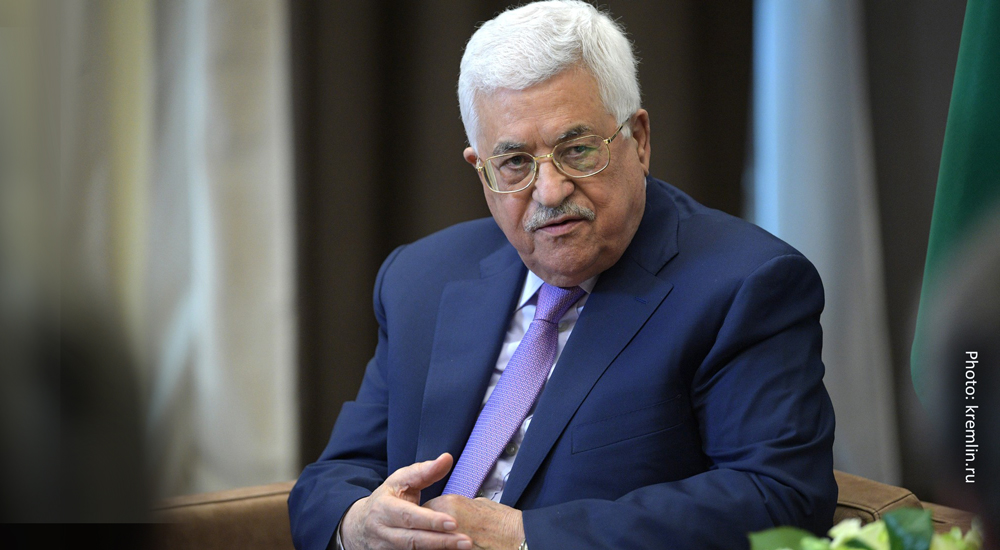
Over the last two years, Israel has been swept up by a state security whirlwind that focused on the following three fronts: The domestic, particularly the steps associated with the governmental coup and the equal sharing of the burden; the Gazan, namely the events of October 7th and Iron Swords War; and the regional, especially the war with Iran and President Trump’s attempts to renew the talks on an overall agreement in the Middle East.
As these developments unfolded, little attention has been given to the Palestinian issue, and the Palestinian Authority’s fate on the day after, when the dust of war has settled. This issue has not only been ignored due to the reasons stated above, but because overlooking it serves the policy of some members of the current government well, such as Smotrich and Ben Gvir, who wish to remove this item from the public agenda entirely, and support the complete annulment of the Palestinian Authority. Instead, they strive to claim full Israeli sovereignty over the territories in Gaza, Judea, and Samaria.
The Palestinian issue has several aspects worthy of attention:
The first pertains to the Palestinian Authority’s status and functioning – The PA has barely been present since the war began and, with the exception of some random statements by its leader, Abu Mazen, an official stance has rarely been taken by it throughout these long months of fighting. The main reason being that the IDF campaign against Hamas, which aims to topple the latter’s rule in the Gaza Strip, serves the interest of the Palestinian Authority. Nevertheless, the question of the day after has come up, and, with it, a significant problem, since Abu Mazen wishes to regain control of the Gaza Strip, whereas some members of the Israeli government refuse to allow the PA to return there, and are looking for alternatives. While some government members consider these alternatives to be international rule or foreign forces, the extremists support the establishment of an Israeli military regime, and rebuilding of Israeli communities on Gazan territories.
The second pertains to the internal power struggle over PA leadership on the day after – Abu Mazen has recently appointed Hussein al-Sheikh as his deputy and potential successor. This step gives al-Sheikh a significant advantage in the future fight for leadership of the Palestinian Authority, although he is not particularly popular on the Palestinian streets, despite having filled various high-ranking positions over the years in both the Tanzim and various Fatah political committees, and even though the international community considers him acceptable. Presumably, a struggle between high-ranking PA officials who view themselves as suitable to lead the PA toward its future will follow on the day after Abu Mazen; and a separate paper has been published on this topic several months ago. The most important aspect of this struggle will be its impact on the Palestinian Authority’s degree of strength in the post-Abu Mazen era, as well as its ability to actively enforce its rule in both the West Bank and future Gaza Strip. Nevertheless, this struggle will undoubtedly involve other senior officials who will affect developments in this area.
The third pertains to the Palestinian Authority’s status in future regional arrangements – In this context, Saudi Arabia has made it clear that it will not progress toward a regional arrangement or agreement with Israel unless an initiative is put in place to cement the establishment of a future Palestinian state, and a solution provided for this matter. For this very reason, President Trump is prioritizing the end of the war in Gaza and pursuit of a regional arrangement, and is likely to exert pressure on Israel to reach an arrangement with the Palestinian Authority too or, at the very least, to present an initiative for the PA’s return to the Gaza Strip, and a process leading toward a two-state solution.
The fourth pertains to the goings-on in the Palestinian Authority itself – Due to the ongoing weakening of the PA and its central government, local forces have emerged, and are currently leading the civil population both in the West Bank and Gaza Strip. Easily identified in Gaza are Abu Shabab’s forces, supported by the Palestinian Authority and Israel too, it seems, in their aggressive struggle against Hamas, but in a way that is building them up to be an organization of significant standing that will demand its place in future leadership in this area. In the West Bank, the disintegration is manifest in several ways: Several dozen sheikhs, representing a total of half a million civilians, have recently come together in Hebron, and demanded to be disengaged from the Palestinian Authority so that they may recognize Israel as the Jewish state, set up a separate emirate in Hebron, and join the Abraham Accords. This step is extremely dramatic, since their letter states that a Palestinian state will not be established anytime in the next one thousand years, and therefore, other solutions must be sought. The PA’s loss of control can be felt in other areas within the West Bank too, such as Jenin, Nablus, and Tul Karem, as local terror and power-seeking forces emerge, funded by Iran or various criminal families. The Palestinian security apparatuses’ attempts to fight these terror hubs have utterly failed, forcing the IDF and ISA to return in full force, and take full responsibility for thwarting their attacks.
The fifth is associated with the Israeli government’s attitude toward the PA – Since the current government has been formed, extreme right-wing ministers Smotrich and Ben Gvir have been spearheading a policy designed to fulfil their vision of ending and quashing the Palestinian Authority, fully annexing all West Bank and Gazan territories, and claiming full Israeli sovereignty over them, while expelling the Palestinians or turning them into second-class citizens. This policy has been greatly advanced since President Trump has returned to office, as the government ministers have been given the impression that he will support the fulfilment of their vision. The Israeli government policy led by Minister Smotrich considerably weakens the Palestinian Authority’s status, while providing tailwind to the extreme Jewish forces in the territories.
In addition to these seven aspects, it is noteworthy that the Palestinian Authority has never independently managed its own finances, which have been managed by Israel since its inception, whether in terms of tax collecting, import and export, energy infrastructure, or other areas. This further weakens the PA’s power and ability to maintain its status vis-à-vis both the Palestinians and others in the region, especially at a time when the Israeli Minister of Finance is doing all he can to put a dent in the Palestinian Authority’s economic capabilities.
This all means that, while the Palestinian Authority has been a weak political entity for some time, it has become weaker still in recent years, and its very existence is currently at risk. There are multiple causes for this state of affairs: the conduct and functioning of the head of the PA, Mahmoud Abbas; Israeli government policies and right-wing extremists; internal struggles within the PA; and the rising power of new local forces within the Palestinian population in both Gaza and the West Bank. At the same time, however, the Palestinian issue is being highlighted as central and crucial to the signing of any regional political agreement in the Middle East in the future, receiving tremendous support throughout the Middle East and Europe.
Under these circumstances, it is hard to predict what the future holds; however, the following several scenarios are possible:
The first is the disappearance of the Palestinian Authority in its current format, and its breakdown into various parts so that governability will be split up among several elements of national power in the Gaza Strip, and several areas in the West Bank, such as the independent emirate seeking to be established in Hebron, and the Abu Shabab forces in the Gaza Strip. Another process that may contribute to the realization of this scenario is the introduction of foreign forces into the Gaza Strip, and weakening of the PA’s potential to regain governability and control there once the war has ended. Thus, we foresee Israel having to claim full security control and governance of the Palestinians while possibly returning to the characteristics of a military regime.
The second is the strengthening of the Palestinian Authority in response to Saudi Arabia’s demand, which would lead to an American demand that Israel will reach a new arrangement with the PA. Such a process would significantly bolster the Palestinian Authority’s status both domestically and internationally, and could pave the way for a future power transition in the PA on the day after Abu Mazen. Under such circumstances, and if the power transition will be organized and not anarchical, we foresee the PA continuing to regain its strength and governability in both the West Bank and Gaza, assuming that Israel will enable its return to the latter. Thus, security control as well as governance will be reclaimed by the PA in areas B and C, and reality could be similar to present times.
The third is an interim scenario whereby the Palestinian Authority remains as a central government of sorts in Ramallah, under which are various Palestinian autonomies managed by local forces in the Gaza Strip and West Bank. Under such circumstances, Israel will have full security control in all areas; however, governance could also be left to Israel, as is the case at present in some of the Palestinian territories.
As far as Israel is concerned, the preferable scenario is one where the ISA and IDF have complete freedom of action in the Palestinian Authority’s territories, as well as terror-thwarting capabilities in collaboration with the Palestinian security apparatuses as has been the case to date in the West Bank, while governance is fully handed over to the Palestinian Authority so that the Palestinians will not become second-class Israeli citizens living in territories under Israeli sovereignty. To get there, the Israeli government must formulate a political initiative whereby its relations with the Palestinians will be arranged so as to completely disconnect them from the State of Israel, both physically by creating complete separation, and economically in terms of tax collection and energy provision. At the same time, this scenario would grant Israel full security control and broad thwarting capabilities in these areas. Any arrangement of this kind must provide a solution for the Palestinians’ future political status, whether as an independent state or some form of demilitarized autonomy.
Authored by Mr. Lior Akerman, a senior researcher at the Institute for Policy and Strategy (IPS), Reichman University.
If you wish to receive the weekly brief regularly, please follow the link to register.
