


Summary of the Review: Political Representation
This review aims to investigate the evolving perceptions of political representation among Israeli citizens, with a focus on the extent to which the public feels that the political system and its parties reflect their interests. Representation and accountability are foundational principles in any democracy: elected officials and state institutions are expected to act on behalf of the public, while citizens must feel their interests are genuinely present in the decision-making process.
Israel’s proportional electoral system, characterized by a single nationwide district and a relatively low electoral threshold, has historically enabled the existence of multiple parties, thereby theoretically allowing for broad and diverse representation. Indeed, earlier research indicated that Israelis reported relatively high levels of perceived representation and political efficacy, as well as robust voter turnout, when compared to other democracies.
Nevertheless, in recent years, Israel has experienced significant political turbulence, including five elections between 2019 and 2022, the judicial reform crisis of 2023, and the October 7th war that still goes on. These events have intensified societal polarization and have had a marked impact on public perceptions of representation. Against this backdrop, the review examines how Israelis’ sense of representation has changed during these turbulent years, and whether certain segments of the population feel less represented than others.
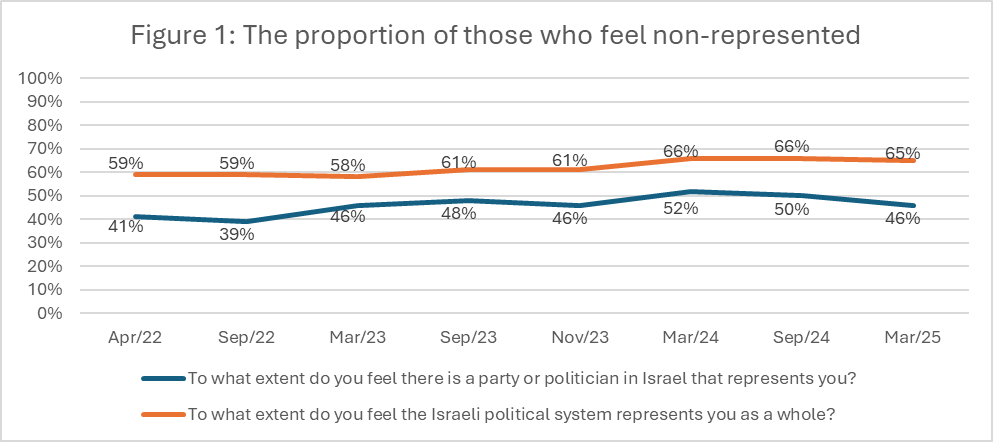
The analysis is based on eight surveys conducted between April 2022 and March 2025, comprising a cumulative sample of 12,415 respondents. Two central questions guided the inquiry: (1) To what extent do you feel there is a party or politician in Israel that represents you? and (2) To what extent do you feel the Israeli political system in general represents you?
The findings reveal a clear and troubling trend: the proportion of respondents who feel that no party or politician represents them increased from 41% in April and September 2022 (during the Bennett-Lapid) to 46% in March 2023 (amid the judicial reform protests), and further to 52% in March 2024 during the ongoing war. By March 2025, this level remained high, with only a marginal further increase. Regarding the political system, the share of those feeling unrepresented rose from 59% in April 2022 to 65% in March 2025. These results indicate periods of crisis and instability are associated with a decline in citizens’ sense of political representation, a pattern also documented in other democracies during times of upheaval.
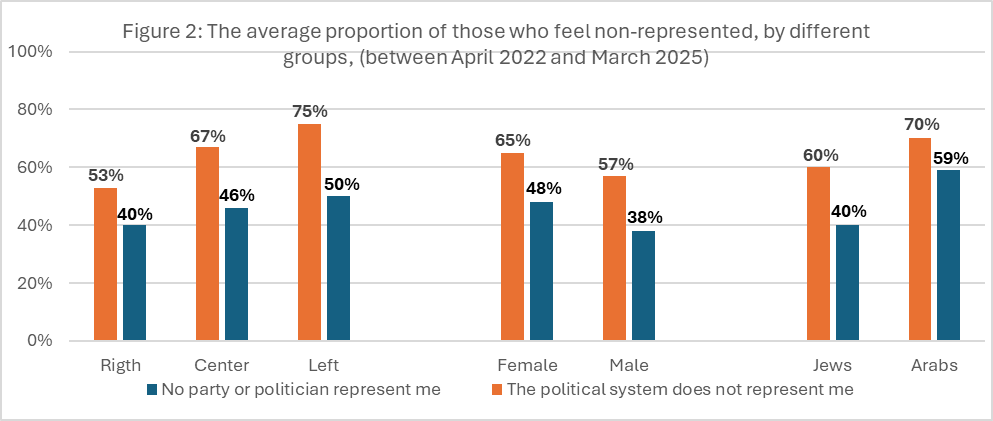
The review also highlights significant differences among various groups. Israeli Arabs report markedly higher levels of non-representation: on average, 59% feel no party or politician represents them, compared to 40% of Jews. Similarly, 70% of Arabs feel the political system does not represent them, versus 60% of Jews. Gender differences are also evident. Women consistently report higher levels of non-representation than men: on average, 48% of women feel non-represented by any party or politician, compared to 38% of men; 65% of women feel the political system does not represent them, versus 57% of men. These disparities may be attributed both to the actual underrepresentation of women in decision-making positions within the political systems. Ideological divides are pronounced as well. Those identifying with the political left report the highest levels of non-representation (50% feel no party or politician represents them, and 75% feel the system does not), followed by centrists, while right-wing respondents feel the most represented. Interestingly, during the Bennett-Lapid government period, these differences narrowed, but polarization soon returned as political crises deepened.
A cross-national comparison using CSES (comparative Study of Electoral systems) surveys shows that 47% of Israelis feel no party represents them, a rate higher than in Western democracies such as Britain, USA, Canada, Germany and Scandinavian Countries, but similar to many European nations. The growing sense of political non-representation in Israel may, over time, bring the country closer to the levels of non-representation seen in democracies experiencing significant crises.
In conclusion, the review documents a significant and growing sense of political non-representation in Israel, especially during periods of crisis. This trend is particularly pronounced among Arab citizens, women, and those on the political left, raising important questions regarding political efficacy and the resilience of Israeli democracy. Addressing this crisis of representation requires both political and institutional reforms, greater transparency, and increased public participation to rebuild trust and ensure the stability of the democratic system.