




Article by Dr. Yossi Maaravi, Dr. Boaz Hameiri, Dr. Tamar Gur-Aria, under the title:
Political ideology shapes support for the use of AI in policy-making
Cite article:
Gur, T., Hameiri, B., & Maaravi, Y. (2024). Political ideology shapes support for the use of AI in policy-making. Frontiers in Artificial Intelligence, 7, 1447171.
The study examines how political ideology (right versus left) affects people's support for the use of artificial intelligence (AI) in government decision-making and public policy. The study was conducted in the political context taking place in Israel in early 2023, after the announcement of a controversial political reform that sparked widespread protests across the country.
The main message is that there are significant differences between people with right-wing views and those with left-wing views. Left (or center-left) views regarding their perception and support for the idea that artificial intelligence will assist in administrative or policy decision-making.
The data was collected through an online survey conducted on April, 2023 by a company that provides panels of participants,703 Jewish participants resident in Israel, diverse in terms of age and gender.
Approximately 43.1% of the participants defined themselves as right-wing, approximately 24.2% as left-wing, and approximately 32.7% as center-right.
For the purpose of the analysis, the left and center groups were combined as one group (“Center-Leftists”) and compared to the right-wing (“Rightists”).
The survey asked many questions about opinions and feelings towards the use of AI in government decision-making, aspects such as the sense of effectiveness and value of AI, positive/negative feelings towards its use, level of trust and feeling of “warmth” towards the technology, and more. In addition, attitudes towards the current government were examined and the proposed reforms.
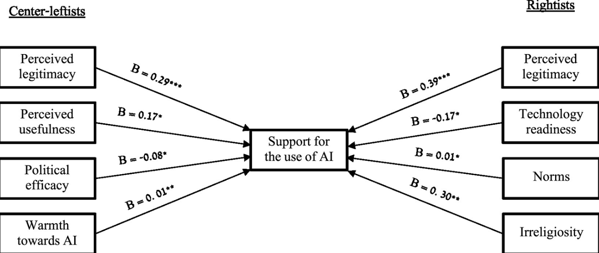
The study findings revealed clear differences in attitudes between the groups, the Center-Leftists group expressed higher levels of support for the use of AI in government decisions, had more positive feelings towards its use such as warmth, interest and less fear, and also saw AI as a useful and less dangerous tool.
In contrast, the Rightists group demonstrated lower support for the use of AI in public decision-making, felt more fear, apprehension and sometimes less openness to technological change.
No difference was found between the two groups in terms of declared knowledge of technology or in terms of their assessment of how much the public supports the use of AI (public norms).
The study also revealed that what predicts the level of support for the use of AI is not similar for the two groups, with Center-Leftists having stronger support being particularly influenced by the feeling that AI is effective and useful, a feeling of “warmth” towards artificial intelligence, and the belief that they have the ability to influence Political. For Rightists, support was more related to “social will” and norms that they find socially acceptable, as well as to the level of irreligiosity (secularism) and their affinity for technology. Interestingly, more “comfort” with general technology did not always guarantee support for this specific use of AI in government decision-making.
The study highlights the importance of political ideology in shaping opinions about the integration of advanced technologies into society and the state. This may have theoretical roots in the personality structure and different values that define the left and right, people with a left-leaning tendency are often more open to change and innovation, right-wingers tend to prefer stability, order and fear of uncertainty.
This is especially significant in the context of artificial intelligence that leads to rapid change and also raises ethical, legal and humanitarian concerns.
The main conclusions that emerged from the study showed that there is a clear gap in the positions between right-wing and left-wing people regarding support for the use of AI in policy decisions.
Understanding support is not Unambiguous but influenced by the strength of the value that each group places on different elements - usefulness, social norms, trust, and a sense of “warmth”.
The findings are important for future planning of public AI policy, as they indicate the need to treat different ideological groups differently when creating legislation or integrating technology into government decision-making areas.