




Article by Prof. Tamar Elmor and her partners, under the title:
The dual effect of board gender diversity on R&D investments
Cite article:
Almor, T., Bazel-Shoham, O., & Lee, S. M. (2022). The dual effect of board gender diversity on R&D investments. Long Range Planning, 55(2), 101884.
The article deals with a central question in the world of management and entrepreneurship: how gender diversity on the board of directors (i.e., integrating women alongside men in decision-making) affects companies' investments in research and development (R&D), a critical area for innovation, growth and competitiveness.
In recent years, interest in gender diversity on boards of directors has been growing, both for social reasons and from the understanding that this has business implications. However, the research literature is not unambiguous: some studies indicate a positive impact of women on the board, while others indicate more complex effects. The aim of the study is to examine whether gender diversity has a "dual effect" on innovation investment decisions.
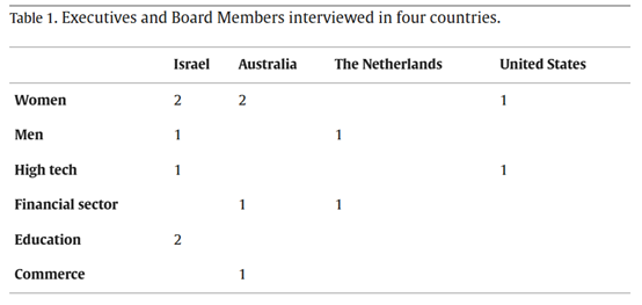
The study is based on an empirical analysis of company data, examining the relationship between the composition of the board (and especially the proportion of women on it) and the volume of investment in research and development. The researchers analyze data over time, to identify patterns and not just a point-in-time relationship.
The methodological approach combines: quantitative measures of R&D investments, data on the composition of the board, and statistical analyses that allow the effect of gender diversity to be isolated from other factors
The main finding of the study is that gender diversity on the board has a dual and complex effect on innovative investments:
The first, a positive effect - women on the board bring different perspectives, encourage broader thinking and increase the discussion around innovation. This may lead to more informed decisions and strategic investments in research and development.
The second, a restraining effect - at the same time, women on the board of directors sometimes tend to demonstrate greater caution in risk management. Since investments in R&D are inherently risky and uncertain, this may lead to a certain reduction in the volume of investments. In other words, it is not a one-way effect but a combination of encouraging innovation and financial prudence.
The article emphasizes that gender diversity is not absolutely "good" or "bad" but depends on the organizational context and the way decisions are made. Diversity contributes to the quality of discussion and multiple angles of thinking but also affects the level of risk that the organization is willing to take.
The researchers suggest understanding the board of directors as a group in which a balance exists between different approaches: an entrepreneurial approach and willingness to take risks versus a more cautious and conservative approach, the combination of the approaches may actually lead to higher-quality decisions in the long run.
The main conclusion is that gender diversity on the board of directors has a complex impact on innovation, it can improve the quality of decision-making but also to provide too risky investments. Therefore, organizations should not see gender diversity only as a social goal, but also as a strategic tool that can influence the conduct of the company.
In addition, the study suggests that managers and decision-makers understand this dynamic and exploit it wisely, that is, to integrate diversity while being aware of its effects on the level of risk and innovation.