




Article by Dr. Tamar Yogev and Dr. Yael Parag, under the title:
Managing uncertainty through middle actors in energy entrepreneurship and innovation: Insights from Israel and the United States
Cite article:
Parag, Y., & Yogev, T. (2026). Managing uncertainty through middle actors in energy entrepreneurship and innovation: Insights from Israel and the United States. Energy Research & Social Science, 135, 104653.
The article addresses the question of how innovation and entrepreneurship in the energy sector can be promoted in a period characterized by high economic, regulatory, political, and technological uncertainty. The researchers examine the role of what they call “middle actors” - entities that stand in the middle between the government and entrepreneurs and young companies, and act as intermediaries, connectors, and promoters of innovation within the energy ecosystem.
The study focuses on two main foci: Israel and the United States. In Israel, the organizations Ignite the Spark and EnergyCom were examined, and in the United States, the Center for Innovation and Entrepreneurship of the National Energy Laboratory (NREL) was examined. The researchers specifically chose these organizations because they operate in highly active, but also complex and unstable innovation environments. The goal of the study was to understand how these “intermediate players” help startups and entrepreneurs cope with conditions of uncertainty and rapidly changing markets.
Methodologically, this is a comparative qualitative study. The researchers used cross-case comparison and AI tools that helped map the strategies and actions of these organizations. They analyzed public information, statements, activities and initiatives of the various bodies, and examined how they affect the innovation environment in three main dimensions:
• Assistance and empowerment of startups and entrepreneurs.
• Mediation between different actors, for example between governments, investors, companies and entrepreneurs.
• Concentration and accessibility of knowledge, connections and resources.
One of the key concepts in the article is VUCA, an environment characterized by volatility, uncertainty, complexity and ambiguity. The researchers claim that the energy sector today is affected by all four of these elements: changing regulation, geopolitical crises, price fluctuations, technological competition and rapid changes in environmental policy. In such a reality, it is very difficult for entrepreneurs to act alone. Therefore, these “intermediary actors” become a critical factor that provides relative stability and enables coordination between the various factors in the system.
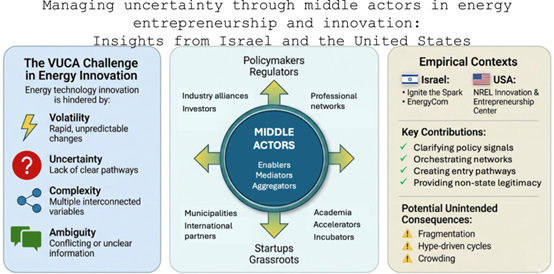
The research findings show that intermediary organizations play several particularly important roles. First, they help entrepreneurs better understand policy directions and market needs, thus reducing uncertainty. Second, they create networks of collaboration between different actors – companies, researchers, governments and investors – and thus strengthen the entire ecosystem. In addition, they give entrepreneurs legitimacy and credibility, which is especially important in a field like energy, where there are high barriers to entry and significant costs.
However, the article does not present an ideal picture.
The researchers emphasize that these organizations may also have negative consequences. Sometimes they may create “hype” around certain areas, cause fragmentation in the innovation system or push smaller players out. In other words, the same mechanisms that promote innovation can also create burdens, unbalanced competition or dependence on intermediary bodies.
In conclusion, the article argues that in order to deal with the climate crisis and promote a transition to clean energy, it is not enough to rely only on governments (“top-down”) or only on entrepreneurs from below (“bottom-up”). The intermediary entities that connect all parts of the system are also of enormous importance. The study contributes to a broader understanding of energy innovation processes and shows how more resilient and flexible innovation systems can be built in a time of global uncertainty.