




An article by Prof. Dafna Kariv and her research partner under the title:
Emotional resources and knowledge management: a gender perspective on human-centric innovation amidst crises
Cite article:
Audretsch, D. B., & Kariv, D. (2025). Emotional resources and knowledge management: a gender perspective on human-centric innovation amidst crises. Journal of Knowledge Management.
In times of crisis, innovation in ventures declines, as entrepreneurs avoid the risk and costs involved in developing innovation and wait until the situation calms down. But a venture without innovation loses its relevance. Therefore, ventures struggle to mobilize technology, funding, and opportunities to continue developing innovation at all costs.
New research reveals that this is not the case among female entrepreneurs. Their driving force for developing innovation during a crisis is not directly directed towards the search for technology or funding, but rather lies in their self-perception of their mental health.
A new study led by Prof. Dafna Karib from the Adelson School of Entrepreneurship at Reichman University, and Prof. David Oedrich from Indiana University, USA, published in the prestigious journal of Knowledge Management, has revealed a connection between developing innovation in times of crisis and mental health – among female entrepreneurs.
Questionnaire findings from a large sample of 464 Israeli entrepreneurs, founders of technological ventures, men and women, who were in the midst of complex crises, and in-depth interviews, indicated high levels of personal mental health perception among women relative to men, on a continuum of issues such as: psychological, mental, functional, physiological, and lifestyle health, both during and after crises. However, the interesting point is that in a crisis, men's self-perception of mental health decreases dramatically, while there is no change in women's perception of health. It seems that the turbulent situation outside is not It is expressed in their perception of their personal abilities.
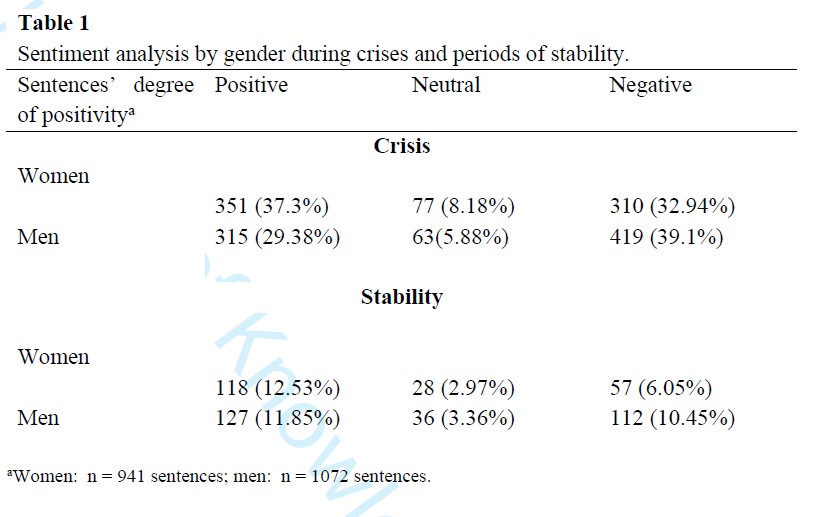
From the Article
The study shows that this feeling of strong mental health, in all its forms, creates among women, especially in times of crisis, a sense of competence, a sense of 'I am on top of things', and an incentive to act in a focused, effective and reality-adapted manner in order to develop innovation, with the uniqueness of the study being in the understanding that it is precisely in times of crisis that women dare to leverage opportunities that they avoided before the crisis. For example, women turn to investors more precisely during a crisis, compared to times that are not crises.
It turns out that the perception of mental health is a powerful driving force among women, especially during a crisis. The researchers explain that since during a crisis the perception of men's mental health declines, women feel more responsible, or conversely, they dare more (when competition is more balanced) and are therefore more active in bringing all the resources required to produce innovation.
The study was based on a combination of qualitative and quantitative research methods. The qualitative part also used advanced analysis tools based on artificial intelligence, which revealed sentiments beyond the content of the interviews. It was discovered that women are not afraid of crises, while men are, and that women express positive sentiments and leverage crises to reduce the gap in developing innovation compared to men.
Hence, the self-perception in terms of mental and general health, especially among women, allows them to achieve entrepreneurial achievements in crisis situations.
The study calls for a change in research and practical approaches to developing innovation during times of crisis, and suggests balancing the perception of innovation, which is mainly technology-focused, and adopting a person-centered approach, which emphasizes the contribution of entrepreneurs' resources and emotional abilities as a central component in generating innovation. The study also makes it clear that women are a significant force in times of crisis, since they maintain mental and general health resilience and can therefore be relied on.
The researchers recommend integrating emotional abilities as a dynamic capability in knowledge management processes, with the aim of creating a strong framework for sustainable innovation even in crisis conditions.