




Article by Prof. Tamar Almor & partners, under the title:
Maturing Born Globals and Their Acquirative Behavior
Cite article:
Øyna, S., Almor, T., Elango, B., & Tarba, S. Y. (2018). Maturing Born Globals and Their Acquirative Behavior. International Business Review, 27(3), 714-725.
The article deals with the phenomenon of companies called Born Globals, that is, companies that enter international markets at a very early stage of their activity, in contrast to the traditional model in which companies first develop in the local market and only then expand abroad.
The study focuses on a later stage in the life of these companies, the maturing stage and examines how they use acquisitions of other companies as a tool for growth and development.
The main goal of the study is to understand how born global companies change over time, and in particular how their strategic behavior develops when they are no longer young companies. Specifically, the researchers examine the acquisition patterns of these companies, that is, when, how and why they acquire other companies and what motivates this behavior.
The study is based on an empirical analysis of data about born global companies, using information on acquisitions they have made over time. The researchers examined companies from different countries and compared various characteristics such as company age, international experience, scope of activity, and type of acquisitions carried out. Through this data analysis, they attempted to identify recurring patterns and draw conclusions about how these companies mature and develop.
One of the key findings is that as born global companies mature, they tend to use acquisitions more as a growth strategy. That is, instead of relying solely on organic growth (internal development), they begin to acquire other companies to expand their operations, enter new markets, or obtain knowledge and resources.
In addition, it was found that the international experience that companies accumulate over time affects the way they make decisions. Companies with more international experience tend to make acquisitions in a more calculated and strategic manner. They learn from experience and develop more complex management capabilities.
The study also shows that not all acquisitions are the same, some are aimed at obtaining technology, others at expanding the market, and others at strengthening existing capabilities. In other words, there is diversity in the objectives of acquisitions depending on the stage of development of the company.
The discussion in the article emphasizes that born global companies do not remain "young" in terms of Strategically. Over time, they adopt behaviors that resemble larger, more established companies, such as using acquisitions as a key tool for growth. At the same time, they still maintain unique characteristics, such as flexibility and the ability to operate quickly in international markets.
The researchers note that the transition from organic growth to acquisitions is not accidental but stems from the need to cope with global competition and continue to grow in a complex environment. Acquisitions allow them to shorten processes and gain advantages quickly.
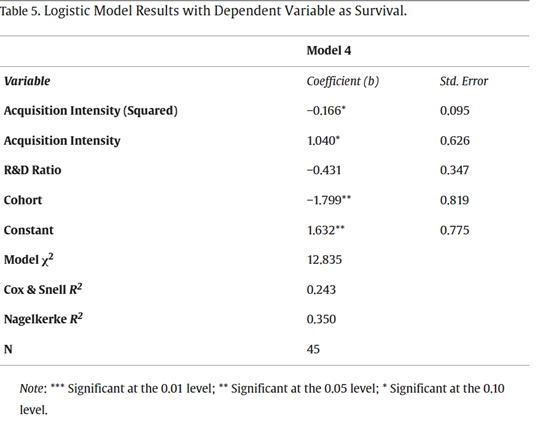
The main conclusion of the article is that born global companies undergo a process of strategic maturation, during which they adopt more advanced tools for growth, primarily acquisitions. This behavior is influenced by the experience they gain and the need to deal with global challenges.
The article contributes to a broader understanding of the development of young international companies and shows that although they start out differently from traditional companies, over time they approach larger companies in their behavior patterns while still maintaining advantages Unique.