




An article by Prof. Dafna Kariv and her colleagues, under the title:
Fostering Entrepreneurial intentions: exploring the interplay of education and endogenous factors
Cite article:
Kariv, D., Giglio, C., & Corvello, V. (2025). Fostering Entrepreneurial intentions: exploring the interplay of education and endogenous factors. International Entrepreneurship and Management Journal, 21(1), 17.
The study addresses a central question, how do entrepreneurial education programs and people's internal qualities (such as a sense of self-efficacy and control) affect their desire to be entrepreneurs?
In the research landscape in the field, there are conflicting results regarding the impact of entrepreneurial education, with some studies showing that it increases students' intention to start a business, and some not finding such a clear impact.
The researchers chose to examine not only the impact of entrepreneurial education itself, but also how internal variables of the individual affect the relationship between education and entrepreneurial desire. These variables are called endogenous, that is, internal factors related to self-perception and the way a person perceives their abilities to deal with challenges.
The study is based on the Theory of Planned Behavior, one of the leading theories in the field of social psychology for understanding behavioral intentions. It claims that in order to understand why people intend to perform a certain action (such as starting a business), several indicators need to be examined:
-Their predisposition to do so.
-Their belief that they have the ability to do it.
-Their perception of what the people around them expect of them.
In this framework, the researchers seek not only to examine whether entrepreneurial education is related to entrepreneurial intention, but how it is related and what personal traits play a role. The analysis was based on data collected as part of a large survey of Italian students, some of whom took part in an entrepreneurial education program as part of their studies, and some of whom did not.
The researchers used two main approaches to analyze the data:
PLS-SEM - an advanced method for analyzing relationships between complex variables.
fsQCA - a method that uses group logic to identify patterns of conditions that lead to a particular outcome.
Combining the two methods allows us to study not only the direct relationship between variables, but also complex configurations of factors that together exert an influence.
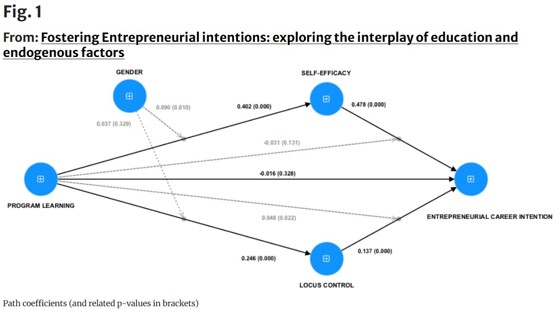
The researchers found several key findings,
-Positive impact of entrepreneurial education - The study found that entrepreneurial courses and training do indeed have a positive impact on students' desire to develop a business in the future, but this impact does not stem only from the education itself, but also from internal characteristics of the individual (such as self-confidence and assessment of one's personal ability to deal with risks).
-The importance of internal variables - variables such as locus of control (the belief that your successes and failures are in your hands) and a sense of self-efficacy were significant contributors to entrepreneurial intention and sometimes even increased the impact of entrepreneurial education.
-A combined model provides a better explanation - The study demonstrated that combining psychological theory with the statistical model allows for a more complete and correct understanding of the phenomenon, meaning that when analyzing only entrepreneurial education without taking into account internal factors, an important part of the picture is missed.
The researchers emphasize that instead of just striving to offer more entrepreneurial courses, it is also important to examine how these courses affect students, especially in terms of building self-confidence, awareness of personal abilities and understanding risks.
They suggest that educational institutions have an important role not only in teaching technical knowledge, but also in developing personal capabilities related to entrepreneurship, for example, cultivating an active approach to dealing with failures, or the ability to take informed risks.
Entrepreneurial education is important, but not enough on its own; it only influences the desire to be an entrepreneur when it also considers the person's internal perceptions and capabilities.
Curricula should also incorporate personal development, not just professional knowledge.
Multivariate analysis provides a deeper picture and combining different analysis methods can illuminate patterns that are not visible with traditional methods.