




Article by Prof. Tamar Almor et al., under the title:
Encouraging environmental sustainability through gender: A micro-foundational approach using linguistic gender marking
Cite article:
Shoham, A., Almor, T., Lee, S. M., & Ahammad, M. F. (2017). Encouraging environmental sustainability through gender: A micro-foundational approach using linguistic gender marking. Journal of Organizational Behavior, 38(9), 1356-1379.
The article addresses an important and practical question, what makes organizations adopt proactive environmental sustainability policies? While many studies have examined the relationship between sustainability and financial performance, the results are not unambiguous. That is, it is not always clear that environmental investment pays off in the short term.
The researchers offer a different perspective, the micro-foundations approach. Instead of asking only about the characteristics of the organization as a system, they examine how specific individuals within the organization, and in particular board members, influence the organization's behavior. The central question is: Does the mere presence of women on the board of directors affect the company's level of environmental commitment? And does the culture of the country, as reflected in language (and especially in grammatical gender marking), affect the representation of women on boards of directors and thus indirectly on sustainability?
The study is based on a large and unusually large sample, approximately 4,500 companies from 71 countries in 52 different industries over 7 years (2007–2013), a total of approximately 17,800 company-year observations.
The sustainability data was taken from the Thomson Reuters Environmental Index (EN Rank), which is ranked between 0 and 100. In addition, the researchers examined the level of reporting of the companies according to the GRI standard, that is, how transparent and reporting the company is on its environmental activities.
Regarding gender, the proportion of women on the board of directors was examined, whether there is at least one woman / whether there are at least three women
Another innovative aspect is the measurement of culture through grammatical gender marking in language. The researchers created an index (GII) that examines the extent to which a language emphasizes a distinction between male and female (for example, the number of grammatical genders, distinctions in pronouns, etc.). The idea is that language reflects deep cultural patterns, which may Influence perceptions of gender and women's roles.
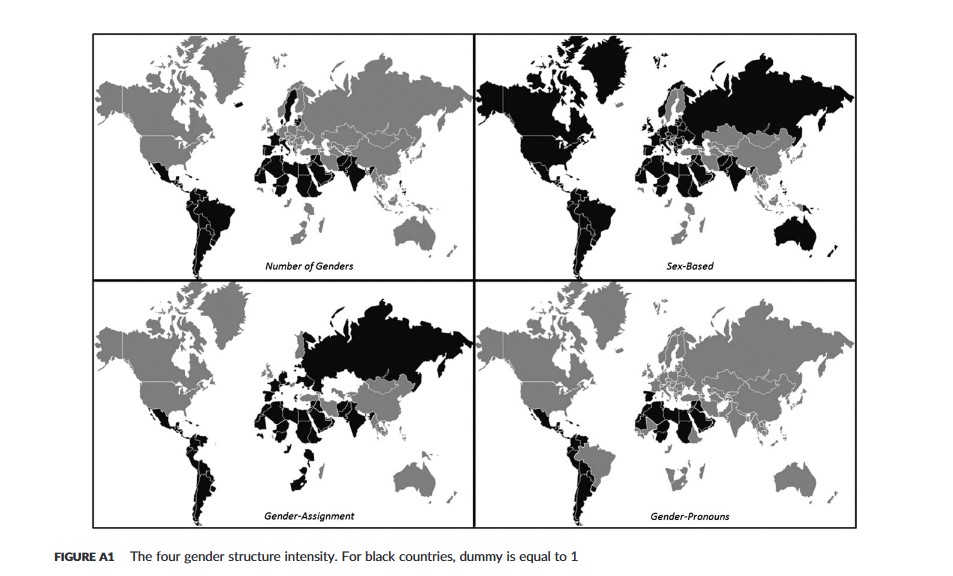
Key findings from the study include:
The presence of women on the board is significantly associated with higher levels of sustainability - even the presence of just one woman on the board significantly increases a company's sustainability rating.
The more women on the board, the higher the level of environmental reporting and transparency - companies with three or more women tended to report more and demonstrate higher commitment.
Languages with strong gender marking are associated with lower representation of women on boards - that is, in cultures where the language emphasizes a clear gender distinction, there are fewer women in senior management positions.
The effect of language on sustainability is indirect - the gender marking in language affects the number of women on the board - which in turn affects the level of sustainability.
The findings remained stable even when the researchers controlled for additional factors such as company size, gross national product, gender pay gaps, level of education and more.
The study contributes to the discourse The academic field has two main levels: first, a theoretical contribution, the study demonstrates how an individual-level characteristic (gender of a board member) can influence a broad organizational outcome (environmental policy). In doing so, it strengthens the micro-foundations approach to management.
Second, a cultural-linguistic contribution, the study offers an innovative measure for measuring culture through the structure of language, rather than relying solely on surveys.
From an applied perspective, the conclusion is clear: if an organization wants to improve its environmental commitment, changing the composition of the board, and especially including women, is a relatively simple and feasible move, compared to trying to change deep-rooted cultural norms.
The study shows that gender diversity is not only a matter of social justice, but also a real strategic lever for promoting environmental sustainability.