




Process innovation is technology transfer too! How entrepreneurial businesses manage product and process innovation
Cite article:
Kariv, D., Krueger, N., Kashy, G., & Cisneros, L. (2024). Process innovation is technology transfer too! How entrepreneurial businesses manage product and process innovation. The Journal of Technology Transfer, 49(5), 1762-1786.
The article deals with the research field of business innovation and in particular with the question of how entrepreneurial companies manage two types of innovation:
Product innovation - the innovation of new products or services for customers.
Process innovation - improving the ways in which a company develops, produces or delivers products and services.
The study addresses an interesting claim: Although process innovation is critical to improving business performance and competitiveness, most previous studies have focused only on product innovation. The researchers sought to better understand the factors that drive both product and process innovation—and to show that process innovation is not just a “technology transition” but an important and active part of entrepreneurial activity.
The study attempts to determine which factors influence whether an entrepreneurial company will lead both product and process innovation.
What is the role of relationships with external stakeholders?
How do growth aspirations influence the choice of a collaborative versus a more conservative approach?
The researchers focused on two types of strategies:
Bridging - a bridging approach and creating collaborations with external parties (e.g. collaborations with customers, suppliers, universities, etc.).
Buffering - a more conservative approach, which focuses on maintaining confidentiality, independence, and lack of information sharing.
The study is based on two main research approaches:
Quantitative methods - a large survey, the researchers surveyed 509 business owners and entrepreneurs in Quebec, Canada, and asked them about management strategies, relationships with external factors, and innovation they implement.
Qualitative methods - case studies and interviews, in addition to the quantitative data, the researchers analyzed several companies and interviewed managers to understand in depth the way in which different strategies affect innovation. This way, the researchers were able to examine not only whether there is a connection, but also how it actually arises.
The study has several main findings, product innovation and process innovation are not born in the same way
The study revealed that there are important differences between them.
The Bridging approach is associated with high levels of both product and process innovation, meaning that relationships with external factors help to improve overall innovation.
On the other hand, process innovation in particular also attracts Buffering responses, companies maintain secrecy and lack of transparency to maintain a competitive advantage.
Process innovation reveals the weaknesses of the company, when a company focuses on process innovation, it may feel more vulnerable because it is developing new skills and processes within the organization and this requires caution and protection of strategic assets.
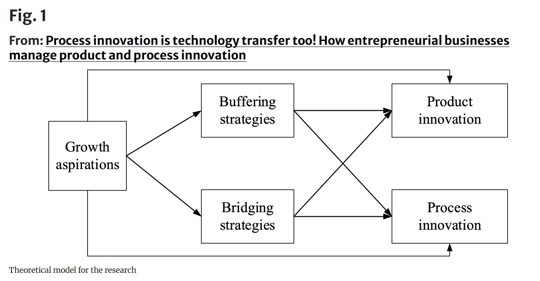
The study found that the growth aspirations of managers and entrepreneurs also affect the way they choose to manage innovation, entrepreneurs with high growth aspirations tend to perform more bridging with partners.
Entrepreneurs who prefer independence are more prone to Buffering.
The researchers highlight interesting points, most studies in the field have focused on product innovation only, but process innovation is no less important for achieving a competitive advantage. Developing an innovative process can be like “transferring technology within the organization”, it requires learning, sharing knowledge, and dealing with weaknesses within the business. The decision whether to work in collaboration with partners or to maintain independence is related not only to resources but also to the strategic goals of the entrepreneur.
The study also revealed that process innovation is "not considered" innovation in the eyes of the ecosystem, for example in the eyes of investors, banks, angels and strategic partners, and therefore they refrain from providing financial, infrastructural or technological assistance to ventures to develop innovation in the venture's processes. They will allocate assistance only when it comes to innovation in the product that the venture is developing. For their part, ventures are actually aware of the financial, cash flow and image significance of innovation in the process, but since they receive refusals to finance such innovation, they are afraid to raise the issue with investors and other partners in the ecosystem, thus creating a total concession in the development of process innovation, compared to the development of product innovation.
The light at the end of the tunnel came from the entrepreneurs' focus on sustainability. The findings showed that once there is an opportunity to contribute to sustainability, entrepreneurs will do everything in their power to create process innovation, and will insist on receiving assistance and funding from the ecosystem to implement it. From this, the researchers concluded that although entrepreneurs are aware of the benefits of process innovation and understand its implications for the profitability of the venture, due to the cold shoulder of the ecosystem towards financing and assisting in the development of process innovation, entrepreneurs will also give up on it. However, if it can also contribute to sustainability, entrepreneurs will not compromise on it.
Beyond the research topic, the analysis of the research findings itself was innovative, since it relied on both statistical analysis and analysis using NP methods in AI.