



A new study by Dr. Yossi Maaravi and Dr. Tamar Gur-Aria, under the title:
The algorithm of friendship: literature review and integrative model of relationships between humans and artificial intelligence (AI)
Cite article:
Gur, T., & Maaravi, Y. (2025). The algorithm of friendship: literature review and integrative model of relationships between humans and artificial intelligence (AI). Behaviour & Information Technology, 1-21
The article examines a growing phenomenon in the digital age: people are not just using artificial intelligence (AI) as a technical tool but are developing real emotional connections with it. As AI systems become smarter, more empathetic, and more present in everyday life, in chatbots, voice assistants, mental health apps, and social robots, the connections they form with humans are also growing.
The aim of the study was to systematically map the existing knowledge on human-AI relationships: what causes them to arise, what types of relationships develop, and what their implications are for people and society. The researchers sought to propose an integrative model that organizes the field and allows us to understand the big picture, not only through a consumer or technological prism, but also psychological and social. The study is based on a “systematic literature review” of 38 peer-reviewed empirical studies. The researchers searched for articles in major academic databases (such as ProQuest, Web of Science, and EBSCO), using combinations of terms such as “Friendship,” “Attachment,” “Intimacy,” “Anthropomorphism” along with “AI.” The filtering process was rigorous, with hundreds of initial articles gradually narrowed down by examining titles and abstracts, until only studies that directly addressed emotional connections between humans and AI agents remained.
The articles were then analyzed in depth according to four main dimensions:
1. The theoretical basis (which theories explain the relationship)
2. The factors that precede the formation of a relationship
3. The types of relationships that develop
4. The consequences of these relationships
Key findings:
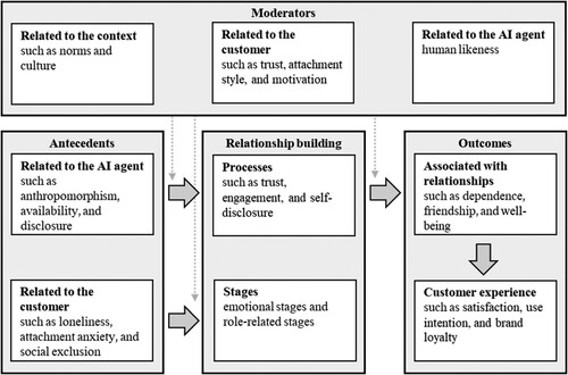
What causes people to bond with AI? The researchers identify three types of factors:
Human factors - loneliness, need for connection, tendency to trust, fear of judgment, or a sense of technological competence. People who feel lonely or are looking for a listening ear are more likely to develop an emotional connection with AI.
Characteristics of AI - anthropomorphism (resemblance to a person), empathy, warmth, a smile, a consistent "personality" and constant availability. The more human and understanding the AI is perceived as - the greater the chance of a relationship.
Environmental factors - the role assigned to the AI (friend? helper? therapist?), the influence of the social environment and the framework of use.
What types of relationships are formed? The review reveals a wide range of relationships:
From superficial acquaintance or a general sense of psychological closeness, through friendship and emotional support, to intimate and romantic relationships. Some people described AI as a “good friend”, a “therapist”, and even a partner. Interestingly, most of the theories explaining these relationships are taken from the world of human-human relationships (such as attachment theory), which suggests that we also activate similar psychological mechanisms towards machines.
What are the consequences? The effects are not unambiguous. There are positive effects: Reduced loneliness improved mental well-being, reduced stress, a sense of support and availability. Mixed and negative effects are possible: increased satisfaction with products, increased purchase intention, brand loyalty, dependence or addiction, damage to the sense of identity, privacy concerns, distancing from human connections, potential for manipulation by organizations.
The researchers emphasize that human-AI relationships are no longer a marginal phenomenon, but an expanding social reality. These relationships can be a significant source of support, especially in situations of loneliness or lack of human response but can also create complex ethical and social risks.
Future studies should examine which types of relationships are more common in different populations, who benefits from these relationships and who may be harmed, and how AI can be designed responsibly that promotes well-being and does not exploit vulnerability.
The key conclusion is that the question is no longer whether people will develop relationships with AI – but rather how society will choose to manage, regulate, and shape these relationships in an ethical and beneficial way.