




Article by Prof. Tamar Elmor and Dr. Mark Lehrer, titled:
Startups internationalizing in quest of a business model: The global prospecting of process niche firms
Cite article:
Lehrer, M., & Almor, T. (2022). Startups internationalizing in quest of a business model: The global prospecting of process niche firms. Journal of International Management, 28(1), 100906.
The article deals with a growing phenomenon in the world of entrepreneurship, startups that embark on international operations at very early stages of their lives, before they even have a clear and coherent business model. The study focuses on a specific type of company called “process niche firms”, that is, companies that develop innovative solutions or processes in very focused areas and try to find a suitable market for them around the world.
The goal of the study is to understand how such companies use international activity not only to sell, but also as a tool for discovering and developing their business model. In other words, instead of seeing internationalization as an advanced stage after establishment, the study presents it as a central tool for learning and experimentation.
Methodologically, the study is based on a qualitative analysis of several startup cases. The researchers examined the companies’ decision-making processes, their patterns of activity in different markets, and the way they learned and developed over time. They relied on interviews, organizational data, and other sources to understand the dynamics of the internationalization process.
One of the key findings is that companies do not enter foreign markets just to expand, but to “test” where their solution is most suitable. This process is referred to in the article as “global prospecting,” that is, scanning different markets in order to identify opportunities, potential customers, and the fit between the product and needs. The companies conduct experiments in several countries simultaneously, and sometimes even change their product or service according to the feedback they receive.
In contrast to the traditional view of internationalization as a linear phase (first the local market, then nearby markets, and then distant ones), the study shows that the process is much more dynamic and nonlinear. Companies jump between different markets, leaving markets that are not suitable, and focusing on those that show higher potential. In other words, internationalization is part of a continuous trial and error process.
In the discussion, the researchers emphasize that this approach changes the way we understand international entrepreneurship. Instead of seeing the business model as something that is predefined and then implemented, here it is an evolving process. The business model itself is built while operating internationally. In addition, the study emphasizes the importance of flexibility, rapid learning, and adaptability as critical factors for success.
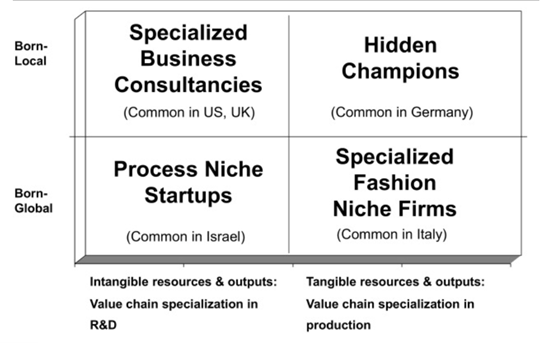
The conclusions of the article are that for startups, especially in innovative and focused fields, early internationalization can be a significant advantage. It allows exposure to a wide range of customers and markets, accelerates the learning process and increases the chance of finding a match between the product and the market. However, it also requires resources, complex management skills and dealing with high uncertainty.
In conclusion, the study offers a new perspective on the internationalization process of startups: not as a final stage of growth, but as a key tool for developing and solidifying the business model. This insight can be very important for both entrepreneurs and investors, as it emphasizes the need to think about international markets from the very first stages of establishing the company.