




An article by Dr. Yossi Maaravi and Dr. Tamar Gur-Arie, under the titled:
How Practitioners Decide When to Move First in Negotiations: Insights into Their Approach and Reasoning
Cite article:
Maaravi, Y., & Gur, T. (2025). How Practitioners Decide When to Move First in Negotiations: Insights into Their Approach and Reasoning. Humanities and Social Sciences Communications, 13(1), 58.
The article examines a fundamental yet important question, Is it advantageous to make the first move in negotiations, or is it better to wait for the other party to initiate? If so, why and how do professionals who negotiate regularly as part of their work make this decision?
In classic academic negotiation research, many studies emphasize the importance of making the first offer. The rationale behind this is the anchoring effect - the idea that the first offer creates an "anchor" that shapes the direction of the negotiation and may lead to more favorable outcomes for the party who sets it.
However, real-world evidence suggests a more complex picture. Experienced negotiators often argue that it can be strategically wiser to wait and allow the other party to move first. This creates a gap between what academic literature typically recommends and what practitioners actually do in practice a phenomenon referred to as the "researchers versus practitioners paradox". The article explores this gap by examining the perspectives and reasoning of professionals who negotiate as part of their careers.
The study addresses two central questions:
What are professionals’ preferences regarding who should make the first move in negotiations?
Under what circumstances do they choose to initiate, and when do they prefer to wait and what reasoning guides these decisions?
To investigate these questions, the researchers conducted semi-structured, in-depth interviews with 49 professionals who regularly engage in negotiations as part of their work. Participants were asked about their preferences, experiences, and the factors influencing their decision of whether to make the first offer. The sample consisted of two groups: 30 Israeli professionals (Study 1A) and 19 international experts (Study 1B). Each interview lasted approximately 30 minutes, was recorded, and collectively generated more than 350 pages of qualitative data. The researchers employed qualitative thematic analysis, identifying recurring patterns and organizing responses into key thematic categories.
The findings reveal that approximately 23% of respondents generally prefer to make the first move, 43% prefer to wait for the other party to initiate, and about 33% adopt a situational approach sometimes initiating and sometimes waiting, depending on the specific context.
The researchers identified several major categories of considerations underlying these choices.
Considerations supporting making the first offer include: Leveraging the anchoring effect to set the negotiation range. Reducing large initial gaps between offers and steering the discussion toward a more focused outcome. Exercising strategic influence by defining the bargaining range early.
Considerations supporting waiting for the other party to initiate include: Gaining valuable information about the other party’s expectations before committing to a position. Concern that making the first offer may anchor one’s own position and reduce flexibility later in the negotiation. The desire to foster trust and relational balance.
In addition, many professionals emphasized that context matters. Even negotiators who generally prefer one approach may shift their strategy depending on the type of negotiation, the relationship between the parties, prevailing norms, or situational dynamics.
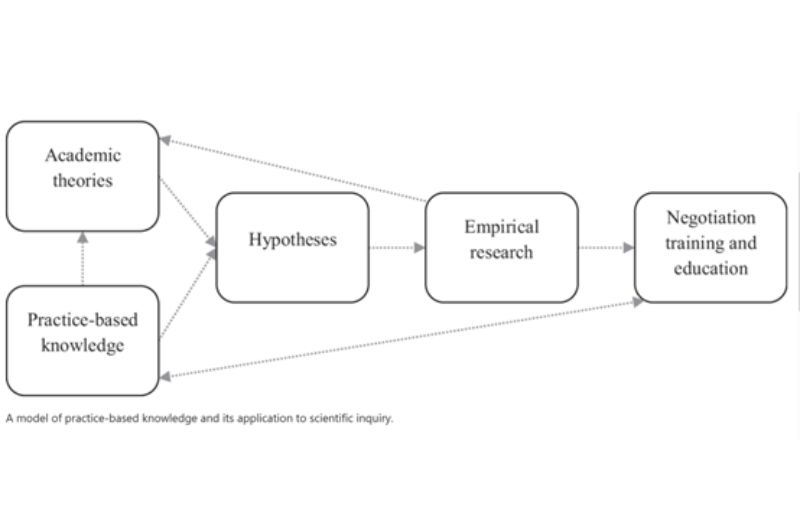
Overall, the study highlights a clear gap between laboratory-based academic findings and real-world professional practice. While experimental research often demonstrates the advantages of moving first, primarily through the anchoring effect, practitioners operate in more complex environments where informational, relational, emotional, and strategic considerations play a critical role. In many situations, waiting may be more advantageous.
The authors conclude that negotiation research would benefit from greater integration of field-based studies that capture the realities of professional negotiations, rather than relying solely on controlled laboratory experiments. Their findings offer a more nuanced model for understanding the decision of whether to move first in negotiations, one that extends beyond anchoring alone and incorporates contextual and interpersonal factors.
To the article >>> https://www.nature.com/articles/s41599-025-06356-9