




Article by Prof. Tamar Almor and Dr. Yifeng Liu, under the title:
How culture influences the way entrepreneurs deal with uncertainty in inter-organizational relationships: The case of returnee versus local entrepreneurs in China
Cite article:
Liu, Y., & Almor, T. (2016). How culture influences the way entrepreneurs deal with uncertainty in inter-organizational relationships: The case of returnee versus local entrepreneurs in China. International Business Review, 25(1), 4-14.
The study addresses the broad question of how culture influences the ways in which entrepreneurs deal with uncertainty in inter-organizational relationships, that is, in situations where businesses and organizations interact with each other in complex markets. The study focuses on comparing two types of entrepreneurs in China, local entrepreneurs - people born, having grown up and worked in China their entire lives, returnee entrepreneurs are people who studied or worked abroad (mainly in the West) and returned to China to start companies or lead ventures.
The central assumption of the study is that the perception of uncertainty and its responses differ between Western and Eastern cultures, and this has an impact on the way entrepreneurs manage collaborations, make business decisions, and interact with suppliers and business partners.
Before we address the results, it is worth understanding what is meant by uncertainty. Business uncertainty refers to a situation in which information is unclear or incomplete, and decisions need to be made despite not knowing for sure what the future outcome will be. In such situations, the entrepreneur must choose how to interpret and solve the problem, whether to act analytically, strategically, emotionally, or intuitively.
The study bases the work on Milliken's model, according to which uncertainty is not a single variable but consists of three aspects:
Environmental uncertainty, what is unclear in the environment in which the entrepreneur operates
Impact uncertainty, what will be the consequences of decisions
Response to uncertainty, how one reacts to unexpected situations.
The study is not experimental in the sense of a laboratory experiment or large-scale statistics, but rather qualitative research with observations and case studies. The researchers examine examples of businesses in China, some local entrepreneurs and some "return" entrepreneurs, they analyze the ways in which their business manages uncertainty in relationships with suppliers and business partners and identify different cultural patterns.
The choice to focus on existing examples allows for a deeper understanding of thinking processes, perception and response to complex situations, instead of just measuring quantitative numbers. In other words, the study is not about an experiment with hundreds of participants, but about a deep cultural understanding of entrepreneurs.
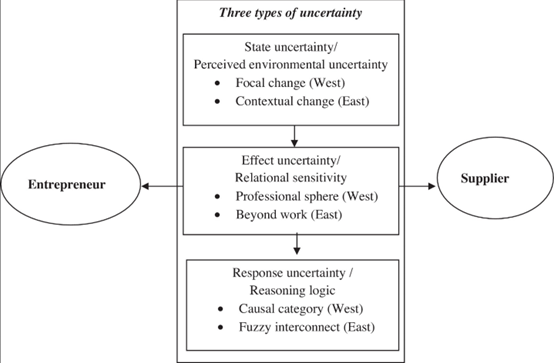
The study found that there are striking differences between local entrepreneurs and those influenced by Western culture. Entrepreneurs with Western influence tend to see situations of uncertainty as a focus of change or opportunity and respond through analytical, careful, and planned thinking. They break down the problem, analyze causes and effects, and produce planned and concrete responses.
Entrepreneurs with Eastern cultural influence (such as in China) tend to see situations in a broader context and focus on interpersonal relationships and community participation. They may make decisions that are not only functions of data but also of relationships, trust, and social connections.
The discussion in the study points to several interesting points:
Uncertainty is not just an information problem but is influenced by cultural beliefs and the entrepreneur's worldview.
Entrepreneurs with Western influence are less likely to see the barrier of uncertainty as a psychological or social problem, they resort to rational thinking and analysis. In contrast, local entrepreneurs in China emphasize more on the social and contextual aspect, i.e. “What connections do we have?”, “How do partners perceive the situation?”, “How do we maintain harmony in business relationships?”.
In addition, the study suggests that when entrepreneurs face uncertainty, the way they perceive situations affects not only their decisions but also how their partners react.
In other words, culture not only affects the entrepreneur himself, but also the entire system of inter-organizational relationships. This distinction is especially important in a global environment where businesses operate in many markets and different cultures.