




Article by Prof. Tamar Elmor et al. under the title:
Preferences for Video Consultations in Family Health Stations: A Discrete Choice Experiment Among Ultra-Orthodox Jewish Women
Cite article:
Chudner, I., Drach-Zahavy, A., Almor, T., Madjar, B., Gelman, L., & Habib, S. (2026). Preferences for Video Consultations in Family Health Stations: A Discrete Choice Experiment Among Ultra-Orthodox Jewish Women. The Patient-Patient-Centered Outcomes Research, 1-12.
The article deals with the preferences of Ultra-Orthodox Jewish Women in Israel regarding the use of medical consultations via video (Telemedicine) compared to physically coming to the clinic, especially at family health stations (Tifat Halav). The background to the research is the understanding that certain population groups, especially closed religious or cultural communities, encounter unique difficulties in accessing health services.
Ultra-Orthodox Jewish women, for example, face constraints such as large families, cultural and modesty restrictions, and sometimes limited access to the Internet or smartphones. Therefore, video services can be a solution, but only if they are culturally adapted (for example, using rabbinically approved "kosher" devices).
The aim of the study was to understand which factors influence the choice between video consultation and face-to-face consultation, and how medical services can be designed that are suitable for this population.
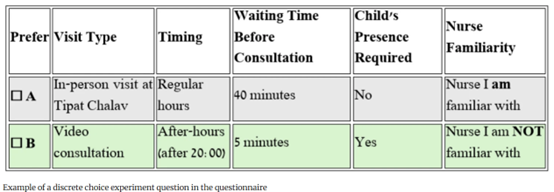
The study used a method called the "Discrete Choice Experiment", which is a common method for studying preferences.
First, culturally adapted interviews and focus groups were conducted to understand which factors are important to Haredi women. Then, a questionnaire was developed in which the participants were asked to choose between different scenarios of medical consultation.
The main variables examined were - waiting time for an appointment, hours of receiving the service, whether it is necessary to bring the child for examination, familiarity with the attending nurse.
174 women participated in the study, and each was exposed to 12 different scenarios. The data were analyzed using an advanced statistical model (mixed logit), which also allows us to understand differences between subgroups in the population.
The results showed that the most significant factor in the decision was the waiting time, the shorter it was, the greater the preference for the service.
Then, in order of importance: convenient hours (e.g. availability in the evening), familiarity with the nurse, whether the child needs to be brought.
A particularly interesting finding is that the type of consultation (video vs. face-to-face) was not a significant factor in itself, that is, women did not clearly prefer video or a physical visit, but rather the conditions of the service.
In addition, older women were less likely to prefer video consultation, simulations showed that if digital services are planned correctly, 58–78% of visits can be transferred to video services.
The discussion in the article emphasizes that the preferences of patients in different cultural groups do not depend only on technology itself, but mainly on its adaptation to lifestyle. For example, in the Haredi community, time management around family and children is of great importance, there is a high value on personal acquaintance with the therapist (trust) and there are restrictions on the use of technology.
In contrast to studies in the general population, here we found that, for example, making an appointment in advance is less important, which indicates deep cultural differences between different groups.
The study concludes that telemedicine services can also be integrated into conservative populations, but only if the services are adapted to their unique needs.
Key recommendations of the study:
- Shorten waiting times
- Offer flexible hours (especially in the evening)
- Allow continuity of care with the same staff member
- Reduce the need to bring children to the clinic
Ultimately, the article demonstrates how data-based research can help design culturally adapted health services and improve accessibility even among hard-to-reach populations.