




A new study by Dr. Yossi Maaravi, Dr. Tamar Gur-Arie, and Boaz Hameiri, under the title:
Perceptions of Victimhood and Entrepreneurial Tendencies
Cite article:
Maaravi, Y., Hameiri, B., & Gur, T. (2022). Perceptions of victimhood and entrepreneurial tendencies. Frontiers in Psychology, 13, 797787.
The study investigates the relationship between trait victimhood and entrepreneurial tendencies and entrepreneurial action. Victimhood is defined as a fundamental belief that a person is a “victim” in a variety of relationships, such that this feeling becomes a central part of their identity. This is a personality trait whose influence on various behaviors has been studied in the past, but is very rare in the context of business entrepreneurship and entrepreneurial behavior in general. The researchers claim that victimization may be negatively associated with important characteristics of the entrepreneur's personality such as: internal control, belief in one's own abilities and resilience in the face of difficult situations, and therefore may affect the desire and ability to act in entrepreneurship.
The study addresses several key questions:
Do people with a higher tendency to feel victimized have less entrepreneurial personalities?
Does this tendency affect actual entrepreneurial behavior?
Can a sense of self-efficacy reduce the negative impact of victimization on entrepreneurship?
The research methodology was based mainly on two sub-studies conducted in Israel,
First study – Entrepreneurship student sample
208 undergraduate entrepreneurship students (41% women, average age 23) answered an online questionnaire that measured:
Victimization tendency (with questions such as “It is important to me that people who harm me recognize that they harmed me”),
Personal entrepreneurial tendencies (using the GET2 index) and entrepreneurial behavior (whether they have initiated a business venture in the past).
The results showed that victimization tendency is negatively related to personal entrepreneurial tendency.
That is, the more a person tends to feel like a victim, the less they exhibit personal entrepreneurial traits in this study. However, in this study, victimization tendency did not appear to be related to actual entrepreneurial behavior (such as actually starting a business), which the researchers explained could be related to the sample population, entrepreneurship students are already less prone to victimization in general, and therefore the relationship was weaker.
Second study, a sample from the general population
354 adults from the Jewish-Israeli population (48.6% women, average age 41) who answered similar questionnaires and also a questionnaire regarding their sense of global self-efficacy (Global Self-Efficacy) to what extent they believe in their ability to deal with complex challenges.
The results showed again that victimization alone does not predict entrepreneurial behavior.
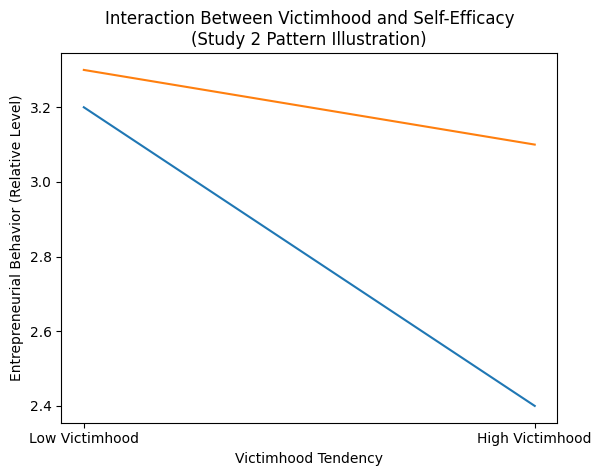
But more importantly: when we examined the interaction between victimization and self-efficacy, an interesting phenomenon was discovered:
Among people with a low level of self-efficacy, victimization was negatively related to entrepreneurial behavior, that is, people with a high level of self-efficacy and low self-confidence were actually less entrepreneurial. people with high levels of victimhood and low self-efficacy were less entrepreneurial.
In contrast, among people with a high level of self-efficacy, this relationship is almost nonexistent, that is, a strong sense of self-efficacy “neutralizes” the negative effect of victimization.
Discussion and Significance of the Findings
The researchers emphasize that their study adds several important insights to entrepreneurship theory:
The relationship between personality and entrepreneurship - entrepreneurship is not just a matter of skills or technical abilities, but is also related to personal identity, self-perception of reality, and emotional and psychological thinking mechanisms.
Victimhood may serve as a barrier - people who experience themselves as victims may see the world as unsafe, full of obstacles and unsolvable problems, and therefore will exhibit less entrepreneurial behavior.
Self-belief can serve as a "shield" - a high sense of competence helps people overcome the limitations of victimization and be more successful in entrepreneurial activities.
The researchers, who are academic lecturers, note that in light of the findings, it is important not only to teach entrepreneurial skills, but also to cultivate self-confidence and mental resilience in those who want to work in the field of entrepreneurship.
The article shows that personal victimization is negatively related to entrepreneurial personality traits, meaning that people who tend to see themselves as victims in social situations exhibit fewer entrepreneurial characteristics such as initiative, risk-taking, and perseverance. However, when examining actual entrepreneurial behavior, the picture is more complex: victimization alone does not necessarily predict whether a person will start a venture or act entrepreneurially. The most important and significant finding is that a sense of self-efficacy changes the picture.
In people with low self-efficacy, victimization is indeed associated with less entrepreneurial behavior.
In people with high self-efficacy, the negative effect of victimization almost disappears.
In other words, the decisive factor is not only the tendency to see yourself as a victim but also the extent to which you believe in your ability to cope with challenges.
In conclusion, a sense of self-efficacy can serve as a psychological “protective shield” that allows even people with victimization to act in an entrepreneurial manner. This is the main contribution of the article to understanding the relationship between personality and entrepreneurship.