
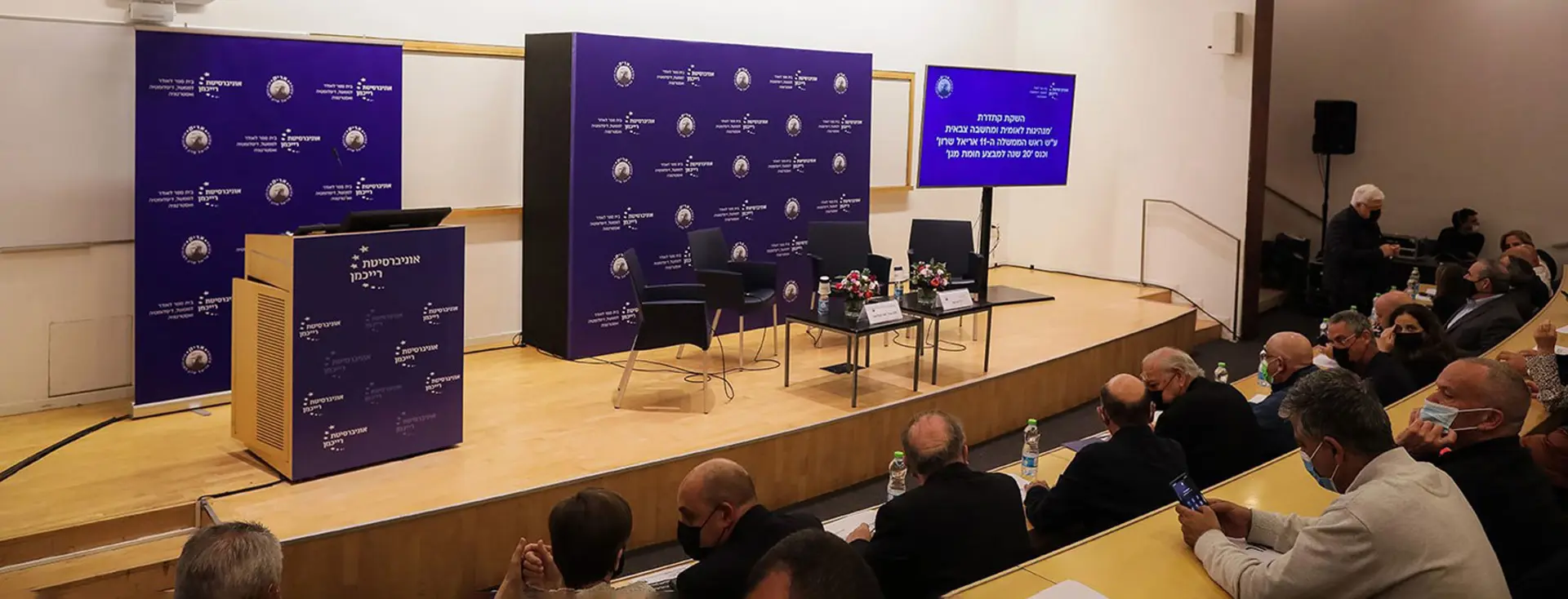


On Sunday, February 13, a conference launching the Ariel Sharon Chair for National Leadership and Military Thought was held on the Reichman University campus, marking the 20th anniversary of Operation Defensive Shield
Operation Defensive Shield was the last military campaign in which the IDF claimed a clear, complete, and unequivocal victory. The Palestinian terrorism that raged in the early 2000s claimed the lives of more than a thousand Israelis. The prime minister at the time, Ariel Sharon, ordered the operation, which was the turning point in Israel’s war on terrorism. Ever since then, the IDF has resumed control in preventing terrorism in all of Judea and Samaria.
The conference was opened by Prof. Uriel Reichman, founding president and chairman of the board of directors of Reichman University, who pondered what Ariel (“Arik”) Sharon would say about what is happening in Israeli society today. “I'm sure there would have been no gutter talk in the political discourse – Arik knew how to give respect to government institutions, even in the midst of a dispute. Even when he was expressing criticism, he was sure to be cautious and avoid provocations. He knew how to deal prudently with the Israeli Arab minority; he would act in a smart and decisive way. He would have responded strongly to the pogroms in the mixed cities, especially when these occurred as an expression of support for Hamas. He would not have put up with the agricultural violence in the north and would not have allowed the build-up of weapons in Arab cities. He would not accepted any of this, and I think he would have also reacted decisively to Jewish violence. And finally, he would have welcomed the existing government, which connects between the left and right. We miss Arik Sharon today, and we see this event as a great opportunity to discuss the man and his endeavors.”
Prof. Reichman was followed by Prof. Rafi Melnick, president of Reichman University, who said that, “Throughout history, Arik Sharon has been a controversial figure; the controversy surrounding him was most intense during the First Lebanon War and the public protest over the Sabra and Shatila affair, the settlement enterprise, the fighting in the territories, Operation Defensive Shield, about which there will be a panel later in this conference, and the disengagement plan. Arik Sharon chose to present national plans and make important policy statements at the national level at IDC Herzliya, today Reichman University; I will never forget the Herzliya Conference where Sharon astounded the audience when he first announced the disengagement plan.”
Prof. Assaf Moghadam, dean of the Lauder School of Government, Diplomacy & Strategy, said, “The purpose of the chair is to serve as a research hub that will engage, among other things, in the research and analysis of Israeli military operations, with an emphasis on those in which Arik Sharon took part. We are very pleased to provide a home for this endeavor and hope that the results from its research will serve Israel for many years to come.”
Afterwards, a conversation took place between Maj. Gen. (Res.) Moshe Kaplinsky, chairman of the Ariel Sharon Chair for National Leadership and Military Thought, and Dr. Dana Wolf of the Lauder School of Government, Diplomacy & Strategy. “I don’t think there was one particular point at which it was decided that we would launch an operation, beyond the Passover attack at the Park Hotel. It's no secret that Arik was not impressed with the state of military activity when he was appointed prime minister; he expected more initiative and more pushing forward on the part of all the commanders. He expected the army to act as we did after Defensive Shield – to be everywhere, to initiate and defend,” said Kaplinsky.
“There were two very unyielding worldviews – there was Shimon Peres, on the one hand, who believed that everything could be resolved through dialogue and negotiation, and on the other hand there was Arik, who said ‘we do not negotiate under fire’ and stood by that statement,” Kaplinsky added. “The ability to manage this tension is one that characterizes great leaders. I think that the cabinet meeting following the Passover holiday, during which we made the decision to embark on the operation, was a good example of how to manage such tension, patiently and while making efforts to compromise. This was one of his significant strengths.”
A conversation was then held between Maj. Gen. (Res.) Shaul Mofaz, former defense minister and IDF chief of staff, and Col. (Res.) Miri Eisin, former foreign media advisor to the prime minister and faculty member of the Lauder School of Government, Diplomacy & Strategy. “During the era of the suicide bombings, our problem was our illegitimacy, in the eyes of the Americans, to take over Area A. They were quick to tell us to leave these areas,” said Mofaz. “The IDF's plans were already 99% ready and were being honed all the time. And as time went on, the IDF gained more and more experience and confidence. All of the achievements of Defensive Shield are the achievements of the commanders and soldiers who took part in it. It was the turning point in our ability to defeat this terrorism and get our hands on the dispatchers, the terror labs. But we didn’t have time. We asked for more time to finish what we’d started, but unfortunately we had no legitimacy from the Americans and had to end the operation.”
Former General Commissioner of the Israel Police and Deputy Head of the Shin Bet Roni Alsheich discussed the NSO affair during the panel “Defensive Shield - Military and Political Aspects,” saying, “I made a very clear statement last weekend, and it is of course limited because I don’t want to interfere with any legal proceedings, but I will say this: As far as I know, all the names published, without exception, were checked in depth by the Israeli Police – and it never happened. That is to say, anyone surveilled was surveilled under warrant. To be clear: The Israel Police does not have Pegasus. Pegasus is a tool that retrieves the entire contents of a cell phone remotely. The police are allowed to perform searches on a phone in one’s possession, but that’s going ten days back, not ten years. The legal oversight is insane, and rightly so. It’s a measured and documented process. I’m just saying that the sensitivity with which the Israel Police employs tools, any and all tools, including mundane wiretapping, is astounding. It’s strict. That doesn’t mean that there can’t be mishaps, but it doesn’t get out of control. I trust that even after I left, the police maintained the sanctity of this process and the privacy of the citizens, fighting crime in accordance with the law. The police do not operate in in another universe; our police are very sensitive to these issues. I promise that when the legal restrictions are lifted, I will ask the hard questions and be interviewed. These spins are not easy – this is a spin and someone will pay for it.”
Along with Alsheich, the panel included Col. (Res.) Miri Eisin, Maj. Gen. (Res.) Noam Tibon, former commander of the Northern Formation, and Brig. Gen. (Res.) Moshe (Chico) Tamir, former commander of the Golani Brigade. The panel was moderated by Alon Ben David, military correspondent for Channel 13 News, who hosted the event.
The conference concluded with remarks by IDF Chief of Staff Lt. Gen. Aviv Kochavi, who referred to Operation Defensive Shield as a fascinating case study from which much can be learned. “When we talk about Defensive Shield, the first thing that comes to mind is the ability to function in very complex circumstances. It was the first time in years that we were fighting in a populated, urban area. As a result, we also had to identify situations in which we needed to adapt, whether because of the enemy or because of us. The only way to deal with this complexity and these changes is through intensive learning processes at all levels. Finally, we saw that we have ability to defeat terrorism, contrary to all the myths and the feeling that this was something that was impossible to do.”
Photo credit: Adi Cohen Zedek.