


Conspiracy Thinking and Belief in Partisan Conspiracy Theories: A Moderating Effect of Partisan Congruence?
Omer Yair, Shira Hebel-Sela, Amnon Cavari, and Asif Efrat
In recent years, conspiracy theories have gained political and societal importance in various democratic countries. For example, it has been argued that belief in various conspiracy theories has many negative effects, including reduced trust in various public institutions, increased polarization, and poor health decisions. One domain in which conspiracy theories have become prominent in the past two decades is partisan politics, with politicians in many countries accusing their political opponents of carrying out malicious conspiracies.
What predicts belief in those “partisan" conspiracy theories, in which rival political groups are "involved" (either as the alleged perpetrators of the conspiracy or the alleged victims of some conspiracy)? In a paper recently accepted for publication in Political Psychology, we argue that the combination of, or interaction of, two important factors in the academic literature that predict belief in partisan conspiracy theories – conspiratorial thinking and partisan “congruence” – helps us better understand who is likely to believe those conspiracy theories.
The term conspiracy thinking refers to the tendency of people to believe in conspiracy theories, or the tendency to perceive reality through conspiratorial "glasses" and to think that malicious forces are constantly working in the dark against the public. A series of studies show that this tendency is correlated with belief in a large number of conspiracy theories. The term "partisan congruence" refers to the extent to which a particular conspiracy theory is consistent or appropriate with the political camp that the citizen supports. For example, if a conspiracy theory blames political opponents and/or presents the citizen's political camp as the victim of a conspiracy, then the conspiracy theory is congruent from the citizen's perspective. Again, many studies show that citizens are much more likely to believe conspiracy theories that are congruent with their camp than those that are incongruent and blame their camp.
To date, the effect of these two important predictor variables has been examined separately. The novelty of our article is the claim that there is a combined, interactive effect between these two variables. In particular, we hypothesized that the effect of conspiracy thinking in predicting belief in partisan conspiracy theories will be stronger when the conspiracy theory is congruent with one's partisan camp, and weaker when it is not. This is because it will be easier for the tendency to believe in conspiracy theories to have an effect when it comes to conspiracy theories that blame political opponents, to whom citizens usually attribute negative motivations anyway. On the other hand, it will be more difficult for said tendency to have an effect when it comes to conspiracy theories that blame one's favored political camp; partisans may feel a dissonance if they believe in that conspiracy theory – how can one believe in conspiracy theories that accuse one's camp and its leaders of malicious acts, and still support that camp? In other words, we show that even those with conspiracy thinking choose the conspiracies they believe in based on the conspiracy's congruence with partisan politics.
To test our moderation (interaction) hypothesis, we used data from six surveys from 2021 to 2025: two from the United States (surveys fielded by other researchers) and four from Israel (fielded by the Institute for Liberty and Responsibility). In total, we collected data on almost 11,000 respondents. In each survey, respondents were asked questions that were scaled to a validated scale designed to measure conspiracy thinking at the individual level, as well as questions about belief in a range of partisan conspiracy theories.
Examples of partisan conspiracy theories asked in the United States include belief in claims that former President Barack Obama forged his birth certificate, that global warming is a hoax, and that Democratic Party activists were behind the attempted assassination of Donald Trump in July 2024. In Israel, respondents were asked, among other things, about their belief that the indictments against Benjamin Netanyahu are the result of political persecution, that there was "betrayal from within" on October 7, and that there is a "deep state" in government institutions. We then determined for each of these conspiracy theories whether it is congruent with a particular political camp in the United States (Republicans/Democrats) or in Israel ("Netanyahu Bloc" parties/"Change Bloc" parties).
From the statistical analyses we conducted, we can see that, in each of the six surveys, there is empirical support for our interaction hypothesis: the effect of conspiracy thinking in predicting belief in partisan conspiracy theories is stronger when there is partisan congruence. Figure 1 below presents the interaction coefficients between the conspiracy thinking scale and partisan congruence in the six different surveys. From the figure we can see that, in accordance with our hypothesis, the interaction coefficient is positive and statistically significant. Thus, in each of the surveys, the effect of conspiracy thinking in predicting belief in partisan conspiracy theories is stronger when the conspiracy theory is congruent with the citizen's political camp.
Figure 1. The interaction coefficient in the difference surveys
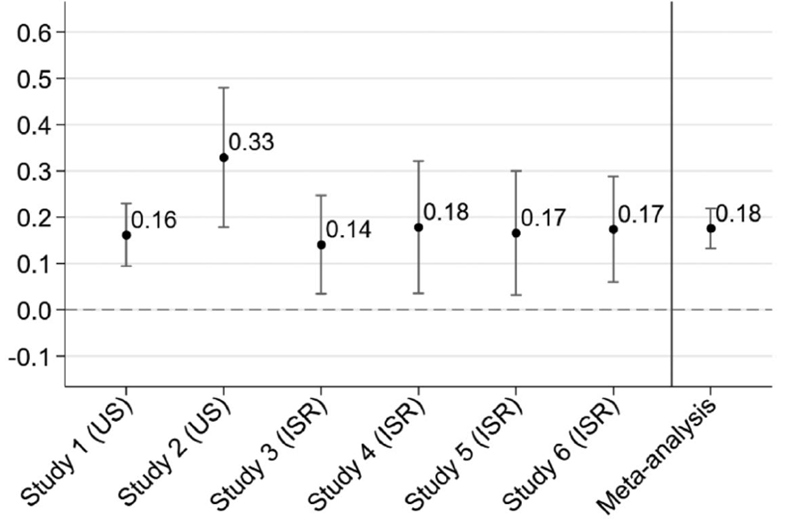 |
Note. The estimates from the various surveys, along with the meta-analytical effect, are presented with a 95 percent confidence interval.
As a more concrete example, Figure 2 below shows the predicted proportion of Israelis from the different rival camps who believed in the “betrayal from within” on October 7 conspiracy theory. It can be seen that in two different surveys, both among Netanyahu Bloc voters and among Change Bloc voters, the conspiracy thinking scale predicts belief in a "betrayal from within". However, in line with our moderation hypothesis, the effect of conspiracy thinking is stronger among Netanyahu Bloc voters when the conspiratorial claim is congenial for that camp and weaker among Change Bloc voters. Thus, Netanyahu Bloc voters with high levels of conspiracy thinking are the ones who are most likely to believe in that conspiracy theory.
Figure 2. Predicted values – Belief in a “Betrayal from Within” on October 7
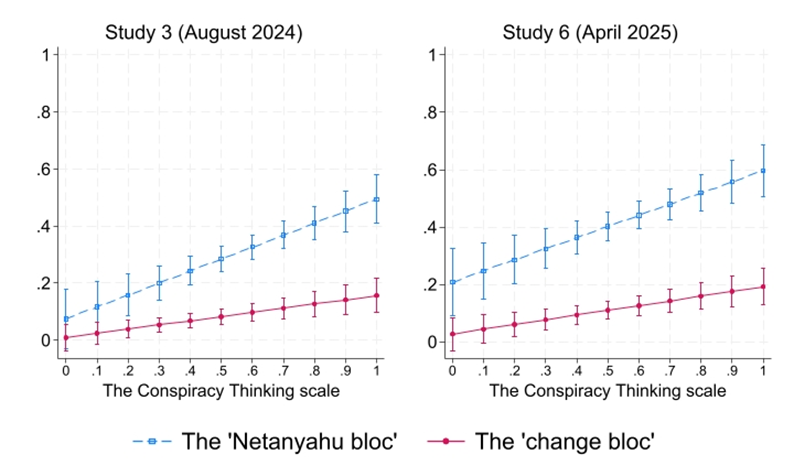 |
Note. Predicted values from two surveys (August 2024 and April 2025), shown with a 95 percent confidence interval. The Y-axis shows the probability of believing in the "betrayal from within" on October 7 conspiracy theory.
In conclusion, across six different surveys, from two countries, we show consistent evidence supporting our hypothesis that the extent to which conspiracy thinking predicts belief in partisan conspiracy theories depends on the specific context: it is stronger when the partisan conspiracy theory is congruent with citizens’ political camp, and weaker when it is incongruent with their political camp. In this sense, we contribute to the literature examining the predictors of belief in different conspiracy theories by emphasizing the importance of the specific context of conspiracy theories. In addition, our research findings also show that not all members of a political camp believe "congruent" partisan conspiracy theories, but mainly those characterized by high levels of conspiracy thinking (see the example of belief in “betrayal from within” above). Future studies can, in addition to replicating these findings in relation to other conspiracy theories, also examine whether the conditional effect we found in this article also holds in other contexts, for example, in conflicts between groups on gender, racial, or national grounds, and not just political ones.
---
Dr. Omer Yair is a Research Fellow at the Institute for Liberty and Responsibility at the Lauder School of Government, Diplomacy and Strategy, Reichman University.
Shira Hebel Sela is a doctoral candidate in the Department of Psychology and a member of the PICR Laboratory for the Study of Intergroup Conflict and Its Resolution, both at the Hebrew University of Jerusalem.
Prof. Amnon Cavari is an Associate Professor and Head of the Institute for Liberty and Responsibility at the Lauder School of Government, Diplomacy and Strategy, Reichman University.
Prof. Asif Efrat is a Full Professor, Head of the MA Program, and Adviser to the PhD Program at the Lauder School of Government, Diplomacy and Strategy, Reichman University.
This post is based on:
Yair, O., Hebel-Sela, S., Cavari, A., & Efrat, A. (2026). Conspiracy thinking and belief in partisan conspiracy theories: A moderating effect of partisan congruence? Political Psychology 47(2): e70131. https://doi.org/10.1111/pops.70131