


Conspiracy Thinking and Electoral Trust during Tumultuous Times: The Case of Israel
Omer Yair, Amnon Cavari, and Asif Efrat
On January 6, 2021, thousands of supporters of President Donald Trump, who had just lost the United States presidential election, stormed the Capitol building in Washington, D.C., in an attempt to prevent Congress from confirming the results of the presidential election, which was won by candidate Joe Biden. Many of these thousands did so out of a belief that the election was rigged and that Trump was the real winner, a belief that is still widely held by many supporters of the Republican Party in the United States.
Two years later, on January 8, 2023, thousands of supporters of President Jair Bolsonaro, who had just lost the Brazilian presidential election, stormed government buildings in the Brazilian capital with the aim of overthrowing the newly elected government. These incidents demonstrate the importance of citizens' trust in the election results, with researchers arguing that perceptions of trust in elections are important in democracies; in particular, they contribute to an orderly and peaceful transfer of power and are also closely linked to satisfaction with democracy and trust in the political system. Yet, in many democracies, distrust of election results is quite common.
What explains distrust in elections? Researchers have found that those who win elections have more trust in the results of the election and in the political system in general than those who lose elections. In addition, in recent years, researchers have found another important explanation for distrust in election results: conspiracy thinking, which is the individual's tendency to believe in conspiracy theories and to think that malicious forces are secretly working to advance their goals and against the general public. The literature shows that citizens who are prone to conspiratorial thinking tend to have less trust in various public institutions, as well as in elections and the way they are managed. These people tend to be suspicious of official bodies and the people who manage them, and also tend to treat errors in the way elections are managed and in the counting of election results that were made in good faith, as proof of a conspiracy against the public (see here, or here).
In addition, it is still unclear whether conspiracy thinking is more important in predicting trust in election results than winning or losing in elections, and it is also unclear whether the importance of conspiracy thinking is more prominent for those who lost elections than for those who won elections. In other words, whether losing elections more strongly "activates" conspiracy thinking than winning elections. Furthermore, the importance of conspiracy thinking in predicting different public positions has hardly been studied in Israel, and it is unclear to what extent it helps us understand Israeli public opinion on various issues.
We examined these questions in a recent article published in the International Journal of Public Opinion Research. We used data from four surveys conducted during 2022 – a politically turbulent period in the State of Israel. The surveys were conducted at different political times: (1) April 2022, when the Bennett-Lapid government (“The Change bloc”) was still in office; (2) September 2022, after the Bennett-Lapid government collapsed, and a little over a month before the November 2022 elections; (3) October 2022, less than a week before the November elections; and (4) December 2022, after the election victory of the "Netanyahu bloc", and shortly before the formation of the government at the end of December 2022. These four surveys allow us to examine whether a change in the status of winners/losers affects confidence in elections, and most importantly, whether that conspiracy thinking tendency is even more important than winning or losing in the election in predicting trust in the election results.
It should be noted that before each of the Israeli election campaigns in recent years, there have been claims, mainly from the political right, about election fraud (see, for example, here, here, or here). Surveys by the Israel Democracy Institute between 2019 and 2021 show that during this period, approximately 30-40 percent of the Israeli public consistently reported low trust in the election results (see here). It is therefore important to understand what predicts these attitudes.
To examine trust in the elections in our surveys, i.e., the dependent variable, we asked respondents to what extent they have trust in the integrity of the Knesset elections, meaning that the results accurately reflect the public vote (from "I have no trust at all" to "I have a great deal of trust "). The tendency to conspiracy thinking, i.e., the main independent variable, was measured using a four-question scale, with the wording of the questions and the breakdown of the answers to these questions shown in Table 1, along with the average of the conspiracy thinking scale.
Table 1. Share of agreement with each of the four questions and the scale average, in the four surveys
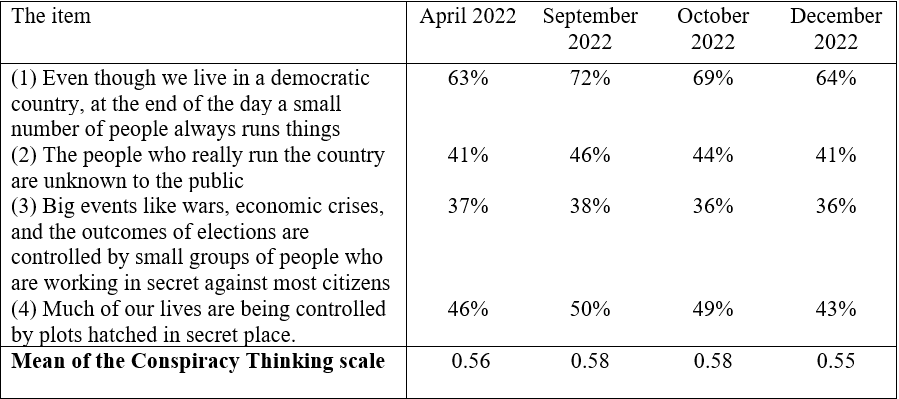 |
Legend: The conspiracy thinking scale ranges from 0 to 1. Higher values indicate a greater tendency toward conspiracy thinking.
To examine the importance of status as winners or losers in elections, we divided respondents by their vote in the elections into the “Netanyahu bloc” parties (Likud, Shas, Yahadut Ha'Torah, and Religious Zionism [before the elections] or Religious Zionism-Otzma-Yehudit [after the elections]) and the “Change bloc” parties (Yesh Atid, Yisrael Beiteinu, Labor, Meretz, Ra’am, Blue and White and New Hope [before the elections] or the Ha'Machane Ha'Mamlachti [after the elections], and Yamina [before the elections] or the Jewish Home [after the elections]). In the first three surveys, voters of the Change bloc parties were considered the winners, and voters of the Netanyahu bloc parties were considered the losers. However, after the November 2022 elections, voters of the Change bloc parties were considered the losers, and voters of the Netanyahu bloc parties were considered the winners. In addition, we controlled for several additional political and socio-demographic variables in our statistical analyses, such as left-right ideology, religion [Jewish/Arab], religiosity, and gender.
The statistical analyses show that conspiracy thinking positively and significantly predicts distrust in the elections in each of the four surveys; even after controlling for many variables, those who tend to believe in conspiracy theories tend to believe less in the integrity of the elections. In addition, those who win the elections also tend to trust the election results more than those who lose the elections: In the first two surveys, before the elections, voters of the "Change bloc" reported higher trust in the elections than voters of the "Netanyahu bloc". However, after the elections and their loss in the elections, voters of the "change bloc" reported lower trust in the elections than voters of the "Netanyahu bloc".
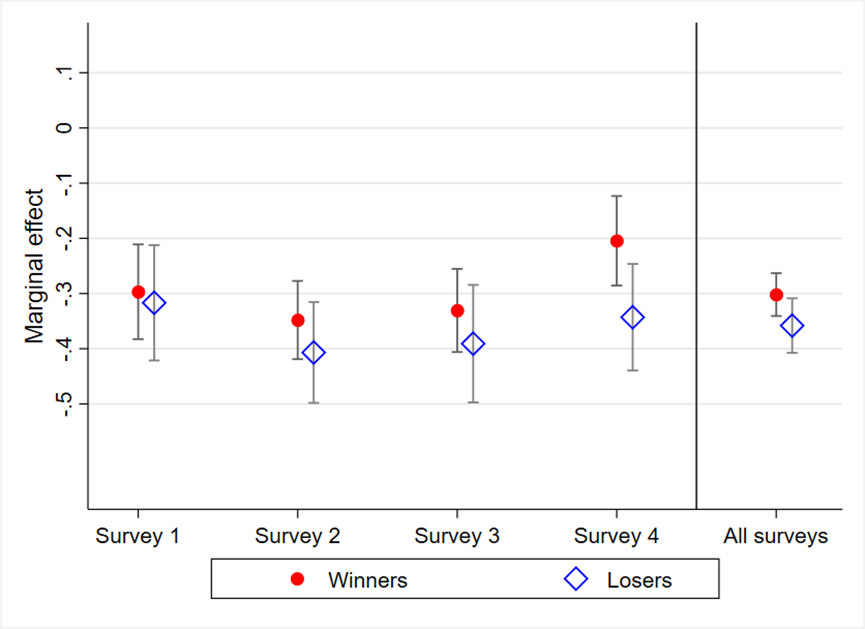
However, the data also show that conspiracy thinking is more important than winning or losing an election in predicting electoral trust. That is, the differences in trust in the election between those with low and high conspiracy thinking are much larger than the differences in trust in the election between those who won or lost the election. Additional analysis we conducted also shows that conspiracy thinking predicts distrust in the election similarly among both winners and losers, as can be seen in Figure 1, which shows the magnitude of the regression coefficient of the Conspiracy Thinking scale among both winners (full red circles) and losers (hollow blue diamonds). That is, the same tendency to believe in conspiracy theories predicts electoral distrust regardless of whether the individual won or lost the election.
Figure 1. The coefficients of the conspiracy thinking scale, among winners and losers, in the four surveys
 |
Thus, conspiracy thinking is a variable of great importance for understanding (dis)trust in elections. Regardless of political affiliation or winner/loser status, those who believe in conspiracy theories remain skeptical about the conduct of authorities and official bodies when it comes to democratic elections.
Accordingly, and because conspiracy thinking is a relatively stable tendency at the individual level, it is likely that in the foreseeable future, many in the Israeli public will suspect the election results and the manner in which the elections are conducted, even if their side wins the elections. In light of the conspiracy thinking's impact on trust in elections, we should examine how to improve trust in the electoral process. Possible ways include raising awareness about the electoral system and the selection process, and increasing the transparency of the electoral system and the vote counting. A loss of trust in the central foundation of democracy – elections – could undermine trust in the entire system and subsequently lead to the rise of undemocratic arrangements in Israel.
---
Dr. Omer Yair is a Research Fellow at the Institute for Liberty and Responsibility at the Lauder School of Government, Diplomacy and Strategy, Reichman University.
Prof. Amnon Cavari is an Associate Professor and Head of the Institute for Liberty and Responsibility at the Lauder School of Government, Diplomacy and Strategy, Reichman University.
Prof. Asif Efrat is a Full Professor, Head of the MA Program, and Adviser to the PhD Program at the Lauder School of Government, Diplomacy and Strategy, Reichman University.
This post is based on:
Yair, Omer, Amnon Cavari, and Asif Efrat. 2024. “Conspiracy Thinking and Electoral Trust During Tumultuous Times: The Case of Israel.” International Journal of Public Opinion Research 36 (2): edae014. https://doi.org/10.1093/ijpor/edae014