


Foreign Agents? Public Attitudes Toward Nongovernmental Organizations in a Backsliding Democracy
Asif Efrat and Omer Yair
This post is based on the article:
Efrat, Asif, and Omer Yair. 2024. "Foreign Agents? Public Attitudes Toward Nongovernmental Organizations in a Backsliding Democracy" Political Studies. https://doi.org/10.1177/00323217241232933.
In various countries where a process of democratic backsliding has been occurring in recent years, we see politicians criticizing nongovernmental organizations (NGOs). These politicians accuse the organizations of operating in the service of other countries and against the state's interests, and even harming the state and its security. Therefore, they act to impose restrictions and undermine the power of those NGOs. Examples of such cases from recent years can be found in India, Turkey, Russia, and Brazil.
In Israel as well, many criticisms have been voiced against nongovernmental organizations in recent years, especially from politicians and groups on the political right. Thus, in recent decades we have seen much criticism and public campaigns against organizations like the New Israel Fund, accusing that these organizations, which often receive funding from foreign countries, are agents acting against the state in the service of other countries. At a conference held several weeks before the establishment of the current government in November 2022, Member of Knesset (then) Bezalel Smotrich accused that "human rights organizations are an existential threat to Israel that the incoming government must deal with." He claimed that the state must get its hands on the funds of those organizations and act against them through legal and security measures.
How does the public evaluate those nongovernmental organizations? Does it see them as a threat and support the use of regulatory measures against them? In our article, published in 2024 in the journal Political Studies, we examined these questions in a survey experiment conducted in Israel, focusing on two dimensions that the academic literature considers as influencing public evaluations of these organizations. First, we examined whether the source of funding for the organizations – external (outside Israel) or internal (within Israel) – affects the Israeli public's evaluation of the organizations. We examined this because some believe that public criticism of nongovernmental organizations stems from the fact that many of them receive their funding from foreign sources, and not because of the political and social issues that those organizations work to advance. Thus, we hypothesized that the public would tend to evaluate organizations receiving funding from foreign sources more negatively, and would tend to support stronger regulation of them, compared to organizations receiving funding from Israeli sources.
Second, we examined whether the ideology of the organizations – promotion of liberal positions and issues (left) or conservative positions and issues (right) – is what affects public evaluations of the organizations. We did this in light of an extensive literature in psychology and political science according to which citizens' political and ideological preferences affect their evaluations. Thus, we hypothesized that Israelis would tend to evaluate more negatively organizations promoting positions and issues that contradict their own positions, and would tend to support more regulation against those organizations compared to organizations with an ideology similar to their own.
To examine this, we conducted a survey experiment involving approximately 2,600 respondents (the experiment included preregistration of hypotheses, experimental conditions, data analysis method, and sample size). As part of the experimental manipulation, respondents were asked to read a short passage in Hebrew. At the beginning of the passage, all respondents read that "various nongovernmental organizations" operate in Israel, and also received a brief explanation of what a "nongovernmental organization" is. Respondents were then presented with examples of three such organizations, as well as details about the funding sources of the organizations. Our manipulation included random assignment to one of six conditions, where in four of the six conditions respondents read that the organizations receive external funding from foreign entities (whether from European governments, the U.S. government, or non-Israeli private donors) and in the other two—that the organizations receive funding mainly from donations by Israeli citizens (internal funding). Through this manipulation we examined the effect of funding source (external/internal) on attitudes toward NGOs and support for their regulation. In addition, in four of the six conditions respondents received information about three left-wing organizations, such as "Yesh Din" or "Sikkuy," promoting liberal goals, and in the other two they received example information about three right-wing organizations, such as "Im Tirtzu" or "Regavim," promoting conservative goals. This manipulation helped us examine how congruence or incongruence between the respondent's ideology and the organization's ideology would affect attitudes toward NGOs and support for their regulation.
Afterward, all respondents answered several questions, which created our two dependent variables: (1) negative perceptions of nongovernmental organizations; (2) support for regulation of these organizations' activities.
Our findings showed that, in line with our expectations, Israelis tended to evaluate nongovernmental organizations receiving external funding slightly more negatively than those receiving funding mainly from Israeli donors. However, despite the effect being significant, it was also relatively small. And in addition, contrary to our expectations, the funding source of the organizations did not affect support for regulation of the organizations at all. The main findings are presented in Figure 1 below.
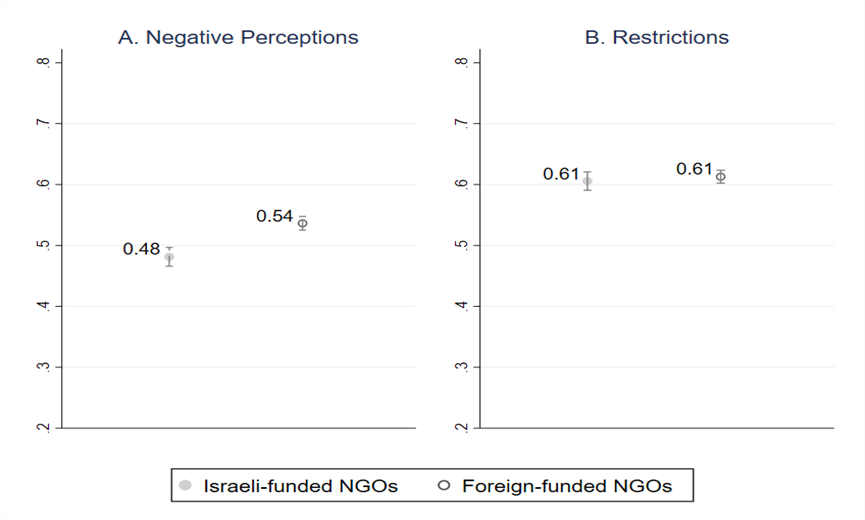
Figure 1. The Effect of NGOs' Funding Source on Negative Perceptions and Support for Regulation. Note: The Y-axis indicates the scale of negative perceptions (left) and the scale of support for regulation (right), with scales ranging from 0 to 1.
Additionally, and in line with our expectations, survey respondents – whether right-wing or left-wing supporters – tended to evaluate more negatively and support more regulation toward organizations promoting a rival ideology than organizations with whose ideology the respondents identified. Moreover, the ideological distance of the respondents in the experiment from the organizations had a much more significant effect than the funding source for the organizations, with the effect of the "ideological incongruence" variable between the respondent and the organizations the respondent evaluated being much larger than the effect of the funding source variable. The main findings summarizing the effect of that "ideological incongruence" variable are presented in Figure 2.
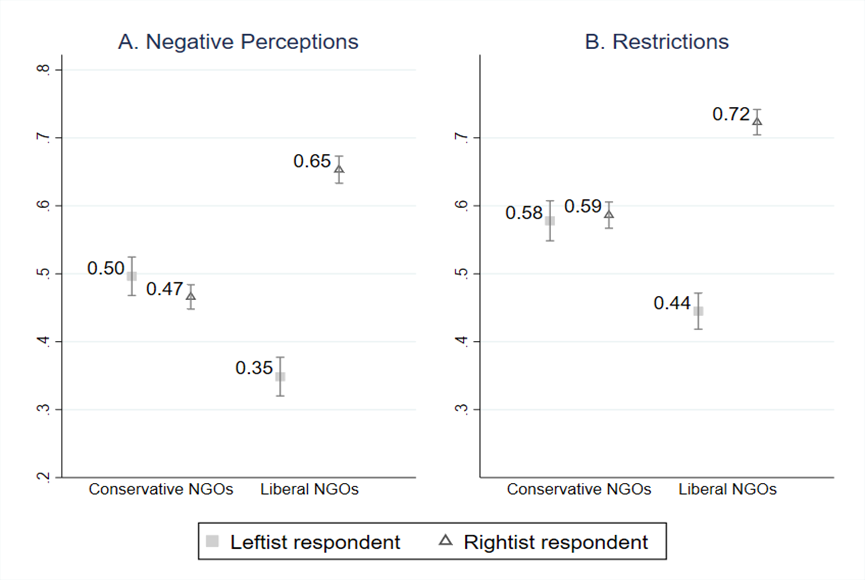
Figure 2. The Effect of Ideological Incongruence on Negative NGO Perceptions and Support for Regulation. Note: The Y-axis indicates the scale of negative perceptions (left) and the scale of support for regulation (right), with scales ranging from 0 to 1.
These findings show that attitudes toward nongovernmental organizations are largely affected by the ideological affiliation of the organizations, and are affected much less by the funding source of the organizations. This is an important issue to note in the Israeli context, where NGOs are sometimes accused of essentially being foreign organizations serving as tools of foreign entities and various countries. Indeed, it appears that the ideological goals of the organizations are far more important than the source of their funds. Additional studies, in Israel as well as in other countries, including replications of the findings in this article, will help us understand the public's attitude toward nongovernmental organizations.
Asif Efrat is a professor of government at Reichman University.
Dr. Omer Yair is a research fellow at the Institute for Liberty and Responsibility at the Lauder School of Government, Diplomacy and Strategy at Reichman University.