


Forming and changing opinions about hostage negotiations during war
Yaakov Greenwald, Dana Katsoty, Pazit Ben-Nun Bloom, and Ariel Knafo-Noam
The events of October 7 presented a complex, emotionally charged, high-stakes, extended, life-and-death moral, political and social dilemma: the hostage crisis. Complicated questions and controversy arose in the context of hostage deal negotiations about prioritizing the return of certain hostages, weighing immediate harm (e.g., to hostages) vs. future risk (e.g., Hamas’s ability to regroup or conduct future attacks) and consequences for ongoing military operations, including the broader choice between pursuing military tactics or diplomatic solutions. In an article recently published in the Journal of Policing, Intelligence and Counter Terrorism, we studied how Jewish-Israelis formed opinions about whether to support or oppose the hostage deals. In particular, we explored two potential routes to forming such decisions: cognitive-based and emotion-based.
Cognitive route. When the hostage deals were proposed, Israelis faced cost–benefit analyses, where prioritizing the hostages meant placing other issues (e.g., military operations) at a lower importance. Therefore, to decide whether to support or oppose the deal, people might weigh the relative importance they assign to (potentially) competing war goals (return hostages vs. defeat Hamas). Also, because the hostage issue became politically contested, citizens’ opinions might align with their political camp. When issues are complex, and elites send clear signals, voters follow co-partisan leaders. As the messaging of Netanyahu’s coalition elites shifted from opposing the second deal to supporting the third, coalition voters’ opinions might shift correspondingly.
Emotional route. Support for the hostage deals may also be emotion-based. The Hostages and Missing Families Forum provided high visibility for the hostages and their families, and Israelis might have developed a sense of emotional closeness to families advocating on behalf of those in captivity, even if most Israelis were not personally acquainted with them. It is possible that people might be motivated not only by their personal priorities and external political cues, but also by their internal emotional state, and choose to prioritize the hostages’ release as if they were family.
To examine our research question and the different routes, we relied on a representative sample of Israeli Jews (total N = 902) recruited by Panel4All. Participants were contacted numerous times throughout the war. Data about political ideology and partisanship were collected by the panel company before the war. In November 2023, before concrete hostage deals were proposed, we asked participants for their opinions about the importance of various war goals, including ‘defeating Hamas’ and ‘returning hostages’. Across three waves of data collection between October 2024 and October 2025, we asked participants whether they supported or opposed three proposed hostage deals, or whether they were undecided. Finally, across four waves of data collection in the middle of the war (December 2023 through January 2025), we assessed the extent to which participants felt connected to the hostages’ families.
War priorities and hostage deal opinion. Just weeks into the war, prior to any concrete negotiations, almost all participants indicated that the two main war goals were of utmost importance: 87.4% concerning returning hostages and 88.6% concerning defeating Hamas. However, support for concrete deals that would bring hostages home was lower, with only 56.8% of participants supporting the deal in October 2024, though support rose to 72.0% by October 2025. Attitudes towards prioritizing the two main war goals (return of the hostages, defeating Hamas) at the outset of war predicted participants’ opinions about concrete deals a year later and beyond.
Participants who prioritized defeating Hamas more than releasing hostages were least likely to support the deals. By contrast, those who prioritized releasing hostages more than defeating Hamas were most likely to support the deals. Participants who were similarly supportive of both goals (i.e. prioritized both goals or neither goal) showed less deal support than those who prioritized primarily the hostages, but more deal support than those who prioritized primarily Hamas’s defeat (Figure 1). Although both war goals were rated as highly important, and support for the deals increased over time, these results suggest people felt the two goals were conflicting, and the relative importance individuals assigned to these competing war goals informed their decision to support (or oppose) the deals.
Figure 1: Hostage deal support between October 2024 and October 2025 as a function of goal priorities early in the war
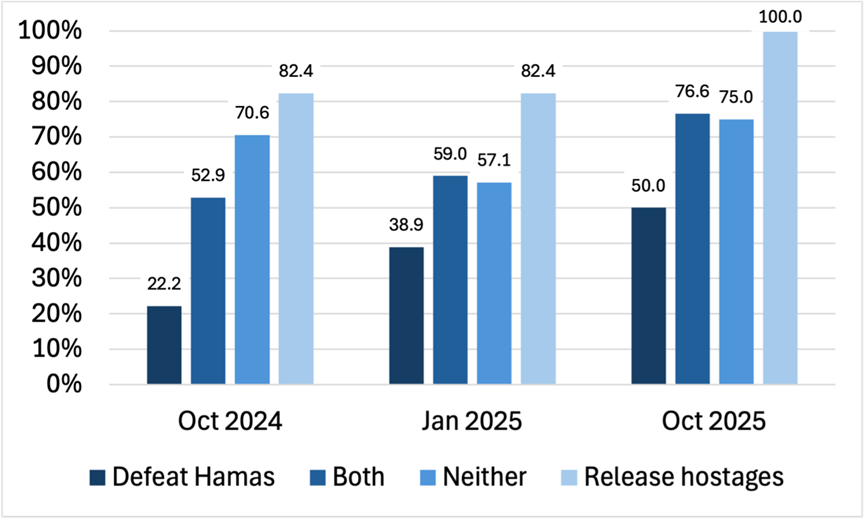 |
Note. Percentage of participants who supported the deals among (a) those who prioritized defeating Hamas (i.e., Defeat Hamas), (b) those who prioritized releasing hostages (i.e., Release hostages), (c) those who prioritized both goals (i.e., Both), and (d) those who prioritized neither goal (i.e., Neither).
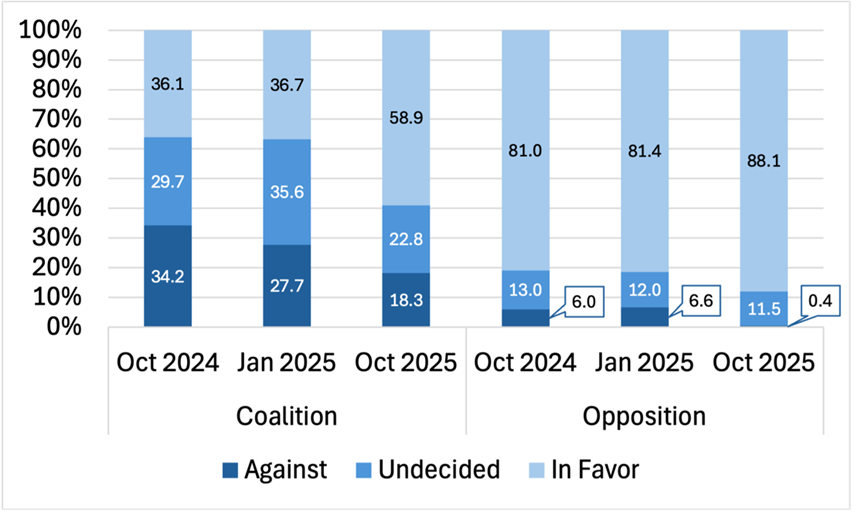
Political opinion and hostage deal opinion. More opposition voters (89.0%) than coalition voters (73.2%) prioritized returning hostages, whereas more coalition voters (87.7%) than opposition voters (74.3%) prioritized defeating Hamas. Clearly, bringing the hostages home was important to Jewish-Israelis across the political spectrum at this early juncture of war. However, partisan differences were already apparent, with voters prioritizing goals differently depending on political alignment. Moreover, across three proposed hostage deals between October 2024 and October 2025, coalition voters were more likely to oppose the deals than opposition voters. The gap between coalition and opposition voters, very large in October 2024 (36.1% vs 81.0% agreement, respectively), was substantially closed towards October 2025, reaching an agreement level of 58.9% in October 2025 for coalition voters (Figure 2).
Figure 2: Hostage deal opinion over time as a function of voting behavior
 |
Feeling connected to hostages’ families and hostage deal opinion. It is unlikely that many participants were personally acquainted with hostages or their families, yet respondents reported a high sense of connection with them. Across four waves of data collection, over one-third of the sample (34.9–40.4%) chose the scale’s highest point to describe their connection to the hostages’ families. Feeling connected to the hostages’ families predicted greater hostage deal support, above and beyond political ideology and partisanship. People’s decision to support the hostage deals may have reflected an emotional connection with those closest to the hostages.
Our findings indicate that the Jewish-Israeli public strongly desired to see the hostages return home. However, compared to war goal priorities endorsed early on, views were more mixed concerning the hostage deals, when decisions involved explicit, concrete tradeoffs between important consequences. The hostage deals presented a complex dilemma involving a (perceived) clash between war goals: securing hostages’ freedom and defeating Hamas. Participants seem to have assessed the deals by weighing the importance they assign to competing goals. Those who prioritized the hostages’ return were most likely to support the hostage deals, those who prioritized defeating Hamas were least likely to support the hostage deals, and those who did not prioritize one goal over the other were relatively conflicted. Clearly, choosing to support the hostage deals was not straightforward (indeed, a consistent contingent of participants was undecided across the deals). People may have also been guided by the opinions of those perceived as more knowledgeable. Indeed, coalition voters’ opinions shifted (their support increased across the second year of the war) in line with Netanyahu’s changing position.
Overall, these findings may be indicative of cognitive processes whereby individuals weigh options, integrating priorities, preferences and contextual cues in forming opinions about a complex issue. Another route to participants’ decisions to support the deals may have reflected an emotional connection with those closest to the hostages, as feeling close to their families positively predicted deal support, even while controlling for political variables. Although definitive causal conclusions cannot be made, our findings suggest two parallel sources involved in forming opinions about complex issues. In the case of the hostage crisis, Israelis appear to have relied on both cognitive and emotional processes when forming opinions about one of the most difficult and consequential life-and-death dilemmas faced during the war.
---
Yaakov Greenwald is a PhD student at the Hebrew University of Jerusalem, Jerusalem, Israel
Dana Katsoty is a post-doctoral scholar at Columbia University Irving Medical Center, New York, USA
Prof. Pazit Ben-Nun Bloom is a professor at the Hebrew University of Jerusalem, Jerusalem, Israel, and Stony Brook University, New York, USA
Prof. Ariel Knafo-Noam is a professor at the Hebrew University of Jerusalem, Jerusalem, Israel
The post is based on this article:
Greenwald, Y., Katsoty, D., Ben-Nun Bloom, P., & Knafo-Noam, A. 2026. Forming and changing opinions about hostage negotiations during war: Early attitudes, political orientation and emotional connection to hostages’ families. Journal of Policing, Intelligence and Counter Terrorism, 21(2), 257–274. https://doi.org/10.1080/18335330.2026.2640064