


From Citizen Input to a More Egalitarian Agenda: Public Inquiries and the Political Agenda
Hen Kersenti-Feldman and Ilana Shpaizman
In a representative democracy, one expects a certain degree of alignment between the political agenda and citizens’ priorities. Ideally, elected officials respond to public concerns and promote issues of importance to their constituents within the parliament. However, studies consistently indicate a gap between this ideal and reality: the policy agenda tends to disproportionately reflect the issues and interests of affluent and well-connected groups, as opposed to those of the lower classes. While the latter tend to prioritize immediate social needs such as welfare and public services, wealthier groups prioritize issues such as taxation and regulation, and it is these groups that typically garner the most attention from decision-makers.
This representational inequality stems, in part, from the way information flows within the political system. Policymakers cannot attend to every piece of information they receive; they are compelled to filter and prioritize. In this process, they tend to rely on intermediaries such as lobbyists, experts, and organized interest groups, or on elite social networks. The result is an echo chamber wherein decision-makers are exposed primarily to information reflecting the interests of the powerful, while issues concerning the lower and middle classes are marginalized as early as the agenda-setting stage. To create a more diverse and equitable agenda, a mechanism is required to expose decision-makers to a different type of information.
In a study recently published in the journal Research & Politics, we sought to examine whether public inquiries directed at members of Knesset can serve as such an information supply mechanism. We argue that public inquiries, direct communications from citizens to their representative's seeking assistance with daily grievances, constitute a unique channel conveying direct information from citizens to decision-makers. Unlike general public opinion polls, these inquiries provide detailed information regarding bureaucratic failures and concrete hardships. Our research hypothesis was that when the political agenda is based on these inquiries, it is expected to better reflect the needs of the lower classes in society.
To test this hypothesis, we focused on the Israeli case and the activity of the Knesset’s Special Committee for Public Inquiries (CPI). This committee serves as a unique venue in the Knesset, where the agenda is shaped as a direct response to submitted public inquiries rather than on the basis of government bills, lobbyist activity, or media coverage. We analyzed all hearings held in the committee over a decade (2009–2019) and compared its political agenda to that of two other parliamentary committees dealing with domestic affairs: the Labor, Welfare, and Health Committee, and the Economic Committee. The purpose of the comparison was to examine whether public inquiries, as an information source, lead to a more diverse representation of issues on the agenda compared to committees relying on other information sources.
Using systematic content coding, based on the Comparative Agendas Project codebook adapted for Israel, we classified the hearings into various issues such as health, welfare, transportation, economy, and domestic security. This allowed us to examine the agenda of each committee and identify its focus. The data also enabled us to categorize topics into two groups: lower-middle-class issues (such as public housing, workers' rights, public transportation) versus all other issues. Thus, we could measure the share of the committee's agenda actually dedicated to issues affecting the lower classes.
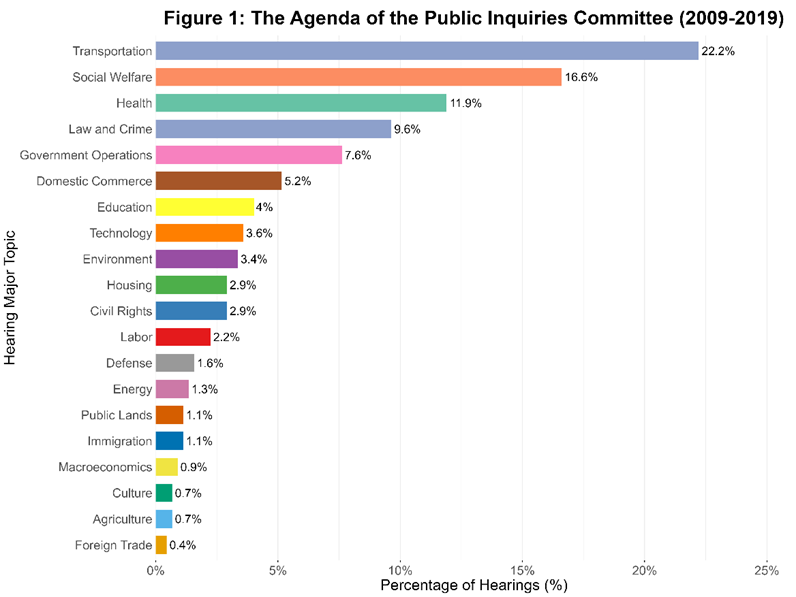
To understand the impact of public inquiries, we examined the topics on which the CPI focuses. As shown in Figure 1, the committee deals primarily with issues related to citizens' daily lives and less with foreign affairs, security, or macro-economics. The most prominent issue was transportation (22%), with an emphasis on public transportation and transport infrastructure in peripheral areas; followed by welfare (17%), concerning allowances and disability rights; and health (12%), focusing on medical infrastructure and patient care.
Figure 1: The Agenda of the Special Committee for Public Inquiries (2009–2019)
 |
Subsequently, we examined the share of engagement with lower-middle-class issues across the three committees. We analyzed the proportion of each committee's agenda dedicated to these issues, and whether this engagement was consistent over time (Figure 2).
Figure 2: Percentage of Hearings Addressing Lower-Middle-Class Issues by Knesset Committee
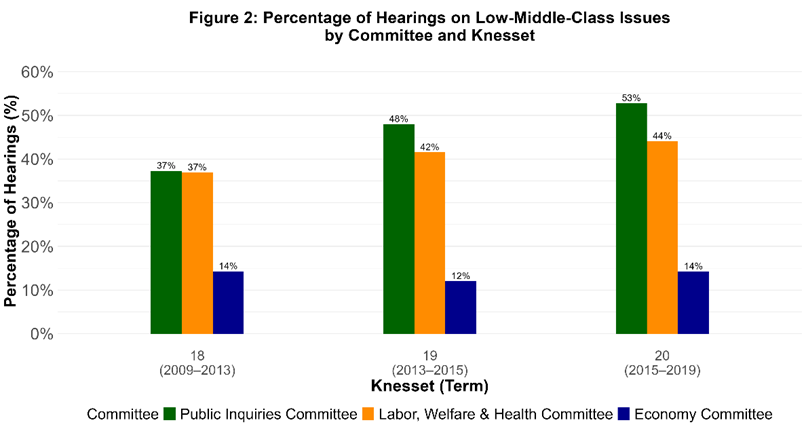 |
The Committee for Public Inquiries (green in the chart) consistently dedicated the largest share of its hearings to issues identified with the middle and lower classes. On average, approximately 45.3% of the committee's hearings were devoted to these topics. The disparity is particularly striking compared to the Economic Committee (blue), which dedicated only 13.8% of its time to such issues. Moreover, even in comparison to the Labor, Welfare, and Health Committee (orange, 41%), which is entrusted with social issues by definition, the CPI led in the scope of its engagement with these issues.
Our logistic regression model indicates that the odds of a lower-middle-class issue being raised for discussion in the CPI are 6.2 times higher compared to the Economic Committee. Another significant finding arising from Figure 2 is the stability of this phenomenon: across three different Knesset terms, the committee maintained its focus on similar issues. Even after statistically controlling for the chair’s ideology and the government’s ideology, no significant correlation was found between these ideological variables and the committee's tendency to address lower-middle-class issues. This reinforces the conclusion that the information source, the inquiring citizens, is the decisive factor. When the agenda is built from the bottom up, it becomes more diverse and equitable.
In conclusion, numerous studies have found that the political agenda is often skewed in favor of issues preferred by affluent groups. We argue that this occurs, in part, due to the biased information to which decision-makers are exposed. This study demonstrated that this bias can be reduced when policymakers are exposed to an alternative information source, namely, public inquiries.
The findings from the Israeli case suggest that when the agenda is derived from public inquiries (as is the case in the CPI), issues identified with the middle and lower classes receive higher representation on the agenda. We posit that direct inquiries serve as a unique information conduit, exposing politicians to issues that concern these populations, information that typically does not reach them through traditional channels. This implies that the grievances of private individuals can translate into broad policy issues raised on the parliamentary agenda. In doing so, the study highlights the potential inherent in citizen input for broadening the boundaries of the political agenda.
---
Hen Kersenti-Feldman is a doctoral student in the Department of Political Science, Bar-Ilan University
Dr. Ilana Shpaizman is a senior lecturer in the Department of Political Science, Bar-Ilan University
This entry is based on the following article:
Kersenti Feldman, H. H., & Shpaizman, I. (2025). From citizen input to a more egalitarian agenda: Public inquiries and the policy agenda. Research & Politics, 12(4). https://doi.org/10.1177/20531680251400480.