


Going to the polls to win, not (just) to influence policy: The importance of identifying with an ideological group in Israel
Dr. Odelia Oshri, Dr. Omer Yair, and Prof. Leonie Huddy
Many Israelis believe that their positions on the Israeli-Palestinian conflict, on issues of state-religion, or on economic issues, such as housing prices and the cost of living, profoundly influence their voting and their level of political involvement. On the other hand, there have been many voices recently saying that in Israel, voting is not ideological but "tribal," based primarily on affiliation with one political group or another, and identification with the "tribe" or political group and its members.
In a new study, recently published in the journal Party Politics, we contribute to this debate and show that a sense of deep identification as rightist or leftist, and a sense of belonging to the "rightists" or "leftists" group, indeed significantly predict voting and political participation in Israel, above and beyond positions on various policy issues.
In the article, we examined not only whether Israelis identify themselves as rightist or leftist (or centrist), but also the extent to which voters identify with the ideological group to which they belong and identify with the members of that group, and the extent to which they feel they belong to the group. This measurement was conducted separately from their ideological positions on matters of security, economy and society, or state-religion, because in Israel the categories “right” and “left” denote not only political positions; they are also distinct socio-cultural categories, with stereotypes that clarify which people comprise each group, as socialization processes help individuals understand which group they belong to.
In fact, many Israelis know that they belong to the “rightist” or “leftist” group even before they understand the meaning of different policy preferences, and certainly before they choose “right” or “left” policy preferences. For many Israelis, self-placemet, for example, as “righist,” also means being categorized as belonging to the “rightist” social group, sometimes even in isolation from a “hawkish” right-wing ideology—or at least without a clear affiliation with a right-wing ideology. We hypothesized that even when controlling for positions on various issues, the more strongly an Israeli identifies with a particular ideological group, the more she will act in a way that increases her group’s chances of winning in the struggle against the opposing group.
To measure this sense of belonging to an ideological group, we conducted two public opinion surveys in 2018 and 2019. First, survey respondents answered a question about which political bloc they identified with (right/left/center). Then, those who indicated that they identified with the right or left were asked eight questions (on a 'strongly agree' to 'strongly disagree' scale), including “When I talk about rightists (leftists) I usually say ‘we’ instead of ‘them’” or “When people criticize rightists (leftists) I feel as if it is a personal insult.” The answers to these questions were used to construct an index of the strength of the sense of belonging to an ideological group.
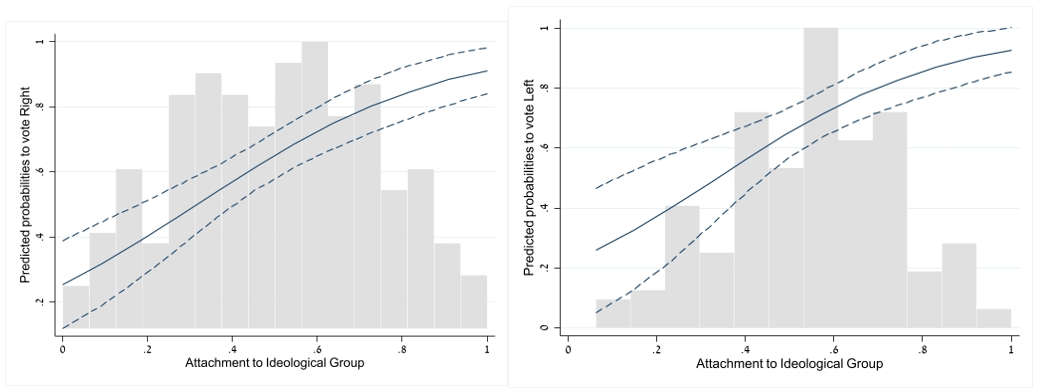
Then, in a series of statistical analyses, we show that this measure of attachment to an ideological group significantly predicts voting intentions and political engagement. Thus, those with a strong sense of group affiliation are more likely to vote for a party from their political bloc (see Figure 1) and tend to be more involved in politics, even after controlling for positions on various issues and a range of socio-demographic variables.
Figure 1. Probability of voting for a right-wing party (right side) and a left-wing party (left side) across the different values on the attachment to an ideological group scale
 |
Our surveys also included embedded experiments, where in both experiments we presented survey participants with information indicating that their political camp was likely to lose or win the upcoming election. We expected that this would lead, in the event of a future loss, to more negative emotional responses among respondents, such as anger and fear, or would lead, in the event of a future victory, to more positive emotional responses, such as enthusiasm and satisfaction. We examined respondents’ emotional responses because different emotional responses, such as anger and enthusiasm, are catalysts for meaningful political engagement, with an emphasis on engagement designed to help the group win the political struggle.
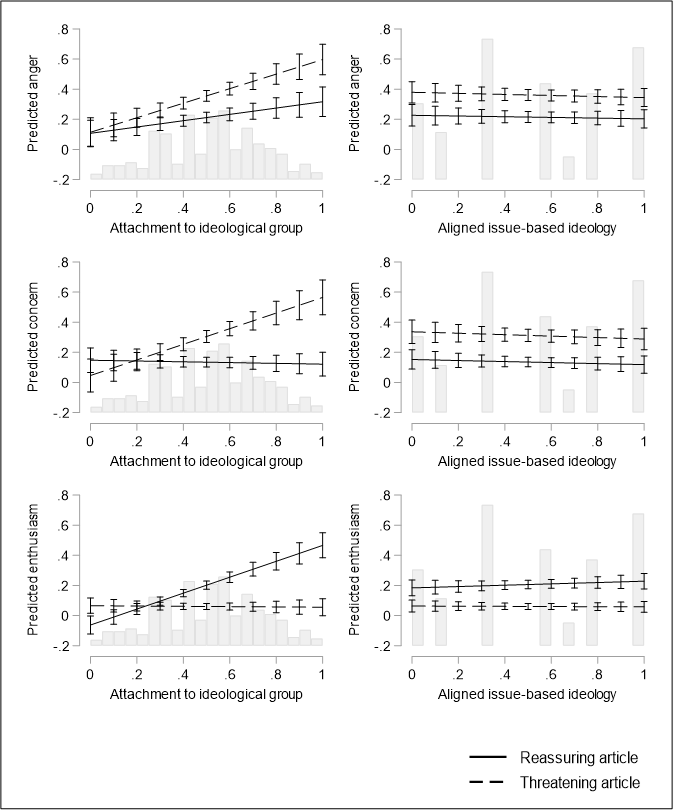
The results of the experiment showed that those who had a strong sense of attachment to the group reported much more anger and anxiety when exposed to information about an expected loss of the group compared to those who reported a weak sense of attachment to the group. A similar phenomenon was also observed when exposed to information about an expected victory of the group: respondents with a strong sense of attachment to the group reported much more enthusiasm and satisfaction compared to respondents who reported a weak sense of attachment to the group (see graphs on the left side of Figure 2). Interestingly, the strength (or “extremity”) of the respondents’ positions regarding policies related to the Israeli-Palestinian conflict, i.e., issue-based ideology, did not predict stronger emotional reactions in response to the loss/victory of the group (see graphs on the right side of Figure 2).
Figure 2. The effect of exposure to a threat to the ideological group versus reassurance to the ideological group's status on emotions, as a function of the strength of identification with the group and issue-based ideology
 |
In conclusion, our research shows that the voting and political participation of many voters are driven by group competition and questions of identity—who are “us” and who are “them.” The stronger the sense of attachment and belonging to an ideological group, the more likely voters are to act to help and defend their political camp. We should make it clear, of course, that the strength of group belonging is not the only important variable; policy preferences and support for a particular party also predict voting and political involvement, as do various socio-demographic variables such as degree of religiosity. Nevertheless, our research shows that a sense of attachment to, and identification with a political camp better predicts voting and political participation in Israel.
---
Dr. Odelia Oshri is a faculty member in the Department of Political Science at the Hebrew University.
Dr. Omer Yair is a research fellow at the Institute for Liberty and Responsibility at the Lauder School of Government, Diplomacy and Strategy at Reichman University.
Prof. Leonie Huddy is a professor of political science and chair of the Department of Political Science at Stony Brook University.
The post is based on:
Oshri, O., Yair, O., & Huddy, L. (2022). “The importance of attachment to an ideological group in multi-party systems: Evidence from Israel.” Party Politics 28(6): 1164–1175. https://doi.org/10.1177/13540688211044475