


Political Polarization in Israel, 1992–2022
Yair Amitai, Noam Gidron, Omer Yair
The elections for the 25th Knesset, held on November 1, 2022, revealed deep divisions among Israeli citizens alongside one broad consensus: Israeli politics is polarized as it has not been in a long time. After five election campaigns and three prime ministers from three different parties in less than four years, the 2022 elections appear to have left Israel divided into two political blocs with a deep and unbridgeable chasm between them. Were records of political polarization broken in the period leading up to the 2022 elections? And if so, in what ways is this polarization expressed in public opinion? These are the questions we examined in a recently published chapter in the book The Elections in Israel 2022.
In the chapter, we distinguished between two types of political polarization in the public: ideological polarization, which is expressed in a lack of agreement regarding policy positions; and affective polarization, which is expressed in the intensity of negative emotions among supporters of the different parties. We examined these two types of polarization in the Israeli public based on data from the Israel National Election Studies (INES) over a period of 30 years: from the 1992 elections to the 2022 elections. This period allows us to examine the degree of ideological and affective polarization in the 2022 elections in comparison to polarization during politically turbulent periods in previous years, with an emphasis on the 1990s (the Oslo Accords, the Rabin assassination).
To examine ideological polarization, we used several questions asked in the INES polls over time, for example, a question about the respondent's position in the survey on a right-left axis ranging from 1 (right) to 7 (left), along with questions about the Israeli-Palestinian conflict, the economy, and religion-state relations. In this measurement, we examined whether the distribution of positions has changed over time, such that the distribution has become one that shows two opposing sides; as well as whether public positions have become more consistent and correlated with each other over time (for more details, see the chapter).
In contrast, to examine affective polarization over time, we used a question that asks survey participants to indicate how they feel about the different parties on a scale ranging from 0 (rejection/hatred) to 10 (support/sympathy). In this case, we focused on voters of the two largest parties in each of the election campaigns, and examined the difference between the (mostly positive) sentiment that party supporters express toward their preferred party – the one they report they will vote for in the upcoming elections – and the (mostly negative) sentiment they express toward the opposing party.
First, in analyzing ideological polarization over time in Israel, we see that there have been some changes in the distribution of ideological self-placement over time, but the division into two ideologically hawkish sides was stronger over the entire period in the 1990s, rather than in recent election campaigns. In other words, the findings do show a certain increase in the level of ideological polarization in recent years, but these are still lower levels of ideological polarization compared to the 1990s. In addition, we also examined whether the ideological positions in the public (political-security, state-religion, and economic) have become more correlated with each other over time. As can be seen from Figure 1 below, there has been a certain increase in recent years in the degree of consistency and correlation between different ideological issues, but only to the extent that the economic issue is ignored. Thus, our findings do not present clear support for the claim that ideological polarization has increased in recent years among the Israeli public. At most, we can say that there is a certain, but not sharp, increase in ideological polarization.
Figure 1. Average of correlations between various ideological axes among the Israeli public, 1992–2022
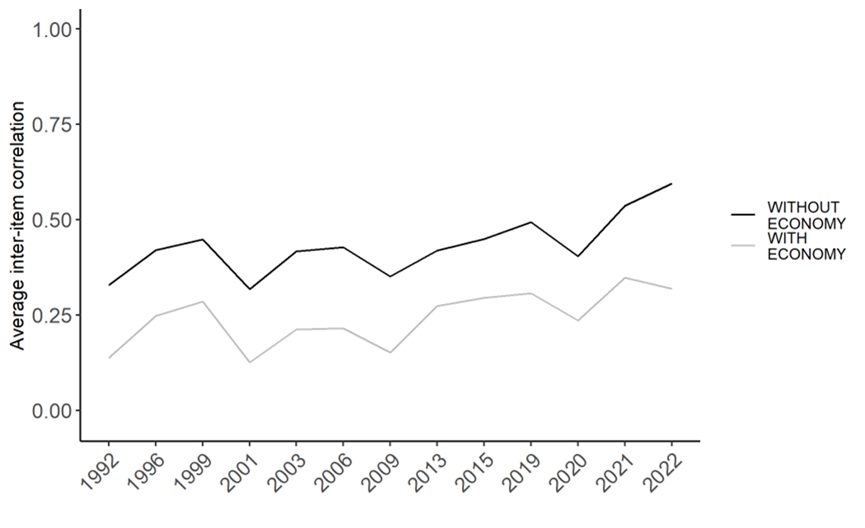 |
Note. The black curve presents the average of the correlations between three ideological axes: general (right-left), political (a Palestinian state), and cultural (state-religion). The gray curve adds to these axes the economic axis (capitalism vs. socialism)
And what about changes in the levels of affective polarization in Israel over time? In this case, we actually see a significant increase in recent years. Figure 2 presents the main findings, with the chart including three curves: the top curve represents voters’ feelings toward their preferred party (“in-party”), the bottom curve along most of the chart shows feelings toward the political opponent (“out-party”), and the middle curve along most of the chart shows the gap between them – which is the measure of affective polarization.
Figure 2. Affective polarization among voters for the two central parties in Israel, 1992–2022
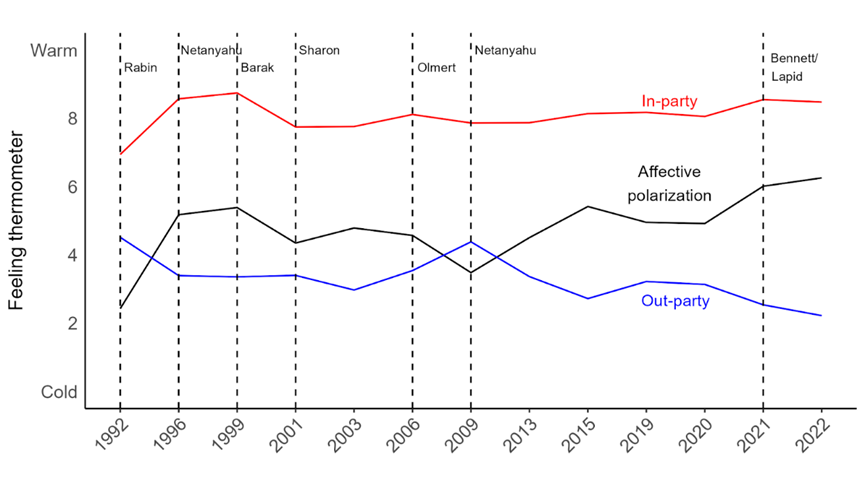 |
Note. This figure presents three curves measuring the feelings of voters for the two largest parties―right and center-left―in Israel. The red curve presents voters’ feelings vis-à-vis their in-party, and the blue curve presents feelings vis-à-vis the out-party. The black curve presents the difference between these two curves.
The affective polarization over the three decades can be divided into three periods. In the first period, from 1992 to 1999, affective polarization increased significantly – more than doubling from 2.4 in 1992 to 5.3 in 1999. This increase stems from both the warming of voters’ feelings toward their preferred party (from 6.9 to 8.7) and the cooling of their feelings toward the opposing party (from 4.5 to 3.3). During this decade, the Israeli political system experienced dramatic events such as the Oslo Accords, terrorist attacks, and the assassination of Prime Minister Yitzhak Rabin.
In the second period, between 2001 and 2009, feelings toward the opposing party warmed somewhat. During this period, the Second Intifada took place, which may have led to a reduction in emotional polarization in the face of the struggle against a common external enemy, and there were relatively broad coalitions that brought rival parties together around the government table. In the third period, which began in 2009 and ended in 2022, there was a worrying reversal of the trend: during this period, emotional polarization increased, and in the 2022 elections, it reached its highest level in the entire period (6.2 – an increase of 180% compared to 2009). This period is characterized by the prolonged rule of Benjamin Netanyahu, whose attitude towards his political figure became a shaping force in the political arena (see here).
In a comparative perspective, the affective polarization between the two major parties in Israel in 2022 is greater than the polarization recorded between the Democrats and Republicans in the 2016 election campaign in the United States. The affective gap between supporters of the two major parties in Israel was 6.2 points in 2022, while in 2016 in the United States, in the elections in which Donald Trump of the Republican Party and Hillary Clinton of the Democratic Party competed, the affective polarization on the same scale was about 4.7 points (see here).
In conclusion, in our chapter we examined political polarization in Israel from 1992 to 2022 based on surveys conducted shortly before the various election campaigns. The chapter’s findings show that ideologically, polarization has strengthened slightly, but the changes are relatively limited. However, affective polarization reached a peak in 2022, after strengthening in the 1990s and then weakening slightly in the early 2000s. Thus, with the end of the 2022 election campaign, the Israeli public is indeed more affectively polarized than at any previous point since the early 1990s.
At this stage, further research is needed to examine both the causes of changes in polarization levels in Israel and different ways and strategies for reducing polarization. The discussion of the characteristics of polarization in Israel indicates the importance of examining issues in Israeli politics from a comparative perspective. The challenge of polarization is not unique to Israel, and so is the concern with examining political mechanisms that may contribute to improving the political climate. A deeper understanding of comparative research on the subject can contribute to advancing the discussion on polarization in Israel, just as findings from research on polarization in Israel enrich the comparative discussion. In this sense, this chapter is not intended to have the last word on the subject, but to contribute to the development of a broad and comprehensive discussion, both empirical and theoretical.
---
Dr. Yair Amitai is a postdoctoral fellow at the Institute for Liberty and Responsibility at the Lauder School of Government, Diplomacy and Strategy at Reichman University.
Prof. Noam Gidron is a faculty member in the Department of Political Science and the Program in Philosophy, Economics, and Political Science at the Hebrew University of Jerusalem.
Dr. Omer Yair is a Research Fellow at the Institute for Liberty and Responsibility at the Lauder School of Government, Diplomacy and Strategy at Reichman University.
This post is based on the article:
Amitai, Y., Gidron, N., & Yair, O. (2025). Political Polarization in Israel, 1992–2022. In G. Rahat, N. Gidron, & M. Shamir (Eds.), The Elections in Israel 2022 (pp. 21–41). Routledge. https://doi.org/10.4324/9781032633299-3.