


International Rankings and Public Opinion: Compliance, Dismissal, or Backlash?
Asif Efrat and Omer Yair
This post is based on the article:
Efrat, Asif, and Omer Yair. 2023. "International rankings and public opinion: Compliance, dismissal, or backlash?" The Review of International Organizations 18(4): 607–629. https://doi.org/10.1007/s11558-022-09484-y.
In recent years, there has been a noticeable increase in the number of global performance indicators. These are comparative rankings compiled by various entities (countries, international organizations, research institutes, private bodies, etc.) that rank countries on a range of topics and issues, such as levels of corruption, human rights, or press freedom in a country. One of the main purposes of these rankings is to exert normative pressure on countries ranked relatively low, with the intention that these countries will act to improve their performance on the issue in question and move closer to accepted international standards. But despite the increase in the number of indicators and the public prominence of these rankings in various countries, academic research examining the impact of these international rankings is only in its early stages.
Most studies have examined the impact of various rankings on decision-makers and on policy. But what is the public's response to international rankings? On one hand, in response to a low and critical ranking, citizens might adopt the criticism and want the country to fix what needs fixing. On the other hand, citizens might remain indifferent to low rankings, and in some cases even increase their support for the government policy that received the low ranking, in a spirit of defiance against the ranking.
In our article, published in 2023 in the journal The Review of International Organizations, we examined this issue, focusing on the question of how the Israeli public responds to an unflattering ranking of Israel's efforts in the area of human trafficking: Do Israelis believe that, in light of a low ranking, Israel should increase its efforts to eliminate human trafficking, or does a low ranking not affect Israelis' attitudes toward human trafficking at all? In this case study, we focused on examining the impact of the U.S. State Department's ranking on Trafficking in Persons (TIP for short). The State Department ranks countries around the world annually into three categories or tiers, where Tier 1 countries act appropriately against human trafficking, Tier 2 countries act partially against human trafficking, and Tier 3 countries do not attempt to address the problem of human trafficking at all. We examined whether presenting Israel as belonging to Tier 2 or even Tier 3 affects the importance Israelis attribute to combating human trafficking.
To examine this, we conducted a survey experiment involving approximately 1,100 respondents. As part of the experimental manipulation, respondents were asked to read a short passage. At the beginning of the passage, all respondents were presented with the issue of human trafficking, including reference to the great suffering of victims of this trafficking. We then presented them with Israel's ranking in the State Department's TIP ranking; our manipulation included random presentation of one of three rankings: (1) In this group, the TIP ranking was presented to respondents without mentioning Israel's tier in this ranking ("no ranking group"); (2) In this group, the TIP ranking was presented to respondents and then Israel was presented as ranked in Tier 2 in this ranking ("Tier 2"); (3) In this group, the TIP ranking was presented to respondents and then Israel was presented as ranked in Tier 3 in this ranking, which is the lowest ranking ("Tier 3").
Afterward, all respondents answered our dependent variable: the level of agreement that the State of Israel should invest more efforts in combating human trafficking, even at the expense of fighting other crimes.
Our findings showed that, contrary to our initial expectation, Israelis displayed a backlash response to Israel's low ranking in the TIP ranking. Respondents who read that Israel was ranked at the lowest tier—Tier 3—displayed the lowest level of support for efforts against human trafficking relative to respondents who read that Israel is ranked in Tier 2 or who were not shown Israel's ranking. These findings are presented graphically in Figure 1 below, with multivariate analysis showing that this effect is indeed negative and significant.
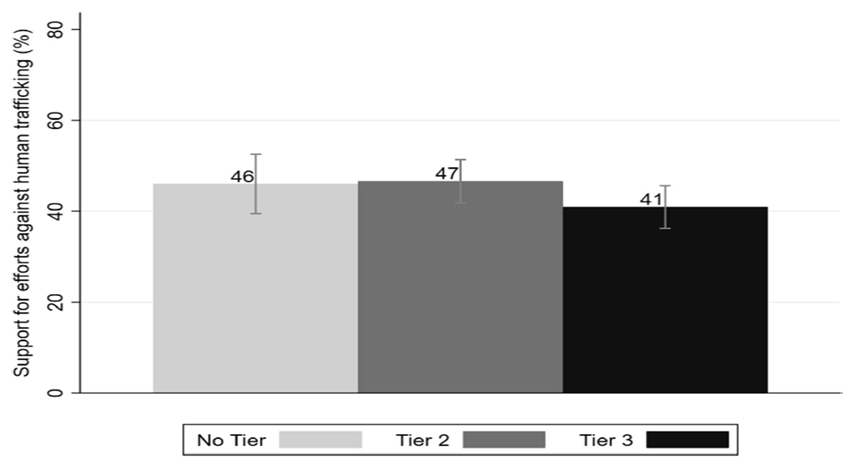
Figure 1. The Effect of TIP Ranking on Support for Efforts to Combat Human Trafficking. Note: The Y-axis shows the percentage of respondents who answered "agree" or "strongly agree" in response to the question about investing efforts in combating human trafficking, even at the expense of fighting other crimes.
Beyond examining the effect of rankings, we also examined whether presenting "peer" countries that are supposedly ranked at the same tier as Israel also affects support for efforts against human trafficking. Previous studies have suggested that presenting a country in a ranking alongside countries perceived as failing or underdeveloped can lead citizens to support efforts to improve the country's performance on the issue in question. In light of this, in addition to the random assignment of Israel's ranking in the TIP ranking, respondents assigned to the "Tier 2" or "Tier 3" conditions were also randomly assigned to receive or not receive the following sentence: "Other countries that received a [2 / 3] ranking are India, Nigeria, and Kazakhstan." We found that presenting these countries, which are not perceived as developed countries, increased support for efforts against human trafficking; in particular, this presentation largely corrected the backlash effect among Israelis who were assigned to Tier 3. As shown in Figure 2, most of the backlash disappears when Israelis read that they are in the same company as rather weak countries with a questionable record in the area of human rights.
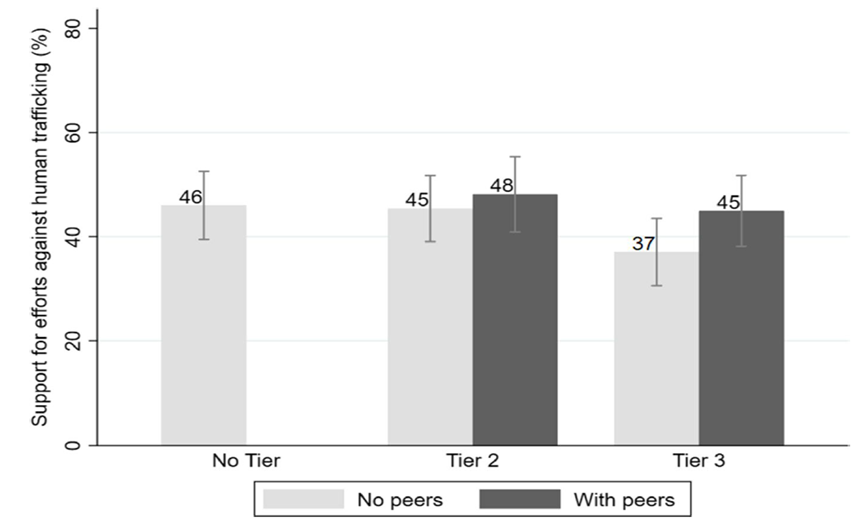
Figure 2. The Effect of TIP Ranking and Mentioning "Peer Countries" on Support for Efforts to Combat Human Trafficking. Note: The Y-axis shows the percentage of respondents who answered "agree" or "strongly agree" in response to the question about investing efforts in combating human trafficking, even at the expense of fighting other crimes.
These findings join a series of studies from recent years indicating that the Israeli public often displays a backlash response to international pressure or international criticism in general (here, or here), and to international rankings in particular (here); in other words, Israelis act defiantly in response to criticism presented against Israel. These findings raise doubts about the effectiveness of international rankings, at least regarding their impact on the public. If the purpose of rankings is to pressure governments to improve their policies, this pressure will probably not come from public opinion: the public, at least in Israel, does not respond well to the criticism expressed by rankings in their current conventional format. It is worth thinking about other ways to increase public demand for policy improvement.
Asif Efrat is a professor of government at Reichman University.
Dr. Omer Yair is research fellow at the Institute for Liberty and Responsibility at the Lauder School of Government, Diplomacy and Strategy at Reichman University.