


International Rankings and Public Opinion: Selective Influence
Amnon Cavari, Asif Efrat, and Omer Yair
This post is based on: Cavari, Amnon, Asif Efrat, and Omer Yair. 2025. “Do International Rankings Affect Public Opinion?” The British Journal of Politics and International Relations 27(1): 349–68. doi:10.1177/13691481241230859.
International rankings have become a central tool in the global discourse on state performance. They offer a simple comparative assessment of how countries fare across a wide range of areas, including education, health, human rights, and environmental protection. A common assumption is that such rankings may put pressure on governments: countries that fall short of international standards are expected to feel embarrassment or face public pressure due to a low score, whereas a high ranking may enhance a country’s reputation and provide legitimacy to its policies. Yet we know very little about how the public reacts to these rankings. Do citizens take them seriously? Do they update their attitudes in response? And can rankings mobilize support for policy change—or, conversely, generate resistance?
We ground our hypotheses in a rich body of scholarship on the impact of international criticism, sanctions, and attempts to shame states within the international arena. This research identifies varied—and sometimes contradictory—effects of international criticism on public opinion and political behavior. In our article, published in 2025 in The British Journal of Politics and International Relations, we examine the effect of international rankings: a form of “soft criticism” that assigns numerical scores to countries’ performance across issue domains.
To assess the effect of such rankings on public opinion, we conducted a survey experiment among 4,016 participants in Israel. The experiment manipulated several attributes of international rankings: the policy domain, the country ranking, and the identity of the ranking body. Specifically, we presented participants with a brief description of a hypothetical 2021 international ranking of Israel. The first experimental factor was the policy domain—participants were randomly assigned to read a ranking concerning either human rights or environmental protection. The second factor was the ranking itself: participants were told either that Israel received a high ranking (14 out of 180 countries) or a low ranking (78 out of 180). Finally, the third factor was the source of the ranking: participants read that the ranking was issued by one of three actors—an international organization (the OECD), an international NGO, or the U.S. government. After reading the ranking, participants were asked to evaluate Israel’s performance in the relevant domain, indicate their support for improving the policy, and state whether they would sign a petition calling for such improvement. In this way, we examined not only changes in perceptions of state performance but also the implications of rankings for attitudes and political behavior.
The findings are clear and provide new insight into the interactions between international information and public opinion. We found that the Israeli public responds to international rankings, but the response is selective and asymmetric. In general, when citizens receive information about Israel’s high ranking, they tend to evaluate the state’s performance more positively. They also express lower support for policy improvement and show less willingness to take political action to promote such change. By contrast, when citizens receive information about a low ranking, their attitudes hardly change—and in some cases, we observed a backlash effect: exposure to external criticism actually increased participants’ positive evaluation of state performance. Comparisons to pre-treatment attitudes reveal that while high rankings shift public perceptions, low rankings have little impact—and can even move attitudes in the opposite direction. In other words, citizens embrace praise for their country but reject criticism.
The mechanism underlying this pattern is tied to the degree of political polarization or contention surrounding a given issue. In our study, we examined two issues: human rights—a domain characterized by sharp political conflict in Israel—and environmental protection, viewed as more technical and less politicized. As shown in Figure 1, compared to attitudes measured before exposure to the rankings, we found that in the environmental domain, a low ranking did not change evaluations of state performance. By contrast, in the highly polarized domain of human rights, we found that the public tended to express more positive evaluations after receiving a low ranking—a classic example of a backlash effect known from research on political shaming. This finding illustrates that the effect of rankings depends not only on their content but also on the political context in which they are received.
Figure 1: Comparison of Performance Evaluation Before and After Exposure to the Ranking
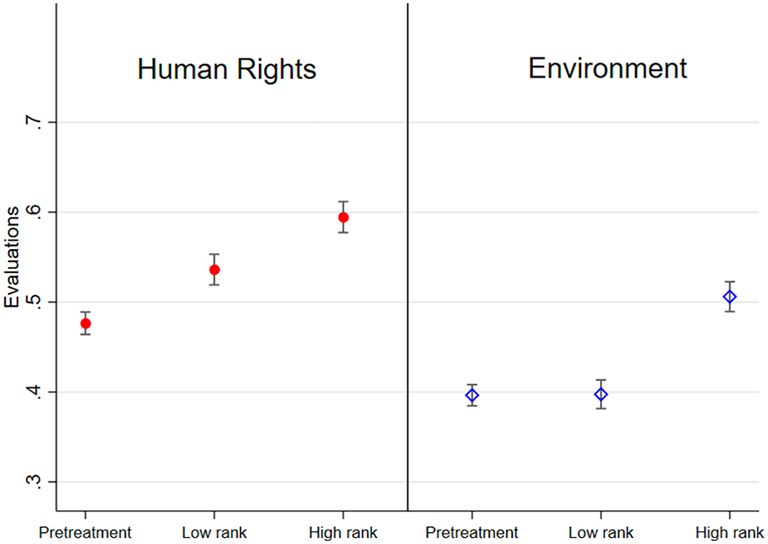
Note: The pre-treatment question refers to a similar question asked before the experimental manipulation.
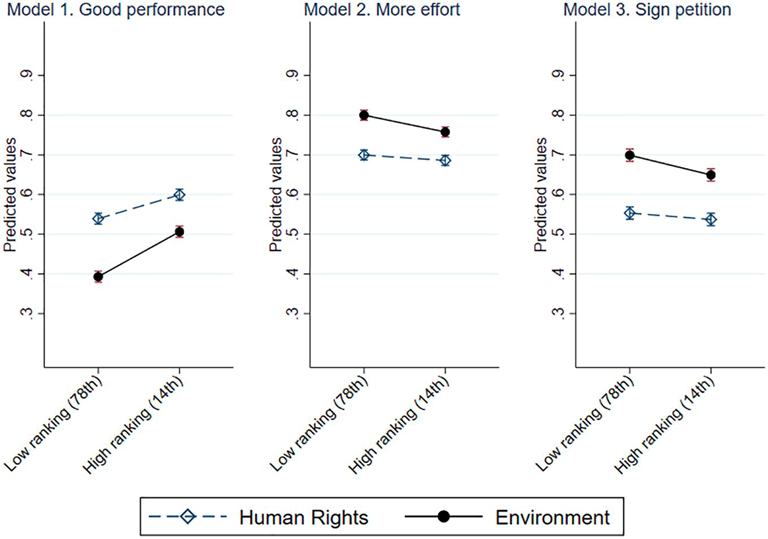
We next examined the impact of low versus high rankings on each of the three dependent variables, conditional on the policy domain. This analysis (see Figure 2) shows that the effect of ranking level (high vs. low) was greater in the environmental protection domain than in the human rights domain. Regarding the environmental protection domain, a high-ranking increased evaluations of state performance, reduced the perceived need for policy change, and decreased willingness to act (signing a petition) against the government. But in the human rights domain, the effect of a high ranking was more limited and applied only to performance evaluations—and even then, to a lesser extent than in the environmental protection domain.
Figure 2: Examining the Difference Between High and Low Rankings
We also tested whether the source of the ranking shaped its effect, assuming that rankings issued by bodies viewed as credible or friendly (such as the U.S. government among many Israelis) might carry greater weight. Surprisingly, we found no meaningful differences among the three sources. The public reacted to the rankings in the same way regardless of their origin. The reason, it seems, is that citizens are influenced primarily when rankings flatter their country—and much less when they criticize it. As a result, even sources viewed as credible or friendly cannot persuade the public to accept external criticism.
Our findings have broader implications: international rankings are not necessarily an effective tool for shaping public opinion, at least not in the way their publishers may hope. While rankings may be simple, clear, and based on comprehensive cross-national comparisons, the public does not respond symmetrically to positive and negative information. This reaction reflects a deep psychological-cognitive pattern: a preference for information that reinforces positive perceptions of the national in-group and a rejection of external criticism perceived as hostile, biased, or illegitimate. This pattern is especially pronounced in politically charged issues, where external information can trigger defensive reactions rather than self-reflection.
In conclusion, we urge caution in assuming that international rankings can generate public pressure for policy change. Citizens are receptive to praise but not to criticism—even when the criticism is “soft,” numerical, and stripped of overt moral judgment. Our findings align with research questioning the effectiveness of international shaming in shaping public attitudes. While rankings may matter in specific contexts, they are far from a universal mechanism for creating bottom-up pressure for policy change.
Prof. Amnon Cavari is an Associate Professor and Head of the Institute for Liberty and Responsibility at the Lauder School of Government, Diplomacy and Strategy, Reichman University.
Prof. Asif Efrat is a Full Professor, Head of the MA Program, and Adviser to the PhD Program at the Lauder School of Government, Diplomacy and Strategy, Reichman University.
Dr. Omer Yair is a Research Fellow at the Institute for Liberty and Responsibility at the Lauder School of Government, Diplomacy and Strategy, Reichman University.
Data collection was supported by the Konrad Adenauer Stiftung (KAS) as part of the Program on Democratic Resilience (PDRD) at the Lauder School of Government, Diplomacy & Strategy.