


Judicial Decisions and Electoral Punishment of Corrupt Mayors in Israel
Yoav Dotan, Raanan Sulitzeanu-Kenan, and Omer Yair
Government corruption is an issue with political, economic, and legal implications in Israel, an issue that often makes headlines in the media. A central question in democratic regimes concerns the role that voters play in relation to the corruption of elected officials. To the extent that the integrity of candidates is a significant consideration in voting, one might expect that fewer corrupt candidates will be elected, and this may act as a deterrent to such candidates from running.
Municipal elections in Israel offer a particularly interesting arena for examining the extent to which this democratic mechanism of elections can prevent corruption. In contrast to the national electoral system in Israel, which is party-based, municipal elections in Israel are personal, and therefore ostensibly allow the public to express its preference regarding the integrity of candidates at the ballot box, and to punish corrupt mayors through electoral means. However, as research on the impact of corruption on voting in other countries shows, the connections between the democratic system and dealing with corruption in local authorities are complex. In recent decades, there have been many examples of mayors who were subject to criminal investigations and nevertheless continued in their positions during the investigation, and even won reelection.
In the study described below, we examined the impact of two High Court of Justice judicial decisions, issued in 2013, on the electoral punishment of corrupt mayors among the Israeli public.
The verdicts in the mayors' matters
A few weeks before the municipal elections in November 2013, the High Court of Justice issued two judicial decisions in which it decided to remove from office three mayors – Yitzhak Rochberger, mayor of Ramat Hasharon; Shimon Gafsou, mayor of Nazareth Illit (now Nof HaGalil); and Shlomo Lahiani, mayor of Bat Yam – after the Attorney General decided to indict them for various corruption offenses. In our study, which was published in 2020 in the Journal of Politics, we took advantage of the fact that these decisions by the High Court occurred just weeks before the 2013 municipal elections to examine whether fierce action against public corruption by a prominent public institution affects citizens' electoral punishment of politicians suspected of corruption. We hypothesized that the High Court's decisions to impeach the three mayors under these circumstances constituted a strong normative message against corruption, a message that decreased voters' tendency to vote for mayors suspected of corruption.
A central point in the structure of the study is the fact that these High Court decisions dealt with the three mayors – Bat Yam, Nazareth Illit, and Ramat Hasharon – but did not include any reference to potential corruption of other mayors in Israel. This aspect is graphically presented in Figure 1. Residents of the three cities whose mayors were ousted by the High Court were exposed to two types of messages: (1) an informative message – that is, information about the suspicions against each of the three mayors; and (2) a normative message regarding the public importance of preventing corruption by mayors, which is reflected in the decision to ouster the mayors.
In contrast, residents of all other cities in Israel (which are not among the three discussed by the High Court) were exposed only to the normative message regarding the seriousness of corruption, as the High Court decisions did not include any information regarding the integrity of their mayors. For this reason, the study did not include in the dataset the three cities involved in the High Court's decisions, but rather all other cities in Israel, including cities whose mayors are suspected of corruption, and cities whose mayors are not suspected of corruption. Under these circumstances, it can be assumed that to the extent that the High Court's ruling influenced the voting pattern of residents of the cities included in the study, this influence is a result of the message regarding the importance of integrity considerations, and not as a result of new information about corruption.
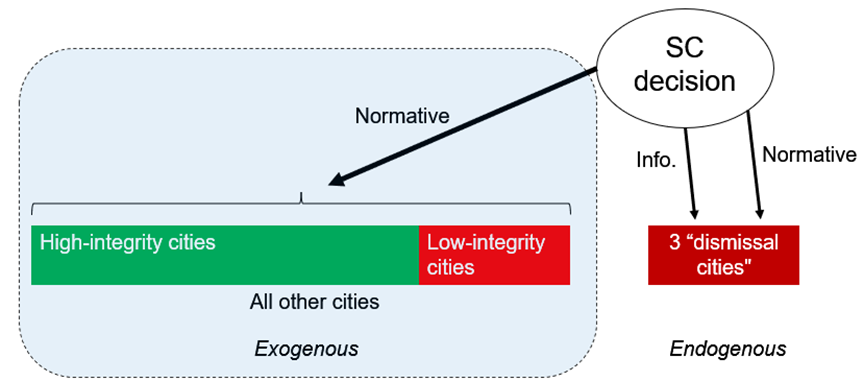
Figure 1: A model of the estimated effects of High Court decisions on residents of cities in Israel. These effects are represented by the arrows; the cities included in the study are represented by the gray rectangle on the left, and they include cities whose mayors are suspected of corruption (red) and cities whose mayors are not suspected of corruption (green).
For the study, we collected data on voting in municipal elections in all cities in Israel in the 2003, 2008, and 2013 election campaigns, focusing on contests in which incumbent mayors who decided to run again participated. The dataset thus includes voting results in 174 municipal election campaigns. An incumbent mayor was defined as having “low integrity” if, during the five years preceding the relevant election, a public police investigation was opened against him on suspicion of corruption and was not closed by the time of the election. In total, 5 such cases were found before the 2003 elections (out of 53 incumbent mayors who ran again in these elections), 14 cases before the 2008 elections (out of 60 incumbent mayors), and 5 cases before the 2013 elections (out of 61 incumbent mayors – not including the mayors of Bat Yam, Nazareth Illit, and Ramat Hasharon).
To measure the rate of electoral punishment, we calculated the difference between the voting share of mayors with high integrity (those who were not suspected of corruption at the time of the election) and the voting share of mayors with low integrity (who were suspected of corruption at the time of the election). Our dataset allows us to estimate the rate of electoral punishment in the 2003, 2008, and 2013 election cycles, and to examine whether there was a change in this rate in the 2013 elections – immediately after the High Court decisions. The 2003 and 2008 election cycles constitute “control” cases, which occurred before the High Court decisions regarding mayors, while the 2013 election cycles allow us to estimate the impact of the High Court decisions.
The results are presented graphically in Figure 2 below. The average support rate for mayors without suspicions (estimates shown in blue) is higher than the support rate for mayors with suspicions (estimates shown in red) – indicating electoral punishment. However, this gap in support differs significantly between 2003 and 2008, and 2013. The average electoral punishment rates in the 2003 and 2008 elections ranged from 3.5 to 4 percentage points (pp), and these estimates are not statistically significantly different from 0. In contrast, the electoral punishment rate was significantly higher in the 2013 elections and stood at approximately 13.5 pp. These results support the hypothesis that exposure of citizens to an institutional decision, which conveys a message about the importance of integrity (or corruption) considerations, increases electoral punishment.

Figure 2: Average electoral punishment rate in municipal elections in Israel, and the impact of High Court decisions in 2013. The Y-axis shows the predicted vote share for the incumbent mayor out of all eligible voters in each city; estimates in blue represent the average support rate in cities whose mayors are not suspected of corruption ("high-integrity") and estimates in red represent the same predicted vote share in cities whose mayors are suspected of corruption ("low-integrity").
These findings indicate that significant institutional measures against corruption (in this case, High Court decisions) can affect the relative weight of integrity considerations in voter decisions, resulting in increased electoral punishment. Although this is a preliminary finding, and further research is needed to substantiate it, it does point to interesting connections between anti-corruption policies adopted by institutions and voter behavior.
---
Prof. Yoav Dotan is the head of the Goodman Chair of Public Law in the Faculty of Law, Hebrew University of Jerusalem.
Prof. Raanan Sulitzeanu-Kenan is a faculty member at the Federmann School of Public Policy and Governance at the Hebrew University of Jerusalem.
Dr. Omer Yair is a Research Fellow at the Institute for Liberty and Responsibility at the Lauder School of Government, Diplomacy and Strategy at Reichman University.
This post is based on the article:
Yair, Omer, Raanan Sulitzeanu-Kenan, and Yoav Dotan. 2020. “Can Institutions Make Voters Care about Corruption?” The Journal of Politics 82 (4): 1430–1442. https://doi.org/10.1086/708504