


Partisan Bias in Citizens’ Evaluation of Public Services Under Conditions of High Political Polarization
Dr. Saar Alon-Barkat, Prof. Amnon Cavari, and Lior Schwartz
This post is based on the following article: Alon-Barkat, Saar, Amnon Cavari, and Lior Shvarts. 2025. “Polarization and Partisan Bias in Citizens’ Evaluations of Public Services.” Political Behavior. https://doi.org/10.1007/s11109-025-10078-8
Partisan bias is a well-documented phenomenon in political science research. Numerous studies from various countries over the past decades show that citizens who identify with the governing party (or with a member of the governing coalition) tend to evaluate the state of the economy and national security more positively than citizens who identify with the opposition. These attitudes shift shortly after a change in government: those who support the outgoing coalition (electoral losers) express more negative evaluations, while citizens identifying with the new governing coalition (electoral winners) provide more positive assessments.
These biases weaken democratic accountability, through which the public demands that elected officials and government systems justify their decisions and actions, incentivizing them to work in the public’s interest. If citizens’ assessments are primarily based on partisan identity, governments and public policymakers have little incentive to work hard to improve citizens’ well-being and deliver policy outcomes.
What drives these biases? One key explanation in the literature is motivated reasoning: a well-established psychological unconscious mechanism in which individuals tend to interpret the reality in ways that align with their group identity (in this case, their alignment with a particular political bloc). People tend to search for information that confirms their preexisting views and reinforces their group identity, giving such information more weight, while discounting contradictory information that threatens that identity.
Until now, research has examined partisan bias mainly at the macro level by assessing national conditions (economy, security). But does such bias also influence citizens’ evaluations of public services such as policing, education, healthcare, and transportation, mundane services they routinely use and personally experience?
This is the central question of our recently published article in Political Behavior. The question is important: while it may be understandable that overall evaluations of state performance are colored by partisanship—given the complexity and abstraction of macro-issues—it is far less obvious that this would apply to concrete, daily public services. Can a change of government automatically alter how citizens perceive the quality of public transportation and of medical services?
If citizens change their evaluations of public service performance simply because of a shift in political leadership, regardless of changes to actual service quality, this represents a fundamental failure of the democratic mechanism. Such a pattern contradicts the basic expectation that citizens in a democracy evaluate government performance in a reasoned manner, forming the basis of their political choices.
In our article, we argue that Israel presents an ideal setting for testing partisan biases in the evaluation of public services. Israel has experienced frequent changes in government, high levels of political polarization, and a highly centralized system of public services, allowing citizens to associate public services directly with the central government.
In recent years, Israel has experienced two major government turnovers within a short period: the formation of the Bennett–Lapid government in 2021, and the return of the Netanyahu government in 2022. Over such a short period, the quality of public services could not have changed meaningfully, while political leadership changed entirely. This allows us to isolate the effect of government identity on citizens’ evaluations: Did supporters of Netanyahu’s coalition evaluate service quality more positively during Netanyahu’s governments? And did supporters of the “change government” evaluate services more positively during the Bennett–Lapid period?
The study relies on a series of surveys conducted between September 2020 and September 2023—roughly nine months before the formation of the change government and nine months after the formation of the current Netanyahu government, and before the Hamas October 7 2023. The surveys assessed four areas of public service: education, healthcare, policing (law and order), and transportation. To strengthen the validity of our findings, we examined two independent survey datasets.
1. The Institute for Liberty and Responsibility’s Public Policy Surveys
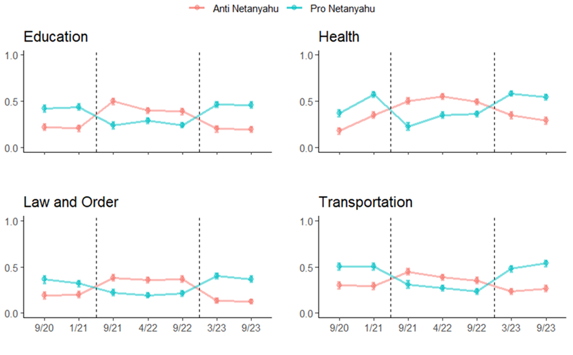
These semi-annual surveys ask respondents whether they think various public services have improved or deteriorated. An analysis of seven such surveys (totaling about 10,000 respondents) reveals substantial partisan bias in evaluations of public service performance.
The accompanying figure (from the article) shows the average voter satisfaction with public service quality across the two political blocs (on a scale from 0 to 1, with 1 indicating high satisfaction). Before the Bennett–Lapid government, supporters of the Netanyahu bloc evaluated service performance more positively. After the government changed, their satisfaction declined, while satisfaction among supporters of the change coalition rose sharply. When the Netanyahu government returned in December 2022, these patterns reversed once again.
Because these shifts occurred over a short period with little opportunity for major policy changes or reforms, they largely reflect partisan bias. These findings remain robust even when controlling for demographic and political differences within each bloc using statistical models.
Figure: Partisan Gaps in Evaluations of Public Service Performance (Institute for Liberty and Responsibility Surveys)
2. The Central Bureau of Statistics (CBS) Social Survey
The CBS Social Survey is conducted continuously throughout the year and includes questions about citizens’ evaluations of public services. It is especially useful for testing partisan bias because it is a large, representative sample of the Israeli population, response rates are exceptionally high because participation is compulsory, and
the survey does not include political questions, reducing the risk of “cheerleading effect” in responses.
Because the CBS survey does not ask about partisanship, we developed an innovative machine learning classification model to categorize respondents into political blocs based on demographic information and place of residence. We trained and validated the model on numerous political surveys, achieving approximately 80% accuracy—the highest level of indirect political classification currently available in political science research.
Analyzing the CBS data from the study period (about 14,000 respondents), using secure access to the CBS Research Room, we find strong evidence confirming the patterns observed in our institute’s surveys. The data reveal consistent patterns of partisan divergence following both government changes. The fact that such clear effects appear even when using an indirect measure of partisanship underscores the robustness of the phenomenon.
The fact that the findings are consistent across two very different data sources strengthens the conclusion that under conditions of extreme political polarization—such as in Israel—partisan bias influences citizens’ evaluations of everyday public services.
Our findings are troubling for the healthy functioning of democratic institutions. Without a meaningful democratic discourse grounded in reasoned public evaluation of government performance and service quality, government institutions would not be accountable for their actions.
Dr. Saar Alon-Barkat is a faculty member in the School of Political Science at the University of Haifa.
Prof. Amnon Cavari is a faculty member at the Lauder School of Government, Diplomacy & Strategy at Reichman University and Head of the Institute for Liberty and Responsibility.
Lior Schwartz is a doctoral student at the School of Political Science at the University of Haifa.
Data collection was supported by the Konrad Adenauer Stiftung (KAS) as part of the Program on Democratic Resilience (PDRD) at the Lauder School of Government, Diplomacy & Strategy.