


Religious People Donate More and Are More Courteous than Secular Individuals—Especially Toward Religious Fundraisers: A Field Experiment in Jerusalem
Ilona Goldner, Shahaf Zamir, Elia Yitzhakian, Tzipi Rosen, Pazit Ben-Nun Bloom
Do religious people tend to help others more? And if so, are they more inclined to help members of certain groups? A large body of research links religiosity to prosocial behavior, while also suggesting that such behavior is often directed primarily toward co-religionists, one’s in-group, consistent with the notion that "Charity begins at home" ("Aniyei Ircha Kodmim"). These findings raise an important question about the underlying motivations of prosocial behavior: Is it driven by generalized values of compassion and helping others, or by strong communal bonds that foster mutual aid? This question is particularly salient in the Israeli context, where definitions of religious in-groups are expanded beyond broad religious affiliation (Judaism) to include distinctions between religious and secular identities, which are deeply intertwined with political, cultural, and social cleavages.
The study we conducted, recently accepted for publication in the Journal for the Scientific Study of Religion, examines the relationship between religiosity and prosocial behavior through a field experiment conducted in Jerusalem, a city characterized by both social diversity and sharp religious polarization. Unlike previous studies that relied on surveys or controlled laboratory experiments, we focused on real behavior in a natural setting: citizens’ donations to a door-to-door fundraising campaign.
This study allows us to explore how religious identity and its various components shape willingness to help, the boundaries of social inclusion and identification, and interactions between individuals from different identity groups within a politically and socially complex context. In Israel, where debates over religion and state are intense and where ethnic, religious, and secular divisions often overlap with political disagreements, understanding the mechanisms underlying prosocial behavior and in-group bias can shed light on the roots of religious solidarity, whether grounded in universal values of fairness and altruism, or in particularistic communal commitments.
The findings demonstrate that the boundary between "us" and "them" within religious groups is not merely a matter of formal religious affiliation, but also of perceived religiosity, based on external cues such as clothing. This insight deepens our understanding of how religion functions as a social category and as a basis for group identity. Finally, the study examines the role of religious communities and residential environments as mediators of prosocial behavior.
The study is based on a field experiment conducted in Jerusalem in July 2019. Two female researchers, alternately dressed in religious or secular outfit, conducted door-to-door fundraising on behalf of Paamonim, a nonprofit organization with no clear religious affiliation that provides assistance and education in financial management. The experimental manipulation assumed that the researchers’ clothing would shape how they were perceived, as religious or secular, and thus influence residents’ willingness to help. The experiment was conducted in two residential areas with different religious profiles: Givat Mordechai, a religiously homogeneous neighborhood (predominantly religious-Orthodox), and Kiryat HaYovel, a religiously mixed neighborhood. Over six days of fundraising, the researchers knocked on doors in 22 buildings (590 apartments). A total of 240 doors were opened, and donations were collected from 103 individuals. Data were collected on prosocial behavior (whether the door was opened, whether a donation was given, the amount donated, and the level of hospitality), as well as on participants’ gender, age, and estimated level of religiosity.
The study yields several key findings:
1. Religiosity Increases the Likelihood of Donating and to Display Hospitality
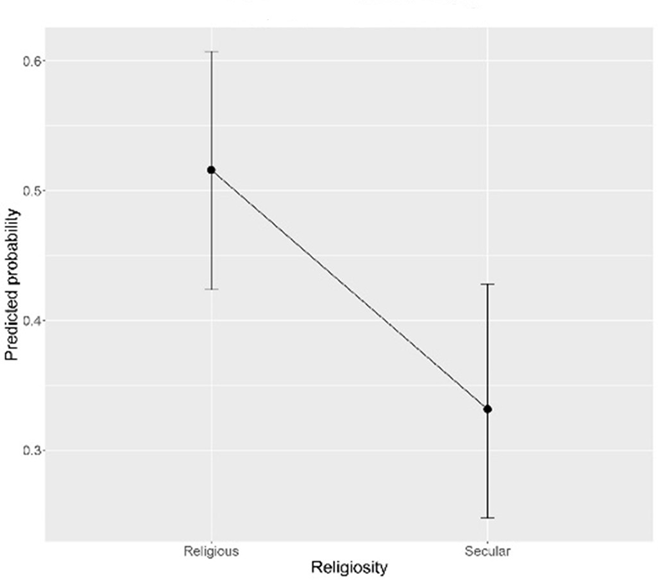
Religious participants were found to be more generous and more courteous than secular participants. For example, 52% of religious participants donated, compared to only 30% of secular participants. Moreover, the likelihood that a religious individual would donate (see Figure 1) and display hospitality toward the fundraisers was more than twice that of a secular individual, regardless of the fundraisers’ outfit. In other words, religiosity was associated with higher levels of generosity and positive social behavior. This finding reinforces existing literature linking religious belief to moral and prosocial values such as compassion, helping others, and charity.
Figure 1: The Main Effect of Religiosity on Donations
 |
2. A Clear In-group Perference
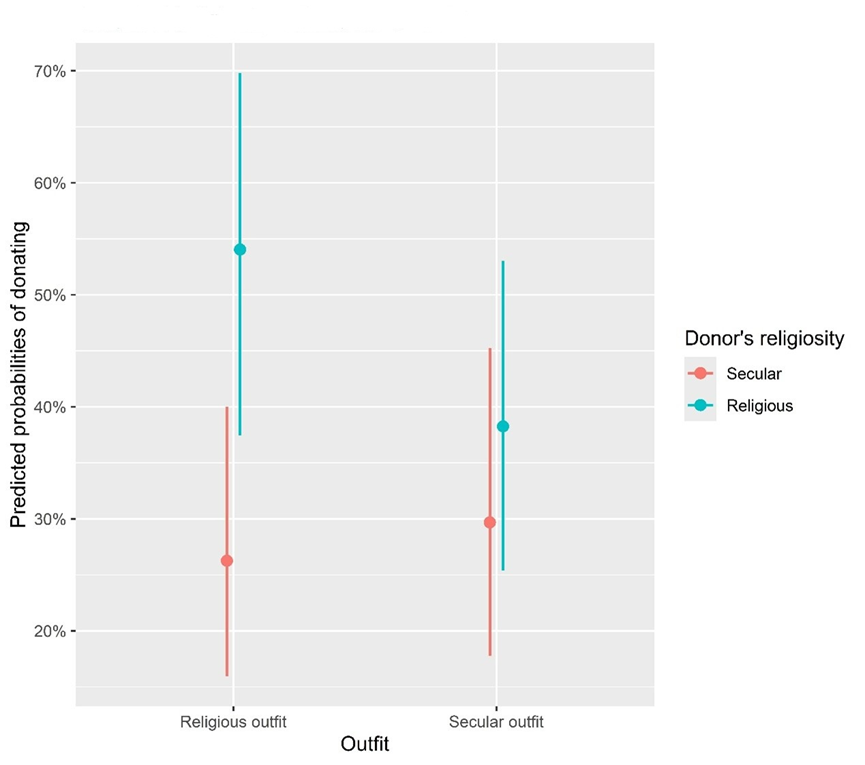
Alongside the higher overall likelihood to donate, the study also identifies a distinct religious in-group bias. Figure 2 presents differences across groups created by the interaction between participants’ religiosity and the fundraisers’ outfit (two binary variables producing four groups: religious participants encountering religiously dressed fundraisers; religious participants encountering secularly dressed fundraisers; secular participants encountering secularly dressed fundraisers; and secular participants encountering religiously dressed fundraisers). Logistic regression results show that among religious participants, exposure to secularly dressed fundraisers reduced the likelihood of donating by 47% compared to exposure to religiously dressed fundraisers. In contrast, among secular participants, no significant difference emerged between religiously and secularly dressed fundraisers. Thus, for religious individuals, prosocial behavior was activated more strongly toward those perceived as belonging to the religious in-group.
Figure 2: The Effect of Fundraisers’ Attire on Donations among Religious versus Secular Participants
 |
3. The Community Context—Does Not Always Matters
Contrary to the hypothesis that living in a religious (homogeneous) neighborhood would increase generosity toward religious fundraisers, no differences in donation levels were found between neighborhoods. However, fewer doors were opened in the religiously homogeneous neighborhood (Givat Mordechai) than in the heterogeneous neighborhood (36% versus 46%). Moreover, openness toward secularly dressed fundraisers was particularly low in the religious neighborhood: only 31.5% of doors in Givat Mordechai were opened to secularly dressed fundraisers, compared to 46% in Kiryat HaYovel (both for secularly and religiously dressed fundraisers). This finding suggests that while religious homogeneity may not promote generosity, it may amplify withdrawal or reluctance toward the "other," highlighting the internal tension between universal values of compassion and the exclusionary effects of strong communal boundaries.
4. Gender—A Surprising Pattern
Interestingly, men—rather than women—were more likely to donate and to display hospitality. The likelihood of donating was 78% higher among men than women, and the likelihood of display hospitality was 71% higher. This pattern contrasts with many prior studies, particularly in Western Christian contexts. It may indicate that among Jewish, and especially religious, communities, gender roles and religious identity intersect differently, with men’s visible religiosity generating a stronger sense of responsibility.
Overall, the study confirms that religion can promote generosity—but within clearly defined boundaries. Help is extended primarily when the recipient is perceived as being "like me", even when both parties belong to the same broad religion (Judaism). Thus, even within religious groups, internal hierarchies and distinctions shape who is considered more or less deserving of assistance.
The findings also raise questions about the role of religious communities: Does living in a religious environment strengthen mutual aid? The answer here is qualified. Personal religiosity may matter more than community composition, and homogeneous religious communities do not necessarily foster greater generosity, and may sometimes do the opposite by intensifying feelings of alienation toward outsiders. The gendered results further suggest that religiosity is context-dependent, underscoring the complexity of religious identity.
Finally, the study makes an important methodological contribution. Unlike studies based on self-reports or laboratory experiments, this research examines actual behavior in real-world conditions, allowing for stronger inferences about the mechanisms through which religion and identity shape prosocial action.
---
Ilona Goldner is a PhD candidate in the Department of Political Science at the Hebrew University of Jerusalem.
Dr. Shahaf Zamir is a Senior Researcher and Research Fellow at the Institute for Liberty and Responsibility, Lauder School of Government, Diplomacy and Strategy, Reichman University.
Elia Yitzhakian is a graduate of the Department of Political Science at the Hebrew University of Jerusalem.
Tzipi Rosen is a graduate of the Department of Political Science at the Hebrew University of Jerusalem.
Prof. Pazit Ben-Nun Bloom is a researcher in the Department of Political Science and Head of the Political Psychology Lab at the Hebrew University of Jerusalem.
The research was partially funded by the European Research Council (ERC) under the European Union’s Horizon 2020 Research and Innovation Programme (Grant Agreement No. 804031), awarded to Pazit Ben-Nun Bloom.
The post is based on the following article:
Goldner, I., Zamir, S., Yitzhakian, E., Rosen, T., & Ben-Nun Bloom, P. (2025). The Intergroup and Contextual Determants of Real-World Religious Donations: An Experimental Test in Jerusalem. Journal for the Scientific Study of Religion, 64(2), 211–226. https://doi.org/10.1111/jssr.12961