


Rightists and leftists agree:
Attorney General Mandelblit is biased against their respective side
Dr. Omer Yair
Israel's Attorney General, Dr. Avichai Mandelblit, is currently facing a difficult and controversial decision: whether to sign a plea bargain with former Prime Minister Benjamin Netanyahu, who is accused of bribery, fraud, and breach of trust. A plea bargain with Netanyahu touches on one of the most polarizing issues in Israeli politics in recent years, and will have many political and legal implications. Therefore, it is not surprising that immediately after the publication of the contacts between Mandelblit and senior officials in the Prosecution and Netanyahu's lawyers regarding a plea bargain, harsh accusations were heard from many on both sides of the political spectrum against Mandelblit himself and the decision regarding a plea bargain.
These accusations against Attorney General Mandelblit join a series of accusations and criticisms against him in recent years. As I will show in this post, Mandelblit, who will end his six-year term as attorney general very soon (early February 2022), will have to make a decision regarding a plea bargain when many – both on the right and the left – believe that he is politically biased against their respective side. These perceptions are likely to make it difficult for both sides to assess the plea bargain with Netanyahu.
The Attorney General of Israel is an important gatekeeper in the Israeli democracy and is expected to act impartially and without favoritism for any politician or party, but some of his decisions can have important political implications. Perhaps the most prominent example of this from recent years is the decisions of the current Attorney General, Mandelblit, regarding the investigations of Netanyahu. It was Mandelblit who approved the opening of the investigations against Netanyahu at the end of 2016, and it was he who decided in November 2019 to indict Netanyahu on charges of bribery, fraud, and breach of trust.
Some saw several of the Attorney General's decisions regarding the Netanyahu investigations as damaging to Netanyahu, especially the decision to open investigations into issues that were perceived as precedent-setting at the time, as well as the decision to file indictments against him, subject to a hearing, just weeks before the April 2019 elections. On the other hand, others saw several of the Attorney General's decisions regarding the Netanyahu investigations as favorable toward Netanyahu, especially the decision not to open an investigation against him in two other cases of suspected corruption, as well as the decision to postpone the hearing scheduled for Netanyahu from July 2019 to October 2019—after the September 2019 elections.
Accordingly, how did the Israeli public evaluate Mandelblit's actions? Was he perceived by the Israeli public as neutral or as biased in favor of a particular political party? Many previous studies in the Communications discipline have shown that political opponents tend to perceive balanced news coverage as biased in favor of their rivals. This is a phenomenon known as the "hostile media phenomenon." A similar phenomenon can also occur in public perceptions of public institutions, and not only in relation to news coverage. Specifically, do rightists and leftists perceive Mandelblit as biased against their respective side, because some of his actions threaten the chances of each political group gaining power?
To examine this, I conducted two surveys during 2019. In the first survey, conducted a few days before the April 2019 elections, survey respondents (1,932 in total) were asked, "Do you think the Attorney General is biased in favor of Netanyahu, biased against Netanyahu, or is he not biased (Neutral)?" The same question was also asked to respondents in the second survey, which was conducted between one and two weeks before the September 2019 elections, with 1,201 respondents.
The surveys' findings, recently published in the Public Opinion Quarterly journal, show that, similar to said “hostile media phenomenon,” both the political right and the political left accused Attorney General Mandelblit of being biased against their side. Figure 1 below presents the findings of the first survey. Respondents in the survey who voted for left-wing parties, and to a slightly lesser extent respondents who voted for centrist parties, tended to perceive Mandelblit as biased in favor of Netanyahu, that is, against their political group. On the other hand, respondents in the survey who voted for right-wing parties tended to perceive Mandelblit as biased against Netanyahu, against their political group.
Figure 1: Perceptions of the Attorney General's bias among voters of different parties
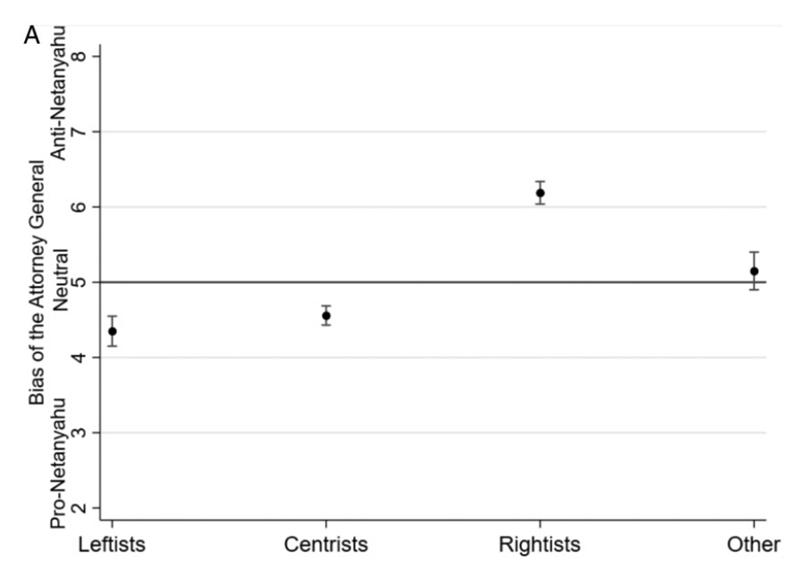
Note. "Other" refers to survey respondents who reported they were undecided about which party they would vote for in the election, as well as respondents who reported that they did not intend to vote in the election.
The findings in the second survey, conducted close to the September 2019 elections, are quite similar: voters of left-wing and centrist parties tended to perceive Mandelblit as biased in favor of Netanyahu, while voters of right-wing parties tended to perceive Mandelblit as biased against Netanyahu.
These findings are of great importance because previous studies have shown that perceptions of bias are directly linked to a decline in trust in a public institution, as well as to the institution’s legitimacy. Indeed, since 2017 and to the present day, many Israelis have called for Mandelblit to be fired in light of his decisions regarding the Netanyahu investigations, with some calling for the trial against Netanyahu to be dismissed, and others calling for additional investigations of Netanyahu in a series of other cases of suspected corruption.
Interestingly, about a year after the second survey, during October 2020, another survey I conducted showed similar findings of perceptual polarization in the attitude of right-wing and left-wing Israelis towards the Israel Police: voters of left-wing and centrist parties tended to perceive the police as biased in favor of Netanyahu, while voters of right-wing parties tended to perceive the police as biased against Netanyahu. This is further evidence of the existence of a phenomenon similar to the “hostile media phenomenon” outside the media context: political opponents tend to perceive public institutions, organizations, and various bodies as biased against their respective side and in favor of their rivals.
In February 2022, Avichai Mandelblit will end his role as Attorney General, and it is quite likely that, similar to Mandelblit, his successor will also be forced to make legal decisions that will have significant political implications, which could lead to various political groups perceiving the new Attorney General as biased against their side. The next Attorney General should carefully consider his/her decisions, and perhaps even examine ways to try to reduce, in advance, perceptions of political bias. For example, increasing transparency in the Attorney General's decisions and establishing accountability mechanisms when errors in the work of the Prosecution are discovered.
---
Dr. Omer Yair is a Research Fellow at the Institute for Liberty and Responsibility at the Lauder School of Government, Diplomacy and Strategy at Reichman University.
This post is based on the article:
Yair, Omer. 2021. The Hostile Mediator Phenomenon: When Threatened, Rival Partisans Perceive Various Mediators as Biased Against Their Group. Public Opinion Quarterly 85(3): 864–886. https://doi.org/10.1093/poq/nfab035.