


TERRORISM AND POLITICAL TOLERANCE TOWARD "FELLOW TRAVELERS"
Mark Peffley, Marc L. Hutchison, and Michal Shamir
Israel has suffered from chronic terrorism for much of its history. With most of the attacks perpetrated by Palestinian terrorist groups in the West Bank and Gaza, we investigated a crucial question for democracies everywhere: How does chronic terrorism increase the public’s willingness to deny basic liberties to domestic groups alleged to be “fellow travelers” of the perpetrators of violence? History is littered with examples of threats from war or terrorism stoking public support for repressing domestic groups who pose little objective threat themselves (e.g., the internment of Japanese-Americans during WWII and the post-9/11 surveillance of American Arabs and Muslims).
During the McCarthy era in the U.S., the scholar Samuel Stouffer and others used the term “fellow travelers” to refer to groups on the left (e.g., socialists, atheists, pacifists)—many of whom were Jews—who were alleged by anti-communists to be supportive of communism despite no formal association with the US Communist Party. With the help of the social identity theory, we extend the term to domestic outgroups whose sociological makeup (i.e., their national, religious or ethnic background) or political views are alleged to enable or support terrorism.
Our study, recently published at the Journal of Conflict Resolution, answers two critical political questions. As fear from terrorism escalates, who favors repressing whom? And how far does intolerance travel? We theorize that political intolerance toward fellow traveler groups should be determined by 1) the level of terrorism and terrorist threat, 2) whether domestic outgroups are demographically or politically associated with terrorist groups, and 3) whether individuals identify with the political Right.
To test these hypotheses, we examined how terror attacks by Palestinians in the occupied territories drove down tolerance among Israel’s Jewish citizens toward three fellow traveler groups distant from the actual perpetrators: Israeli Arab political groups (e.g., the Islamic Movement, Balad), Jewish leftist groups (e.g., Peace Now, Meretz), and Arab citizens of Israel. Intolerance toward all three groups constitutes a diffusion of intolerance toward fellow travelers in Israel.
We combined macro data of fluctuations in terrorism over a 30-year period, from 1980 to 2011, with survey data from 18 Israeli surveys tracking political tolerance among Israeli Jews over the same period. During the 30 years of our study, Israel faced close to 1,500 terror attacks (Global Terrorism Database).
The dependent variable in our study, political tolerance toward fellow travelers, is support for allowing members of the group to demonstrate—not only a fundamental democratic liberty, but critical in Israeli because demonstrations are the most common form of political participation by the Arab minority.
Two types of survey questions were used to measure political tolerance. The “least-liked” measure asked people to select the group they like the least from a list of domestic groups before asking them whether the group “should be allowed to demonstrate.” We focus on those who selected Israeli Arab and Jewish leftist political groups as the least-liked groups. Another “fixed-group” item asked all respondents whether “the Arab citizens of Israel” should be allowed to demonstrate.
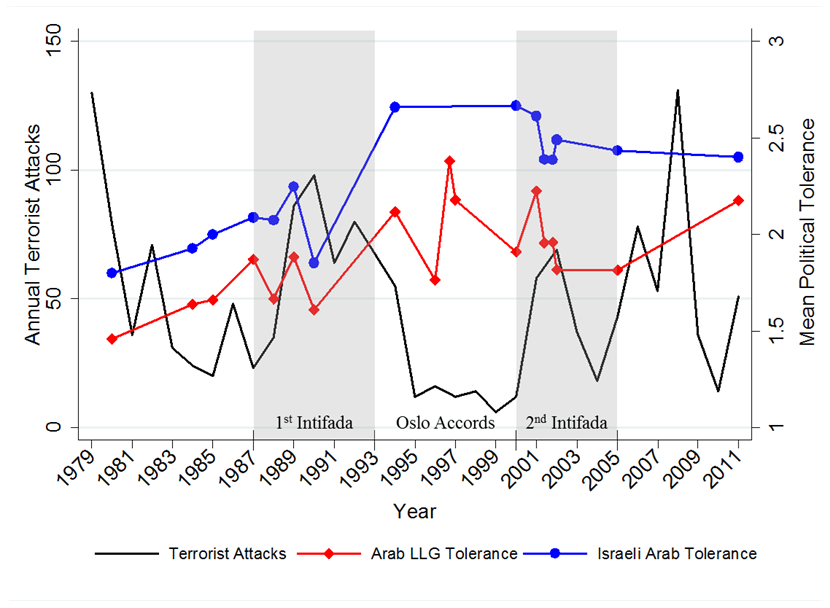
Figure 1 gives a preliminary glimpse of how terrorism and tolerance toward Israeli Arabs and Arab political groups track at the aggregate level. Tolerance falls as terrorism increases and is always lower for least-liked Arab groups than Arabs citizens.
Figure 1. Tolerance Trends Over Time, 1980-2011
A better test uses all the data—the individual-level survey data and macro-level terrorism data, along with controls. Our main results from multivariate analyses are the following:
• Terrorism has a much stronger impact in lowering tolerance toward disliked Arab and Jewish leftist groups among rightists than leftists or centrists.
• Intolerance from terrorism also travels to ordinary Arab citizens, but only among rightists. In fact, Jews who identify with the Right make no distinction between Arab political groups and Arab citizens in their level of forbearance.
• Overall, it is only the Right that reacts to higher levels of terrorism with a diffusion of intolerance toward all three fellow traveler groups. Faced with the same levels of terrorism, Jews in the Center and on the Left do not become more politically intolerant.
Our study is the first to demonstrate how chronic terror attacks precipitated a clear diffusion of political intolerance toward several domestic groups alleged to be fellow travelers of the perpetrators of violence. The groups we studied are classic fellow travelers because they are distant from the actual perpetrators of violence and do not pose a security risk to the state of Israel.
Our extension of social identity theory helps explain the response of right-wingers. When threat is high, the confluence of psychological and political forces blurs outgroup boundaries among rightists, who view their ingroup (“we”) more narrowly and fellow traveler outgroups (“they”) more broadly and categorically without differentiation. In additional research we are currently investigating the microlevel mechanisms that underlie rightists’ and leftists’ distinct responses.
In Israel and elsewhere, the diffusion of intolerance has serious consequences for democratic backsliding. In Israel, public support has allowed right-wing governments in power to pass legislation limiting the rights and liberties of Arab parties and Arab citizens. In the words of journalist Max Fisher, the fear of terrorism triggered an impulse among the Right in Israel to “choose identity over democracy.”
Intolerance toward fellow traveler groups is clearly a global concern. The Kurdish citizens of Turkey, Kashmiri citizens of India, and Muslim citizens of several Western countries have all been subjected to increased surveillance and intolerance after attacks by terrorist groups sharing a common ethnic background.
The diffusion of intolerance toward fellow travelers is not inevitable. Elites play a central role in interpreting “raw” international events for the public. The terror attacks of 2015-2017 in Europe and the U.S. prompted right-wing populist presidential candidates Marine Le Pen (France) and Donald Trump (U.S.) to propose sweeping measures targeting the civil liberties of domestic Muslims. By contrast, just days after 9/11, George W. Bush visited a Mosque to condemn attacks against American Muslims. Future research must investigate how elite rhetoric can raise or lower intolerance toward fellow traveler groups.
Mark Peffley1 is a professor of political science at the University of Kentucky (mpeffl@uky.edu)
Marc L. Hutchison is a professor of political science at the University of Rhode Island (mlhutch@gmail.com)
Michal Shamir is a professor emeritus of political science at Tel Aviv University (m3600@post.tau.ac.il)
The post is based on this article:
Peffley, Mark, Marc L. Hutchison, and Michal Shamir. 2022. "Terrorism and Political Tolerance toward “Fellow Travelers”." Journal of Conflict Resolution. https://doi.org/10.1177/00220027211069121