


The Rabbi said, I vote: The Electoral Effects of Religious Institutions in Israel
Dr. Michael Freedman
Religious political parties continue to flourish in many political systems. However, there is little agreement among scholars regarding how religious parties attract voters, and what impact different tactics by religious political parties have on society.
Scholars typically attribute the political success of religious parties to two related factors. First, a rich literature points to the role of social welfare provision in securing the support of voters. According to this rationale, people vote for religious parties, even if they are ideologically distant from the ideas of the religious parties, since they value the material goods provided by religious actors. In contrast, other scholars note that people will vote for religious parties since they believe that religious parties are less corrupt than their secular counterparts.
In my recently published paper, I examine how local religious institutions help religious parties achieve electoral success. Specifically, I focus on their mediating role in helping connect local voters to religious political parties. In Israel, the major religious political parties (Shas, United Torah Judaism, Religious Zionist parties) receive on average about 20 percent of the combined current vote in Israel. In Israel’s Proportional Representation (PR) electoral system, this electoral strength has historically given the religious political parties a large impact on national politics. However, there has been little work on religious institutions, the intermediaries who are critical for connecting these religious parties with voters.
In Israel, religious institutions are composed of religious study groups known as Yeshivot and Jewish faith organizations. Yeshivot are religious schools that are led by charismatic and influential religious leaders. Their intense focus on Jewish studies makes them comparable to other religious schools such as Islamic Madrasas or Christian religious seminaries. While the model of the Yeshiva has ancient roots in Judaism and was primarily found in the Ashkenazi Haredi world, the institution has also become prominent among the Sephardic Haredi and Religious Zionist communities. In addition to Yeshivot, Jewish faith organizations have been set up across the country to provide religious services, whose purpose is to proselytize and bring Israelis closer to religious observance.
While these religious institutions primarily provide educational and religious services, I argue that these religious institutions also fulfill an important political role in Israel. Like the Christian religious right in the United States who formed an alliance with the Republican party, Jewish religious institutions have chosen to form powerful alliances with Israel’s religious political parties. In this political arrangement, leaders of important religious institutions receive government resources and enjoy a very privileged status within the party. By receiving appointments on the Rabbinic councils who oversee the party, they are able to highly influence Israeli politics via their control over many party decisions.
I theorize that the relationship between religious political parties and religious institutions resembles clientelism - the exchange of goods and services for political support. Specifically, religious political parties ensure that religious institutions receive funding from the state. In turn, religious institutions provide religious legitimacy and support to these parties. At the local level, they also encourage residents to vote for religious political parties by providing club goods that are largely subsidized by state funding.
To test this hypothesis, I spatially linked all available data on local voting for national elections (held between 1977-2015) with data on the founding of over 3,000 religious institutions. Employing a design that exploited the timing in the entry of new religious institutions into neighborhoods, I find that religious institutions are associated with a 4-percentage point increase in the local vote share for religious parties, where this effect is larger for religious institutions with connections to political parties (see Figure 1 below). This implies that religious institutions have an important influence on local politics in Israel, pushing the electorate towards religious and non-centrist parties.
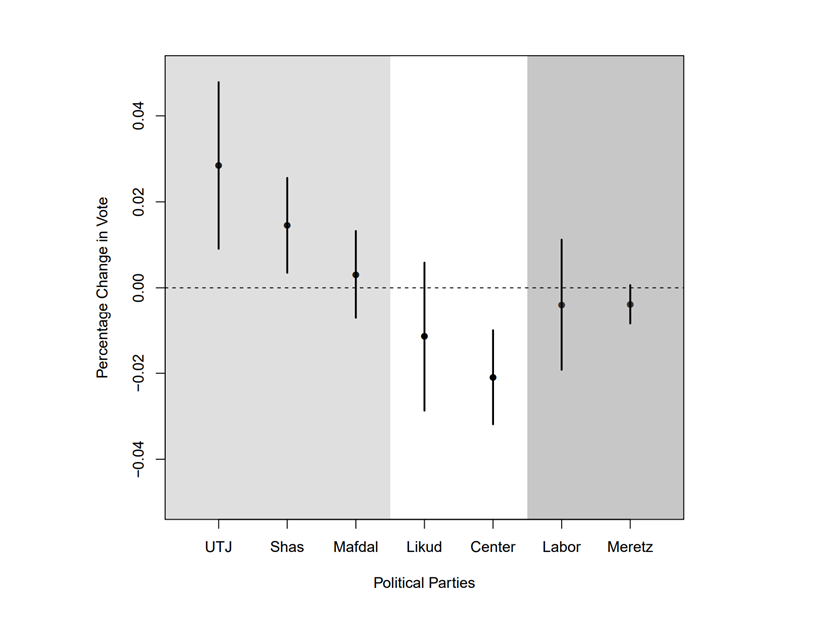
Figure 1. The effect of religious institutions on voting for specific party in the Israeli national elections, 1977-2015
To understand what is driving these results, I distinguish between two channels. First, that existing residents change their vote choice due to mobilization efforts by religious institutions, where residents support religious parties in exchange for tangible benefits. Second, that the results are driven by selective migration, where the entry of religious institutions into neighborhoods is followed by the out-migration of non-religious residents and the immigration of religious migrants. I find more support for the first channel, where the political effects are largest for religious institutions that are connected to political parties. Using census data on immigration, I also find that religious institutions do not appear to be associated with short term changes to the composition of the neighborhood population.
This paper makes two key contributions. First, it adds to the literature on the political role of religious institutions. Many scholars note that religious institutions will contribute to social capital, community building, and political participation. In contrast, my results suggest that by allying with partisan political parties, religious institutions contribute to the local strengthening of sectarian religious parties. Second, it highlights the channel by which religious leaders in Israel enjoy large political influence in Israel and the costs of this influence to Israeli politics as political coalitions which rely on religious parties become increasingly unstable.
Dr. Michael Freedman is an Assistant Professor in the School of Political Sciences at the University of Haifa.
The post is based on this article:
Freedman, Michael. 2020. "Vote with Your Rabbi: The Electoral Effects of Religious Institutions in Israel." Electoral Studies 68. DOI: 10.1016/j.electstud.2020.102241