


The Technological Tracking Strategy during Covid-19: The Israeli Case Study of Secret Service Monitoring
Dr. Sharon Haleva-Amir
The COVID-19 crisis, which began in March 2020, posed unprecedented challenges to states around the world and compelled them to adopt drastic measures to curb the spread of the virus. In the absence of vaccines or effective treatments during the early stages of the pandemic, many governments turned to technological solutions, foremost among them contact tracing technologies (CTTs), aimed at identifying chains of infection. Against this backdrop, Israel stands out as the only democracy in the world that chose to deploy its General Security Service (GSS/Shin Bet)—an agency whose primary mandate is counterterrorism and the prevention of threats to national security—for the technological surveillance of its own citizens as part of the fight against the pandemic.
In a recent article published in Corporate Communications: An International Journal, I examined in depth whether the use of the GSS for contact tracing was indeed effective in containing the pandemic. The analysis offers a comprehensive, multi-dimensional perspective that goes beyond a narrow legal or technological lens and provides a holistic view of the considerations underlying Israeli policy and its broader implications.
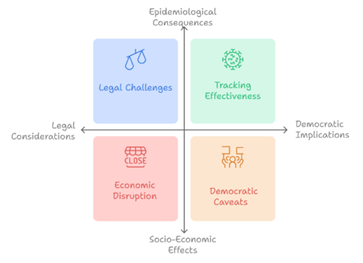
To examine Israel’s CTT policy, the study adopts a case-study methodology and draws on the analysis of diverse sources, including government documents, court rulings, State Comptroller reports, and media coverage. The study’s distinct contribution lies in the introduction of an original theoretical framework that enables a systematic evaluation of the policy across four central dimensions: legal, democratic, socio-economic, and epidemiological. This framework is presented in a matrix format (Figure 1).
Such an approach makes it possible to capture the complex interactions between these domains and to assess the overall effectiveness of the strategy. The matrix format highlights the interdependencies between considerations in each domain and the observable consequences of implementing surveillance technologies.
Figure 1. Considerations – consequences matrix–CTTs implementation.
 |
Israel ostensibly adopted a dual approach: On the one hand, it deployed the GSS “Tool”—a compulsory geolocation tracking system based on cellular location data collected from the entire population without citizens’ consent (whereas prior to the pandemic, access to such data had been permitted only pursuant to a judicial warrant).
On the other hand, the Ministry of Health launched the voluntary HAMAGEN (“The Shield”) application, developed on the principles of mutual responsibility and open-source code. This dual strategy ultimately failed. Analysing Israeli policy through the lens of the considerations–consequences matrix reveals a consistent failure across all four dimensions:
The legal dimension.
The activation of the GSS Tool resulted in: (1) a severe and disproportionate infringement of the right to privacy, as also determined by the High Court of Justice in HCJ 6732/20 Association for Civil Rights in Israel v. Knesset (hereinafter: the ACRI decision); (2) continuous surveillance of citizens’ daily routines and locations, absent any suspicion of wrongdoing; (3) violations of freedom of movement due to erroneous quarantines stemming from systemic inaccuracies; (4) the unlawful collection of personal data without sufficient transparency; (5) concerns regarding inter-agency data leakage and potential use for criminal investigations; (6) the creation of a dangerous “slippery slope” that normalizes mass surveillance and may facilitate future uses unrelated to public health, thereby undermining the principle of separation of powers; and (7) a tangible risk of non-compliance with the EU’s General Data Protection Regulation (GDPR), potentially jeopardizing Israel’s trade relations with the European Union.
The democratic dimension.
(1) The extensive use of the GSS surveillance apparatus generated a form of “digital dystopia,” in which the state indiscriminately collects personal data on all citizens. As then Chief Justice Esther Hayut noted, this is a step “liable to deprive any democracy supporter of sleep” (2) In response, a form of “latent protest” emerged, as citizens purchased “dumb phones” or deliberately left their smartphones at home to avoid tracking, further eroding the Tool’s effectiveness. (3) Over time, public trust in the authorities managing the crisis declined dramatically (for example, trust in professional governmental performance fell from 59% in June 2020 to just 40.5% in July 2020). (4) A reality of permanent surveillance took shape, exerting a chilling effect on citizens and altering the balance of power within a democratic society. (5) Moreover, the exposure of the GSS’s capabilities and limitations harmed its prestige as an intelligence agency, and (6) a dangerous precedent was set for the use of intrusive surveillance tools for purposes unrelated to counterterrorism.
The socio-economic dimension.
The inaccuracy of GSS geolocation tracking led to hundreds of thousands of citizens being placed in erroneous and unjustified quarantines. This resulted in extensive economic harm, both to the broader economy and to individuals themselves, through lost workdays and damaged livelihoods, as well as social and psychological harm stemming from forced isolation. Initially, no effective appeals mechanism existed to contest quarantine orders, and when one was eventually established, it quickly collapsed under the volume of requests. Data indicated that of the hundreds of thousands of citizens quarantined due to GSS tracking, only a small fraction were ultimately confirmed as infected. By way of illustration, between July and September 2020, approximately 645,000 SMS messages ordering quarantine were sent, yet only about 3.5% of recipients tested positive for COVID-19. The result was a massive waste of working days and large-scale economic damage with negligible epidemiological benefit.
The epidemiological dimension.
(1) The GSS Tool proved technologically ineffective. Reliance on GPS data—rather than Bluetooth-based technologies (BLE), as used in HAMAGEN and its more advanced version (HAMAGEN 2.0), suffered from substantial inaccuracies, particularly in indoor and high-rise environments. As noted, the State Comptroller found that only 3.5% of those quarantined due to GSS tracking were COVID-19 positive, compared to a 24% success rate achieved through standard, human-led epidemiological investigations. (2) Consequently, hundreds of thousands of individuals entered false quarantines, while genuine cases may have gone undetected. Despite this, the government failed to sufficiently invest in expanding the far more effective human epidemiological investigation system. (3) The near-blind reliance on a “technological magic solution” obstructed serious consideration of more effective alternatives. Moreover, the voluntary HAMAGEN app - intended as a less intrusive substitute - was never adequately promoted by the Ministry of Health. The public struggled to distinguish it from the GSS Tool, and trust in the app remained low, partly due to reports of erroneous notifications. Although subsequent upgrades (HAMAGEN 2.0) improved accuracy, the app never became a genuine alternative, and the government continued to rely on compulsory and invasive surveillance. Ministry of Health officials later acknowledged during Knesset committees’ discussions that the app had been conceived merely as a supplementary measure.
While most democracies around the world opted for decentralized and voluntary applications to combat COVID-19, Israel stood out for its exceptional reliance on the General Security Service (GSS) to conduct mass surveillance. The Israeli case study offers crucial lessons for public health policymaking, particularly with regard to balancing public health imperatives against the protection of individual rights. It vividly illustrates the dangers inherent in disproportionate measures and their often-unintended consequences. As Justice Daphne Barak-Erez emphasized in the ACRI ruling, the fight against a pandemic, even in the name of the fundamental right to life, cannot justify sweeping infringements on other human rights. The principle of proportionality must remain a cornerstone of crisis governance.
Governments should therefore prioritize minimally intrusive technologies, promote transparency, and conduct comprehensive cost-effective analyses. Equally vital are strict judicial oversight, adherence to the separation of powers, and ongoing public reporting regarding the collection and use of data. These lessons are especially urgent in an era of global democratic backsliding, in which both states and corporations wield unprecedented surveillance capabilities over citizens. Advances in digital technologies and artificial intelligence have made the erosion of civil liberties and fundamental rights disturbingly easy. This moment constitutes a critical wake-up call for scholars to integrate ethical and normative considerations into the study of organizations, public and private alike. The time to act is now.
________________________________________
This post is based on the following article:
Haleva-Amir, S. (2025). An ineffective “Big Brother”: Israeli COVID-19 technological tracing strategy. Corporate Communications: An International Journal.
https://doi.org/10.1108/CCIJ-12-2024-0225