


United in War, Divided over the Government: Israel after the October 7 Attack
Yuval Feinstein and Geffen Ben-David
For decades, scholars have studied the “rally ’round the flag” phenomenon: the rise in public support for governments and their leaders that sometimes follows major international security crises and wars. In a 2022 book ("Rally ’Round the Flag: The Search for National Honor and Respect in Times of Crisis," Oxford University Press), based on extensive research on American public reactions to wars and security crises, the first author showed that rallies are especially likely when several conditions converge: a major crisis involving the country’s security, a despised enemy seen as the aggressor, strong feelings of threat and national humiliation, and leadership rhetoric that casts military retaliation as a defense of the nation’s honor and the respect it receives from other nations. The October 7 Hamas attack on Israel fits that pattern closely. It was sudden, devastating, and widely experienced as a profound national trauma. It generated intense fear, humiliation, and anger, and it was followed by a large-scale military campaign in Gaza supported by both government and opposition leaders. Yet our study shows that it did not produce a full rally behind the government and Prime Minister Benjamin Netanyahu.
In our new article, “United or Divided? A Polarized Society’s Response to War,” recently published at the Public Opinion Quarterly journal, we examine how Jewish Israelis responded to the October 7 attack and the war that followed. To do so, we used original panel survey data collected before and after the attack. Our data consists of 939 respondents who were first surveyed in March-April 2023 and then again in October and December 2023.
Using our data, we find split patterns in public opinion: a large majority supported the war, but trust in the government and Prime Minister Netanyahu remained low. Jewish Israelis largely united behind the war effort, but they did not rally behind the political leadership directing it. As shown in Figure 1 below, support for the military operation in Gaza was very high, with near-unanimous backing for airstrikes and strong support for the ground assault, which increased further once the ground operation began. In contrast, in Figure 2, we see that the security crisis and war did not lead the public to close ranks behind the leadership of Benjamin Netanyahu, as his public satisfaction rates, which were low in our baseline survey in March-April 2023, did not change much in response to the October 7 attack and subsequent war.
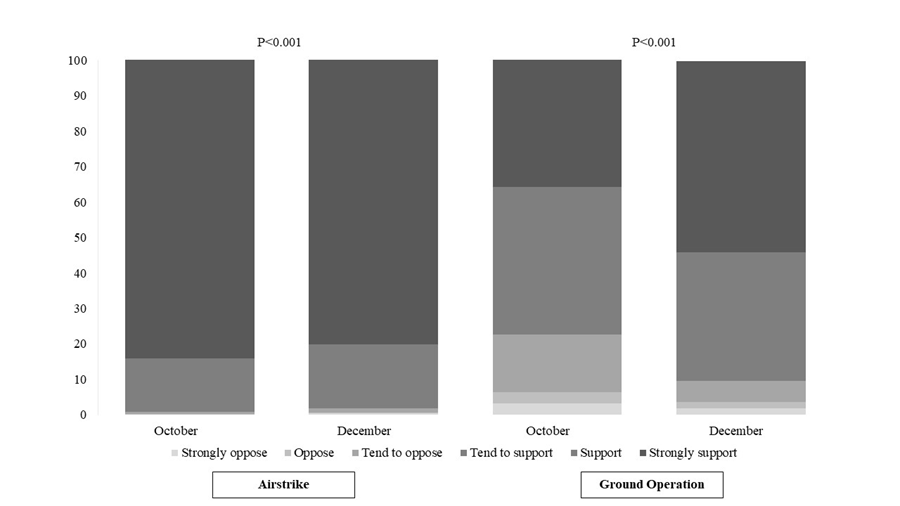 |
Figure 1. Support for the military campaign in Gaza, October and December 2023. Jewish Israelis expressed overwhelming support for the airstrike in Gaza and substantial, growing support for the ground operation.
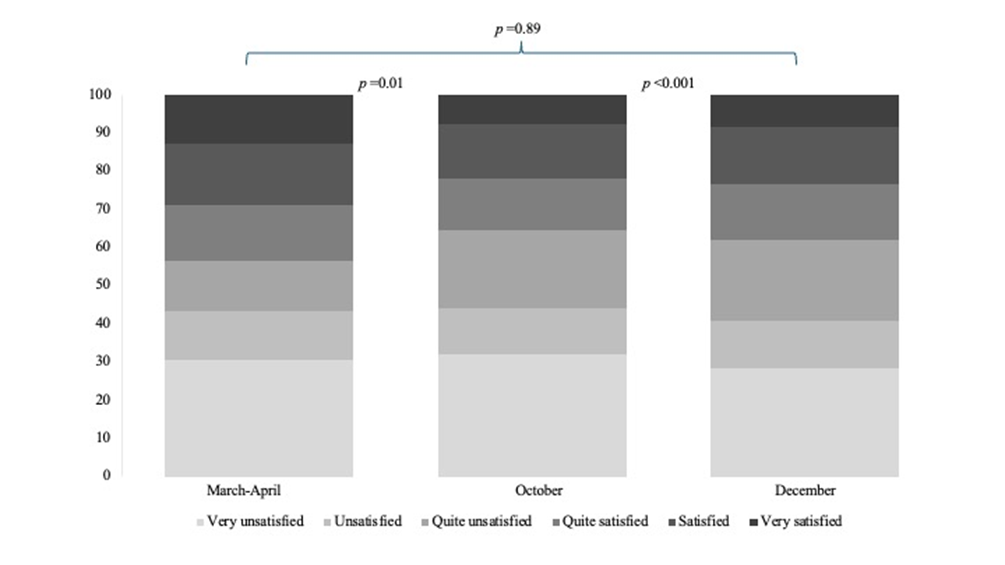 |
Figure 2. Satisfaction with Prime Minister Netanyahu, March-April, October, and December 2023. Most Jewish Israelis remained unsatisfied with the prime minister after the October 7 attack and the beginning of the war.
The split patterns also appear in Figure 3 below, showing a clear divide in public trust: the IDF and the Security Cabinet—which was expanded after the October 7 attack to include former IDF Chiefs of Staff, MKs Benny Gantz and Gadi Eisenkot—were trusted much more than the prime minister and government. Trust in the IDF remained the highest overall, dipping slightly in October and rising again by December, while trust in the prime minister and the government stayed relatively low and did not increase following the October 7 attack and the war in Gaza.
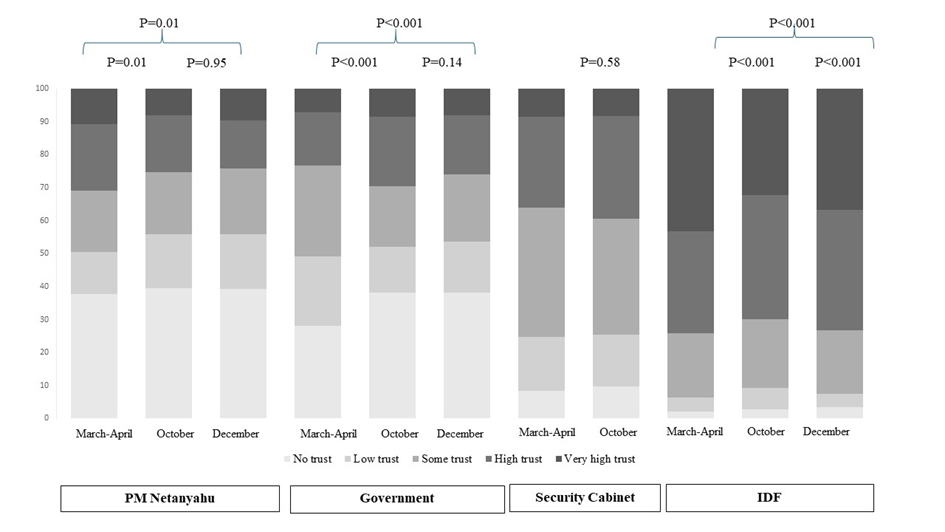 |
Figure 3. Trust in Prime Minister Netanyahu, the government, the security cabinet, and the IDF, March-April, October, and December 2023. The October 7 attack and the war that followed did not produce a full rally behind the government: trust remained low in Prime Minister Netanyahu and the government, somewhat higher in the security cabinet, and highest in the IDF.
Our study shows that the main reason for the split in public attitudes is that prewar polarization shaped the attribution of responsibility for the security crisis. In the months before the October 7 attack, Israeli society was already deeply divided over the government’s judicial reform initiative. Supporters of the reform tended to see it as a justified institutional change. In contrast, opponents viewed it as a grave threat to democracy. After the October 7 attack, these prior positions determined, to a significant degree, who people blamed for the crisis. Those who had supported the judicial reform were more likely to blame the anti-reform protest movement, seeing it as having weakened Israel and signaled vulnerability to its enemies. Those who had opposed the reform were more likely to blame the government, seeing its policies and conduct as having contributed to the conditions that led to Hamas’s decision to attack Israel. These competing attributions of responsibility then strongly influenced people’s trust or mistrust in the government and Prime Minister Netanyahu during the war.
Therefore, the main reason for the split in public opinion after the October 7 attack was not simply the polarization before the war. Rather, it was the different ways in which people interpreted the impact of the judicial reform and the protest movement on Hamas’s decision to attack Israel. Once the security crisis began, prior attitudes toward the judicial reform did not remain in the background but played a decisive role in shaping views of the government and the prime minister. As a result, high levels of support for the war did not translate into increased trust in the government. Many citizens supported a forceful military response to Hamas while at the same time believing that the government and the prime minister bore significant responsibility for the disaster that led to the war.
Our findings therefore point to two distinct patterns of response. Widespread support for the war stemmed from the experience of a security threat and from feelings of humiliation and anger toward Hamas. By contrast, trust or distrust in the government and the prime minister was shaped primarily by prior attitudes toward the judicial reform and by competing attributions of responsibility for the crisis. These findings have implications beyond the Israeli case because they challenge a common assumption in the study of politics during crises, namely that external attacks and wars naturally produce national political unity. Our results suggest that in highly polarized societies, even events that closely resemble classic “rally ’round the flag” scenarios may fail to generate a rally behind the government. Deep polarization does not prevent most citizens from feeling anger toward the enemy or from supporting military action. However, it may prevent that response from translating into trust in political leaders, especially when many citizens hold the government responsible for the crisis itself.
The Israeli case therefore speaks to a broader question facing many democracies today. In societies characterized by deep internal conflict over institutions, legitimacy, and the rules of the political game, severe external crises and wars may no longer produce the kind of unified public response documented in earlier research. When much of the public enters a security crisis already convinced that the government is acting against the national interest, the struggle over responsibility for the crisis may persist even during wartime.
---
Prof. Yuval Feinstein is an Associate Professor of Sociology and Vice Dean of Research at the Faculty of Social Sciences at the University of Haifa.
Geffen Ben-David is a doctoral candidate in the Department of Sociology at the University of Haifa.
The post is based on this article:
Feinstein, Yuval, and Geffen Ben-David, 2026. United or Divided? A Polarized Society’s Response to War, Public Opinion Quarterly. https://doi.org/10.1093/poq/nfag014.
Published on the institute's website in April, 2026