


One Year after October 7, Jews Prefer to Keep Their Distance from Arabs
Dr. Omer Yair
In the war that has been going on since October 7, 2023, Israel has been fighting Arab enemies outside the country's borders, with an emphasis on Hamas in Gaza and Hezbollah in Lebanon. But how has the war affected Jewish-Arab relations within Israel? Since the war's outbreak, levels of anxiety and insecurity among Jews in Israel soared. The trauma, fear, and anger led to many Jews being afraid to be around Israeli Arabs and even to hear words in Arabic. On the other hand, quite a few Arab workers were afraid to report to work in the weeks after October 7 and even afraid to speak Arabic around Jews. Today, more than a year after October 7, do Jews still prefer to maintain a social distance from Israeli Arabs, that is, to avoid direct interaction with them?
In eight surveys conducted by the Institute for Liberty and Responsibility at Reichman University from November 2021 to December 2024, we asked respondents several questions that examined their preferences regarding receiving services from Jewish or Arab service providers. Specifically, in these surveys, which are based on representative samples of Israeli society, we asked about their preference for treatment by a Jewish or Arab doctor when in need of medical care, their preference for contacting a Jewish or Arab handyman for home renovations, and their preference for a Jewish or Arab mechanic for car repairs (in all questions, respondents could also answer that it did not matter to them, or that they did not know or refused to answer). These are different scenarios with different levels of physical proximity to the service provider; thus, in the case of renovation, the service provider is invited to the respondent’s home, in contrast to the other two cases.
These questions refer to encounters with specific service providers, but they are intended to examine, albeit indirectly, preferences regarding distance from members of the other ethnic group and avoidance of encounters with them. Three of the surveys were conducted before October 7 and five surveys afterwards; thus, examining the answers to these questions over time allows us to examine the extent of change in the preferences of Jews and Arabs in Israel following October 7.
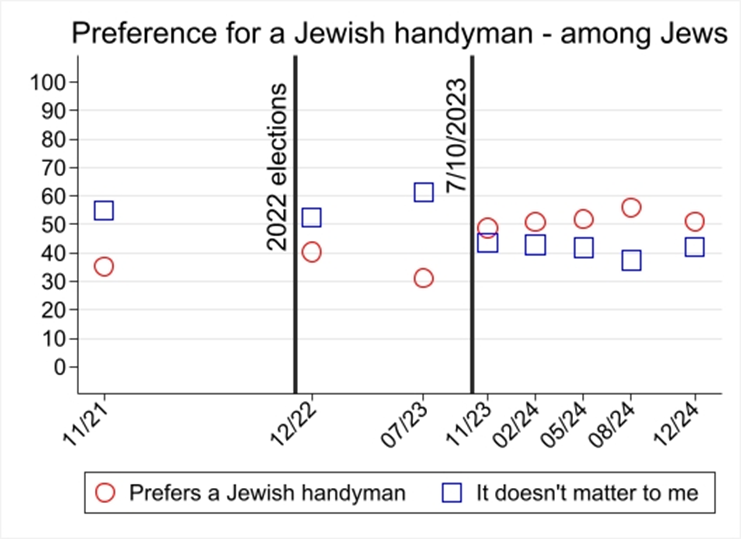
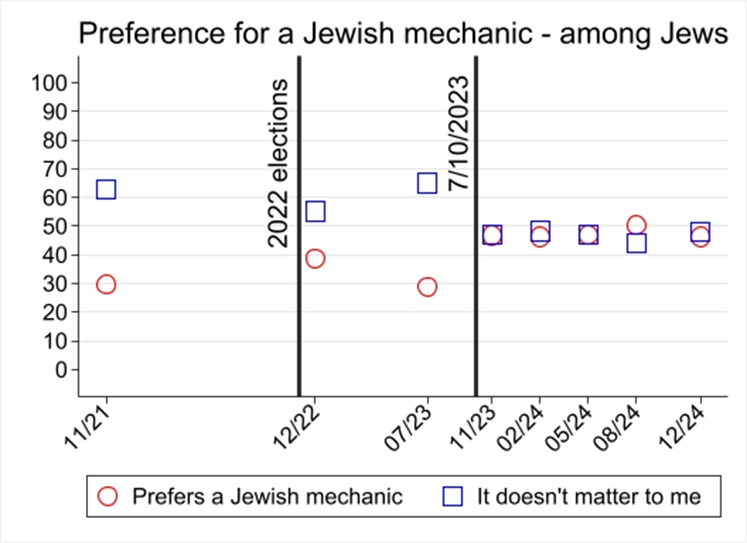
The survey findings show a significant increase in Jewish respondents’ desire to avoid meeting with Arab doctors, repairmen, or mechanics since October 7, with this preference remaining fairly stable for over a year. In the two years prior to October 7 – including in a November 2021 survey conducted just six months after the “Guardian of the Walls” events in May 2021 – about 30% of Jews indicated that they preferred to receive medical care from a Jewish doctor, and about a third preferred to hire a Jewish repairman and a Jewish mechanic, while a majority of between 55% and two-thirds of Jews indicated that they had no preference between a Jewish or Arab service provider (only a few indicated that they preferred an Arab service provider, or answered that they did not know or refused to answer).
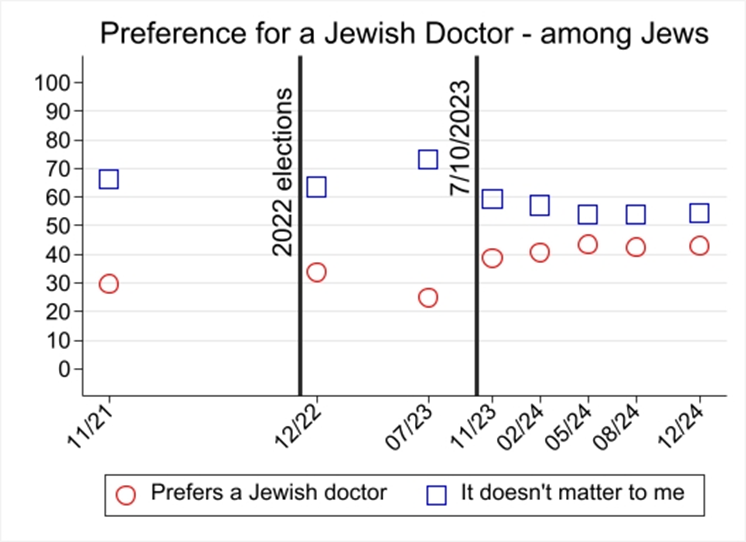 |
The outbreak of war changed the situation. A survey conducted about a month and a half after October 7 recorded a 12-16 percentage point increase in preference for a Jewish service provider, and this preference has remained consistent since then and for more than a year: over 40% of Jews indicate that they prefer medical care from a Jewish doctor and about 50%, sometimes slightly more, prefer to employ a Jewish handyman and a Jewish mechanic. A similar decrease of about 15 percentage points was recorded at the same time in the proportion of Jews who indicated that they had no preference between a Jewish or Arab service provider.
 |
In contrast to the Jewish public, October 7 did not change preferences at all among Arab respondents. Both before and after October 7, about 85% of Arabs indicated that it did not matter to them whether they received treatment from an Arab or Jewish doctor, and for about 70% to 75% of them it did not matter whether it was an Arab or Jewish handyman, or an Arab or Jewish mechanic.
 |
Therefore, since October 7, a larger portion of Jews in Israel prefers to avoid encounters with Arab service providers. In light of the findings regarding Jews’ preferences for the three questions, it can be assumed that the Jewish public also prefers to more broadly avoid encounters with Arabs – a population that constitutes about a fifth of the country’s population and is represented in a variety of professions and activities in the economy and society.
There are several possible reasons for the increased preference for social distancing: fear of physical harm in light of October 7, greater hostility toward Israeli Arabs, or concern about unpleasantness and discomfort in interacting with Arabs—all of these and other factors could explain the increased desire for social distancing. But given the persistence of the desire for social distancing more than a year after October 7, even when the immediate threat to Israeli citizens from Hamas and Hezbollah has significantly diminished, it is clear that relations between Jews and Arabs in Israel have not yet returned to normal and that tensions between the groups—especially on the part of the Jews—are still strong and palpable. It seems that only a long period of significant security calm will help restore the situation to normal.
Dr. Omer Yair is the research director and a research associate at the Institute for Liberty and Responsibility at the Lauder School of Government, Diplomacy and Strategy at Reichman University.