


Crazy about politics:
Who are the Israelis who are deeply involved in politics?
Omer Yair
A study conducted in the United States in 2019 showed that 97 percent of posts (tweets) on the social network Twitter (now X) are written by only 10 percent of users on this platform, while only 22 percent of Americans use Twitter at all. Another study, from 2021, showed that only 9% of Americans who use social networks post and share posts on political and social issues on these networks often, while 30% do so rarely and 40% never do. This means that this is a small minority in society that expresses itself on political issues on social media. Who are these people? And what is their impact on our society and politics today?
In a study conducted at the Institute for Liberty and Responsibility at Reichman University, we examined these questions regarding the Israeli public. The study, which included two online surveys conducted in December 2024 and April 2025 among a total of 2,955 respondents, examined the extent to which Israelis are deeply involved in politics, and how this involvement helps us understand Israelis’ tendency to consume political content, speak out publicly on political issues, and be active in the political sphere.
First, what is deep political involvement? In a 2022 book, researchers Yanna Krupnikov and John Barry Ryan define deep political involvement as an investment of self in politics that is significant and requires considerable attention. According to the researchers, three dimensions together constitute deep political involvement (dimensions which are also relevant to involvement in other domains, such as sports, movies, or cars). First, a great deal of preoccupation and time spent on politics and consuming relevant news, sometimes to the point of obsession. Some people will even change their way of life and social interactions to continue to delve into politics, similar to devoted sports fans who put watching their favorite team's games ahead of many other things in their lives, or avid viewers of a television series who seek out and analyze every piece of information about it.
Second, deep involvement in politics also includes assigning importance to almost every political event, including those that many others would consider insignificant. For those deeply involved in politics, almost every political event is important: almost every tweet by a politician on social media, meeting of politicians with journalists, or news publication is analyzed while evaluating its impact on the balance of power in politics or on important political issues, and is sometimes even seen as requiring informing and warning the public about what is coming and even promoting some kind of action in this regard. All this, while the rest of the public usually attributes great importance only to major socio-political events such as elections, wars, disasters, or any unusual occurrences.
Finally, those who are deeply involved in politics are much more likely than the rest of the population to express themselves on various political issues. Their “tracking” of politics is not complete without expressing themselves on these issues and discussing them with others. While most people interested in politics will think about various political issues, deep involvement in politics also includes publicly expressing positions and opinions on political issues and a willingness to debate them with others. These expressions allow these people to inform and attempt to persuade others about various political issues and events that, as mentioned, are perceived to be of public importance.
In our surveys, we examined the levels of involvement in politics among Israelis by examining their level of agreement with a series of statements such as “It is important to share your political views with other people,” “It is important to encourage others to become more involved in politics,” or “It is important to spend at least half an hour a day keeping up with political events,” and then we grouped all of these questions into a single index (scale). As can be seen in Figure 1 below, the distribution of the Deep Involvement in Political scale is a distribution that resembles a normal (bell-shaped) distribution: there are many Israelis with mid-levels on the scale, while a fairly small minority, about 10%, have high levels (above 0.75 on a scale that ranges from 0 to 1) of deep involvement in politics.
Figure 1. The distribution of the Deep Involvement in Politics scale
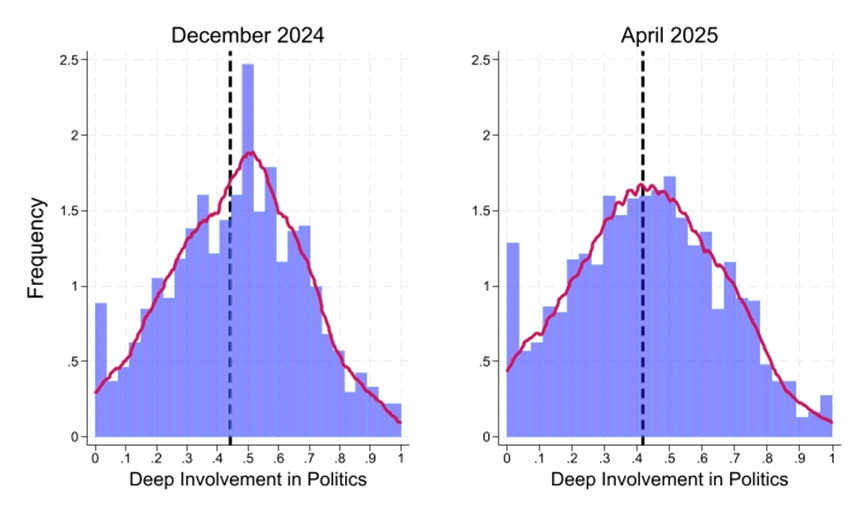 |
Legend. The dashed vertical line indicates the average in the sample (0.44 in December 2024 and 0.42 in April 2025).
In our analyses, we found that there were no significant differences between rightists and leftists, or between coalition and opposition voters, in the level of deep involvement in politics. Not surprisingly, those who did not vote in the election tended to report lower involvement in politics. In addition, respondents aged 60 and over, men, and seculars reported slightly higher levels of involvement in politics than respondents aged 18-29, women, and the ultra-Orthodox, respectively. In general, the political and socio-demographic variables we examined do not significantly predict the Deep Involvement in Political scale, and it is possible that other characteristics, such as different personality traits or growing up in an environment with significant political awareness and involvement, better explain the level of deep involvement in politics among Israelis.
How are those with deep involvement in politics different from the rest of the population? In both of our surveys, we found that, relative to other respondents, those with deep involvement in politics were significantly more likely to follow politics, have political conversations with family members, and believe they can influence government policy. They are also slightly more ideologically extreme and more likely to report boycotting media outlets and businesses if those outlets and businesses supported political stances that the respondent opposed. Research in the United States also found that those with deep involvement in politics are more certain than others that the policy positions they support are correct and are more confident about the expected outcomes of implementing a policy.
The biggest difference today between Israelis who are deeply involved in politics and the rest of the population concerns distributing political content on social media. Social media is an excellent platform for citizens to be exposed to new information, to meet - even if online - many people who are similar to them in terms of interests and level of involvement in politics, to debate with, and try to convince, many others about political issues, and to express themselves on political issues to a wide audience while receiving immediate feedback. These are aspects that fit like a glove for those who are deeply involved in politics. Indeed, these people are overrepresented on social media when it comes to political stances.
In the December 2024 survey, we found that a small minority of all respondents reported uploading or sharing content on political issues on social media: only 8% of all respondents indicated that they do so once or twice a week, and only 4% indicated that they do so once a day or more. On the other hand, 54% indicated that they “never” do so. However, our survey data indicate a large variation among respondents: among those with the lowest levels of involvement in politics, only about 2% share political content on social media once a week or more. But among those with the highest levels of involvement in politics, no less than 52% upload political content on social media once a week or more.
These findings suggest that, in a sense, one of the most important public spheres of the 21st century, the new “town square,” is to a large extent dominated by those deeply involved in politics (at least as far as human participants are concerned), and this has various implications. For example, studies show that many journalists in the United States form different opinions and perceptions of the public opinion based on scrolling through social media, with an emphasis on Twitter. Another study, from 2019, showed that US politicians' tweets are more likely to respond to trends in public opinion on Twitter regarding political issues than to influence that public opinion. And in the Israeli context, Shimrit Meir, an advisor to former Prime Minister Bennett, claimed in 2022 that "the political echelon in Israel corresponds with one thing, which is Twitter." Our survey findings indicate that politicians and journalists are exposed on social media to the voices of those deeply involved in politics far beyond the proportion of the latter in the population.
Finally, our research also found that Israelis who are deeply involved in politics display a more positive attitude toward the group they support than other Israelis, as reflected in an analysis of questions about negative/positive attitudes toward various political groups such as 'rightists' and 'leftists.' Although they are hostile to political opponents in a manner quite similar to other Israelis, their more positive attitude compared to others towards the group they support indicates a higher loyalty to this political group, a willingness to act to strengthen the group's position, and even a lower willingness to criticize the group when it fails in a particular action.
Both social media and people deeply involved in politics will continue to be an important part of our public life for the foreseeable future. Israeli social media users who are exposed to posts on political issues should remember that in most cases the writers of those posts are peculiar people who choose to make their voices heard on these issues. Even if they are sometimes irritating, they do not necessarily represent the rest of their camp, and certainly do not represent the general public. Social media largely reflects the opinion of a small and vocal minority, albeit an influential and important one. Anyone interested in understanding the positions of the general public would do well to rely on a public opinion poll that has been conducted in a comprehensive and reliable manner.
Dr. Omer Yair is the research director and a research fellow at the Institute for Liberty and Responsibility at the Lauder School of Government, Diplomacy and Strategy at Reichman University.
For a full review [in Hebrew] of deep involvement in politics in Israel on the Institute for Liberty and Responsibility website, click here.
For the Executive Summary [in English] of the review, please click here.