


On the Knesset's Birthday: More Laws and Less Trust
Dr. Shahaf Zamir
On Tu B'Shvat, the Knesset marked its birthday. This is a symbolic moment that invites civic and political introspection into the relationship that has developed over the years between the Knesset and the public it is supposed to represent. The data indicates a growing and deepening gap between formal functioning in the form of legislation and public trust.
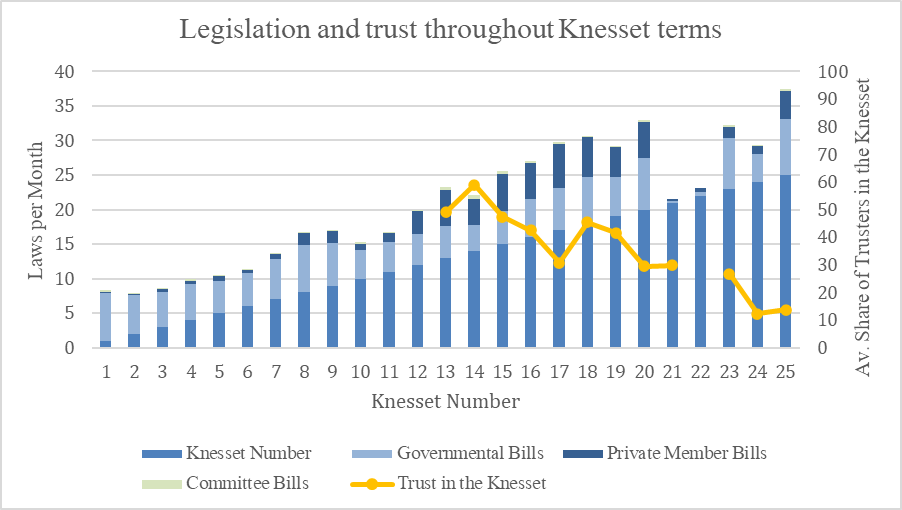
A historical examination of legislative activity in Israel (number of laws passed in third reading per month) indicates a clear acceleration over the years. The Knesset legislates today at a much higher rate than in the past. Simultaneously, since the 13th Knesset—the first for which systematic trust data are available (Sources: the Israel Democracy Institute since 1993, and the Institute for Liberty and Responsibility since 2022)—there has been a gradual yet consistent decline in public trust in the Knesset (see figure below). In other words, more legislation and less trust. For example, during the 13th Knesset, an average of about 10 laws were enacted per month, and public trust in the Knesset stood at approximately 49%. The current Knesset has enacted close to 12.5 laws per month, while trust in it stands at only about 14%.
This is not a simplistic causal claim. We do not have data indicating that legislation has become more hasty, more negligent, or less deliberative. On the contrary, other sources indicate that, on average, more deliberation is invested in each law. Moreover, in the current Knesset, there has been an increase in government legislation, which is perceived as more responsible. During this tenure, on average, approximately 8 government laws were enacted per month, compared with approximately 4 under private legislation. Therefore, this is precisely where the paradox lies. The Knesset, at least in the dimension of legislation—which is one of its many functions—is functioning. And yet, the public is distancing itself from it.
The reasonable explanation for this gap is not technical but behavioral and normative. Trust is not being eroded because the Knesset is supposedly legislating itself to death, but because of the way it is perceived as a political arena. Apparent contempt by Knesset members for the institution itself, inflammatory rhetoric, mutual delegitimization, use of the Knesset as a continuous campaign platform, and neglect of critical functions other than legislation—chief among them serious oversight of the government—all of these convey to the public that the Knesset may be working hard but not necessarily working right.
Another datum reflecting this is the extent to which the public feels represented by political actors. From data of the Institute for Liberty and Responsibility, it emerges that close to half of the Israeli public do not feel there is a party or politician who represents them. This sense of underrepresentation undermines the fundamental link between the public and the Knesset as a representative institution. In such a situation in which the public does not feel represented, even vigorous legislation is perceived as the activity of a disconnected system, not as an expression of the public's will, but as an internal game of politicians.
Thus, it seems that the public does not measure the Knesset only by the quantity of its outputs, but by the quality of its conduct. Intensive legislation does not compensate for cynicism, tribalism, and a loss of accountability. When Knesset members call each other from the plenum podium "Beast" or "Misogynist" and exchange verbal blows, when they arrive at committees and attack civil servants from various government ministries and then abandon the discussion, and when they legislate laws that take care of their salaries when outside "everything is burning," a democratic paradox is created. The institution ostensibly functions in the formal legislative sense, yet its legitimacy is undermined.
On the Knesset's birthday, it is worth saying this plainly. Democracy is not judged only by the number of laws it produces, but also by whether its elected officials honor the institution they lead and to what extent they foster a sense of respect and responsibility among the public. Without a profound change in the political culture of Knesset members and in the way the Knesset also fulfills its oversight, representation, and accountability functions, one can continue to legislate increasingly. Trust will not return. Without trust, the Knesset, as an institution that expresses the sovereign, will become irrelevant, and the public will tire of it and of the political system that positions the Knesset as the elected body.
 |